Religious Texts: .. that text was written by some half literate guy living in a desert who heard tenth hand folk stories from his community from people who had died about a hundred years before his time, mixed in with legends, myths and fairy tales that are thousands of years old ... but it's all true because it came from God, believe it or you will burn in hell forever.
The hypocrisy of any religious book being the words of their all powerful master while they give themselves the option to cherry pick which rules they wish to follow is astounding.
It’s one of the first things that convinced kid me that it’s all made up bullshit to control gullible people.
The funny part that is .... which book are you talking about? ... Christian bible? Jewish Tanakh? Islamic Koran? ... and if its Christian - is it just the Old Testament? New Testament? ... which version of the Christian bible? - King James? New Standard? English Standard? Anglican? Baptist? Lutheran? Methodist? Presbyterian? Roman Catholic? Mormon? Protestant?
That wouldn’t be true for Christianity as 3 of the 4 Gospels were cribbing off the 4th one. Heck the Gospel of John and the Revelation unto John were written by at least two different people and the Revelation likely was included at the Council of Nicea because they both had John in the name. Christianity would be very different without revelations.
The prevailing consensus is that the gospels of Matthew and Luke were cribbing from the gospel of Mark and a text that is lost to us that is referred to as Q. The gospel of John is original as far as we know.
Also, a lot of the Pauline epistles weren't even written by Paul.
Also rewritten, heavily translated with a large variety of biases, and with whole sections taken out or added in depending on the version AND there has been lord knows how many instances of stacking errors because new interpretations often come from already dubious later versions and not the original texts.
But it’s also all the undeniably word of god and you better not question whatever version you grew up with.
I would just expect someone who doesn't like religion to not want to have conversations about it, instead of bringing it up at every vaguely related opportunity.
sounds like you haven't had much experience of having to sit through religious people spout bullshit at you every single day. it's not the least bit surprising to me that it's on someone's mind. or maybe you just don't understand why religion would matter to someone? even to challenge/deny it is to engage with its importance no?
sounds like you haven't had much experience of having to sit through religious people spout bullshit at you every single day.
You mean like what's happening in this thread? Someone had a joke that had nothing to do with religion, and here we are talking about religious bullshit because someone can't let any opportunity pass without mentioning religion.
Again: if you're tired of people spouting religious bullshit at you all day I would expect you to not try to steer even more conversations towards religion.
I didn't steer shit, first of all. I'm not the one who posted the original comment. I'm just telling you to shut the fuck up. Let us enjoy our thing.
Second, do you really believe that if you just ignore things they go away? As if people are not out there bible thumping every single day? and we come in here and try to enjoy a moment of reflecting on the ridiculousness of those beliefs and you have to come in here and bitch about it. hence, I'm here to tell you to shut the fuck up.
I'm sorry if this comes across as rude, maybe cussing will send me to hell or whatever, but i really feel like your input has been the truly rude part of this conversation.
So you do enjoy bringing up religion in every possible conversation?
(and can I just point out the irony of you saying "let us enjoy our thing" when your thing it literally shitting on other people's thing?)
Second, do you really believe that if you just ignore things they go away?
Sir, this is a Wendys meme about math.
As if people are not out there bible thumping every single day?
and we come in here and try to enjoy a moment of reflecting on the ridiculousness of those beliefs memes away from all that bullshit and someone has to come in here and bring it up to bitch about it anyway. hence, I’m here to tell them to shut the fuck up.
i really feel like your input has been the truly rude part of this conversation.
My input has been the simple fact that people who insist on making every conversation about religion are fucking exhausting to everyone else.
I have not subbed to any religious or anti-religious communities, and yet people seem to think it needs to be a part of every discussion. You'd think out of all people atheists wouldn't be the ones doing that shit yet here we are. If you want to talk about that shit go those communities and you will find plenty of like minded people.
Was just watching a kubernetes tutorial recorded a year ago, and the entire website / package repository it uses doesn't exist anymore because modern devs can't go six months without changing everything.
The difference is that if something is proven mathematically it's 100% certain and will not change. In other sciences you may be taught things that later turn out to be flat out wrong.
Bingo, I was taught in genetics class in the 1990s that RNA played a role but DNA was the primary driver and now my understanding is the current consensus is RNA is the primary driver.
Not quite. Science is empirical, which means it's based on experiments and we can observe patterns and try to make sense of them. We can learn that a pattern or our understanding of it is wrong.
Math is inductive, which means that we have a starting point and we expand out from there using rules. It's not experimental, and conclusions don't change.
1+1 is always 2. What happens to math is that we uncover new ways of thinking about things that change the rules or underlying assumptions. 1+1 is 10 in base 2. Now we have a new, deeper truth about the relationship between bases and what "two" means.
Science is much more approximate. The geocentric model fit, and then new data made it not fit and the model changed. Same for heliocentrism, Galileos models, Keplers, and Newtons. They weren't wrong, they were just discovered to not fit observed reality as well as something else.
A scientific discovery can shift our understanding of the world radically and call other models into question.
A mathematical discovery doesn't do that. It might make something more clear, easier to work with, or provide a technique that can be surprisingly applicable elsewhere.
Those are entirely different. Peano developed a system for talking about arithmetic in a formalized way. This allowed people to talk about arithmetic in new ways, but it didn't show that previous formulations of arithmetic were wrong. Godel then built on that to show the limits of arithmetic, which still didn't invalidate that which came before.
The development of complex numbers as an extension of the real numbers didn't make work with the real numbers invalid.
When a new scientific model is developed, it supercedes the old model. The old model might still have use, but it's now known to not actually fit reality. Relativity showed that Newtowns model of the cosmos was wrong: it didn't extend it or generalize it, it showed that it was inadequately describing reality. Close for human scale problems but ultimately wrong.
And we already know relativity is wrong because it doesn't match experimental results in quantum mechanics.
Science is our understanding of reality. Reality doesn't change, but our understanding does.
Because math is a fundamentally different from science, if you know something is true then it's always true given the assumptions.
There's a difference between an advance that repudiates prior understanding and one that doesn't. You can, in maths - and I assume this is the point - know that you are right, in a way that you can't with a more... epistemological science. Of course it's more complex than that, and a lot of maths is pretty sciency, like deriving approximate solutions for PDEs is more experimental than you might imagine, but even though we might make improvements there, we'll never go 'oh actually those error bounds are wrong'. They might be non optimal but they'll never be wrong
This is missing a lot of historical intrigues and "mistakes" in mathematics. Firstly, the way modern mathematical theorems and proofs are built up from axioms is relatively new (a couple hundred years or so). If you go back to Euclid, there are in fact contradictions that can be drawn from his work because he was defining his axioms inappropriately.
In more modern times we have discussions around the "axiom of choice", and whole fields such as set theory and Fourier analysis faced some major hurdles in just being established.
My point is that math is constantly changing, also on a fundamental level, because new systems and axioms are being introduced. These rarely invalidate old systems, but sometimes they reveal a contradiction in terms that puts limitations on when some system is valid.
This is very similar to when Einstein developed a new framework for describing gravity: It didn't "disprove" Newton in the sense that Newton's laws still apply for all practical purposes in a huge range of situations, it just put clearer limits to when they apply and gave a more general explanation to why they apply.
A lot of sciences find core assumptions were not complete or based on the wrong thing. Health practices that have been around for millenia, like like food safety and sanitation, were successfully implemented using the wrong causes because they addressed the real causes. While they were not called science, they still used the same practices of comparing outcomes in the ways available at the time.
Bloodletting was originally to let out evil or something, then was used in formal medicine successfully but the cause it addressed was incorrect. Now we have much better ideas of how and when it helps to make it even more effective, but the underlying reasons and the methods changed completely.
yeah, and physics changes as a science because the actual physics of the universe changes. what are you on about. "we just learn more about it" is pretty much the definition of all sciences.
We discovered one of the postulates was really interesting to fuck with.
It's better to say that we've discovered more math, some of which changes how we understand the old.
Since Euclid, we've made discoveries in how geometry works and the underpinnings of it that can and have been used to provide foundation for his work, or to demonstrate some of the same things more succinctly. For example, Euclid had some assumptions that he didn't document.
Since math isn't empirical, it's rarely wrong if actually proven. It can be looked at differently though, and have assumptions changed to learn new things, or we can figure out that there are assumptions that weren't obvious.
The number of hypotheses we've proven, mostly. Also, we have this whole field of non-Euclidean geometry. And the modern Pythagoreans are a lot more chill about people knowing the irrationality of Pi.
Do be fair, that's less because the fundamentals behind programming are changing and more because the specific implementations are changed all the damn time.
Oh, you use the MediaWiki engine, too? The documentation is always a few versions behind, and between there and now they broke the interface three times...
One of the best programmers I've ever met told me, "All you need is Knuth everything else is just syntax." And I don't know if that's 100% true, but can say I learned more from reading The Art of Computer Programming than I have in basically any other textbook/textbook series I've read on the subject.
Or: "The algorithm and data structure theory stuff is still pretty relevant. However, all of the examples are written in a language no one really uses any more. If they can get away with it."
Mathematics ^teacher^: That textbook was written thousands of years ago, and it is still as useful and relevant as ever, but I want you to buy this one I co-authored instead for the mere sum of $120, otherwise you won't pass.
I took an environmental science class in college, and the professor was a former president of Shell. As part of the curriculum, we had to read his book, Why we Hate the Oil Companies. Predictably, it's a corporate non-apologia, which—hilariously—completely avoids engaging with why we actually hate the oil companies.
Not that I recall. I didn't know anyone else in the class, and I don't remember anything coming up in the class group chat. I did get quite heated with him at a couple of points, but I'm pretty sure he still gave me an A.
Iirc, it was an energy/environment focus, so it was all about analyzing and comparing different energy sources wrt their usefulness, feasability, environmental impact, etc. This was in Houston, so the oil industry plays a huge role in the local economy, and funds the university endowments.
Not the original commenter, but I briefly had one professor in college that did that (their book was $50, though). It was an elective course for me, fortunately. I was able to switch for a different class that fit the same requirement without being forced to buy a book the professor wrote.
I admit I exaggerated a bit. It hasn't happened to me, but I've had some teachers that strongly suggested buying their textbooks and frowned if you didn't.
The other way around. Computer Science studies the implications of physical laws - the relation between space and time, what's ultimately knowable given the make ups of our universe, etc.
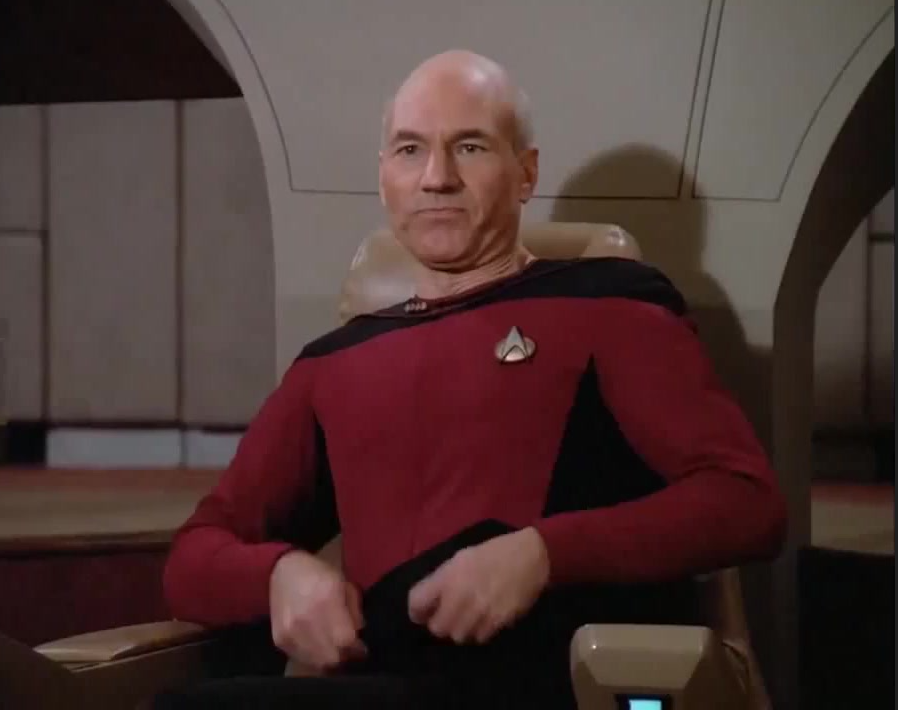
Theres a lovely scene in Star Trek where Picard is captured, then finds an exposed wire on the cell panel. He takes it and begins tapping out prime numbers, to show to the aliens’ mathematicians that they’re sentient and capable of thought, independent of language.
"That's great! I'd love to help you discover the exciting world of programming! The best language for a starter is probably HTML, which stands for Hypertext Text Machine Learning Code 5. You can write HTML in an environment which is a kind of software. The best environments for creating HTML are:
VSCode
Visual Studio Code
Code
HTML
Eclipse
Visual FoxPro
Visual Basic
Visual C+++
Borland Turbo
Pascal
Vienna
Innsbruck
Salzburg
Remember to install your favourite using one or more supported environments. Begin with something basic and work up from there. You'll be in no time. Have fun! Or should I say, Have Fun!"
I love that Eratosthenes was able to estimate the circumference of the earth with the amount of math we had in his era. Meanwhile, modern flat-earthers are still making me want to vomit.
I used to see fractals in the shadows on LSD. I couldn’t think of the word “fractal,” and told my friend, “You know, that thing in math?” And he said to me, “When you trip you see math?!” Fun times. To be a teen again.
I love that Eratosthenes was able to estimate the circumference of the earth with the amount of math we had in his era.
Not only that, but he was much closer to the right answer than Columbus was, yet Columbus is the one to get a day named after him, even though Columbus would have died due to starvation as most people had predicted he would if he had not gotten lucky and run into a continent that no one knew about except for the people that lived there and the Vikings and the Chinese and other people that didn't count! It just proves the principle that the key to success is not to be smart but to be lucky.
Well Pythagoras lived during the Greek era. Buildings like the Temple of Artemis were the greatest projections of power and grandeur the world had to offer at the time. Those great structures would've dwarfed anything seen out in the country. The only way those buildings could ever be erected is with the help of mathematics.
Furthermore mathematical truths are about as true as anything can be in the world. A triangle's angles are always perfectly in harmony for instance. Way back when, when the world was much darker and more chaotic, those mathematical truths must've seemed like a great light in the darkness.
Wrong for physics. Models to describe reality don't magically become wrong just because a model with better predictive power is discovered. Most old models are special cases of newer ones.
Yeah, Newton wasn't just a science bitch who is wrong, sometimes. His equations are the special case of General Relativity when acceleration is very low. Which is the world we live in.
My favorite way to connect people with academia is pointing out how recently zero was invented because even the most reluctant “I don’t know math” person understands zero these days.
Can you really understand zero? I mean, I get what it represents, but I still sometimes struggle to understand its usage...like, you can’t divide with zero thats for sure, but did you know you can divide a number with a really small number (like an infinitely small number) and you get a really large number (like infinitely large)? So, in that special space, if you suddenly replace “0” with a “number-so-close-to-zero-it-can-smell-it” feel free to divide and conquer, and get infinity.
Oh, and sometimes, if you feel like math is letting you down, remember, you can always use positive and negative zeroes, so your math-thing can now work!
If you turn it into a word problem 10/1 could be stated as "If you have 10 things and put them in a bucket, how many things do you have in the bucket?"
10/2 becomes "If you have 10 things, and and put an equal amount of them in two different buckets, how many things are in each bucket?"
So, wouldn't 10/0 become "If you have 10 things, and don't put any of them into the bucket, how many things are in the bucket?"
The fact that there's no buckets means that you can't then usefully draw any further conclusions about the ratio of buckets to things. In your first two examples we can take the results and use them to work out further things like how much might the buckets weigh, what happens if we add more buckets or more things, etc.
In the divide by zero answer, we know nothing about the buckets, and the number of things becomes meaningless. But worse of all is that it's easy to hide this from the unwary, which is why you occasionally see "proofs" online that 1=2, which rely on hiding divide-by-zero operations behind some sneaky algebra.
When we say we "can't" divide by zero, we mean ok you can divide by zero, but you'll get a useless answer that leaves you at a mathematical dead end. Infinity isn't reversible, or even strictly equal to itself.
I think I get it, thanks for taking the time to explain.
With 10/2 there are two buckets, and 10/1 there is 1, so with 10/0 I was wrong to phrase it as there is a 'bucket with nothing in it', it should be 'there is no bucket, so you can't put anything in the bucket, even if you wanted to.' Right?
That $300 stack of the cheapest thin paper was last semester. The online code you need for class is void, and the questions won't match the answer key.
Nothing I do need to account for relativistic speeds or quantum mechanics so I could get by on Newtonian mechanics just fine. Most people could get by on Archimedes.
“It was made up 2000 years ago and is the absolute final word in everything. Well, the parts I pick and choose to fit my own beliefs.” -every religion there is
That was probably inspired by the USA's crappy national curriculum system of forcing kids to learn and use the lattice method which is 100% some sort of scam to make it look like math illiterate children are passing class and failing upwards.
I mean seriously, we've been using base 10 arab system for a millenia, but you're trying to tell me the department of education came up with a better method of drawing a damn chi square matrix abomination that makes even the two millenia old roman numeral system look good in comparison.
Calc 1 & 2 were fine for me. Calc 3 I either couldn't get because I didn't apply myself at all or my professor was terrible. 4 grades. 2 tests totaled 95% of our grade, 2 quizzes that equaled 5%. Got a 100 on the first quiz they said to use as a "progress report". Got a 60 on the first test. Clearly the quiz wasnt a good way to tell my progress.
"… Science is constantly proved all the time. You see, if we take something like any fiction, any holy book… and destroyed it, in a thousand years’ time, that wouldn’t come back just as it was. Whereas if we took every science book, and every fact, and destroyed them all, in a thousand years they’d all be back, because all the same tests would [produce] the same result.”
The answer to that question didn't change, what changed is how you might interpret the question.
If I asked “what are the REAL roots of x² + 2x + 2” the answer is still "none". And prior to imaginary numbers being widely used, that is how the question would have been understood.
Mathematics involves making choices about what set of rules we're working with. If you don't allow the concept of negative numbers, the equation "x+1=0" has no solution. If you give me an apple, then I have no apples, how many apples did I have before? The question describes an impossible situation, and that's a perfectly valid way to view it.
Different sets of rules can change what's possible but don't invalidate conclusions based on other sets of rules. We just need to specify what set of rules we're working with.
My entire point is that before they weren't saying "real" versus "imaginary". You're proving my point. In the other fields mentioned you could make the same argument about the interpretation changing but the book still being useful.
The other fields are attempting to describe reality. While Newtonian physics is useful, as an approximation, it's also quite clearly wrong. You can imagine a universe which follows those rules but it's not this universe, and that's why it's wrong. Mathematics doesn't care about this universe, so you can pick whatever rules you want. Imaginary numbers are not "more accurate", they don't invalidate any previous understanding. They are an imaginary concept with interesting properties. For mathematics, that's enough.
Imaginary numbers are not "more accurate", they don't invalidate any previous understanding. They are an imaginary concept with interesting properties. For mathematics, that's enough.
No. Imaginary numbers have the worst name. Like the Schrodinger's Cat thought experiment it was something meant to mock the concept originally but stuck once real applications were found. Imaginary and complex numbers describe very real processes in nature and are not just some weird artifact of trying to get the square root of a negative number.
Here is an interesting video on the topic that also covers some of the applications used to describe things in nature. https://youtu.be/cUzklzVXJwo
I agree, because really all numbers are imaginary. Numbers are also wonderfully useful for describing nature, and it's amazing how what might start as a quest for completeness and elegance ends up reflecting something about the real world. Each extension on our use of numbers is an augmentation, an extended toolkit to solve different problems, but doesn't negate anything which went earlier. For example finding the roots of a polynomial often represents a problem where complex solutions aren't applicable, and "no solution" is the more meaningful result. One kind of mathematics may be bigger and more complete than another, but that doesn't make it better or more true. It just depends on what you need from it.
Various meta analysis have found that the results of 50%+ of all studies in the field are non reproducible. It could be as high as 70%+.
Again this does not mean that it isn’t a valid field of knowledge, it just not a science yet. People somehow take offense at this because I guess they feel like I’m invalidating the field. I actually only invalidating the validity of their findings so far which is more like a “sorry, try again until you find the fundamental rules of your field”. There’s also this pervasive attitude that all fields must be a science in order to be valuable which is just not true.
The term “social science” reeks of insecurity to me because other than using the scientific method, they are not a sciences at all, but I guess academics needed a way to to defend themselves from the bullying physicists.
My personal opinion is that psychology ignores biology too much, and insists on humans as purely socially constructed beings. If they started looking more at how our biology is the fundamental mold for our psychology, they might start making real progress towards being a science. But then maybe it wouldn’t be psychology anymore.
Im asking these questions to asses what you actually understand science to be.
The term “social science” reeks of insecurity to me because other than using the scientific method, they are not a sciences at all, but I guess academics needed a way to to defend themselves from the bullying physicists.
Do you have a degree, or better yet a terminal degree in a science field? What is your actual academic experience in doing social science experiments?
I have a degree, but not in science. Does that make me unqualified to state that the field of psychology, and most other social sciences lack the epistemic rigor of something like physics or biology and therefore are not real sciences?
I’ll repeat it, psychology is a science in much the same way that medieval medicine was a science. It may one day become an actual science much like medieval medicine became a science.
It lacks predictability and reproduceability. At least to a certain extend. As long as every diagnosis is "this most likely is" or even "could be", it is not science.
But you can still look down on economists, who are somewhere between crystal ball readers or tea leaf interpreters and random number generators on that behalf.
Economists set option prices. That is literally trying to predict the future.
Edit: To be fair, I shouldn't say "economists" in general. There are plenty of good economists out there that understand that economics is not a predictive science, I know a couple personally. But there are definitely some economists out there that think their degree lets them predict the unpredictable.
Yes, maybe, but bcz of that he invented a completely new branch of mathematics that was shunned at first, but we found really important once we got our interstellar dew hickeys working with interstellar time travel. Now he's considered a legend, even tho he died broke and destitute.
...and even newer methods make old math insanely complicated, but much more generalized. Like building definitions for things like numbers and basic arithmetic using set theory.
No sarcasm. Being able to use numbers, integrals and derivatives makes a huge amount of maths easy. Exponential function and it's relatives are so handy. (Sin, Cos, Tan, Cot, log).
The Greeks didn't have any of that to do their math.
To be fair, the first 100 pages of that was justifying the set theory definition for what numbers are. The following two hundred papers are proving that a process of iterative counting we call addition functions in a consistent and useful way, given the set theory way of defining numbers. Once we get to that point, 1+1 is easy. Then we get to start talking more deeply about iteration as a process, leading to considering iterating addition (aka multiplication), iterating multiplication (aka exponents), etc. But that stuff is for the next thousand pages.
Remember, 0 is defined as the amount of things in the empty set {}. 1 is defined as the amount of things in a set containing the empty set {{}}. Each following natural number is defined as the amount of things in a set containing each of the previous nonnegative integers. So for example 2 is the amount of things in a set containing the empty set and a set containing the empty set {{}, {{}}}, 3 is the amount of things in a set containing the empty set, a set containing the empty set, and a set containing the empty set and a set containing the empty set {{}, {{}}, {{}, {{}}}}, etc. All natural numbers are just counting increasingly recursively labeled nothing. Welcome to math.
I actually find the outdated textbooks simpler and easier to understand. Sure the information may not be entirely accurate but it's enough to get you started.
This is one reason I really liked my Dynamics professor. On the first day of class, he wrote "F=ma" on the white board and said, "See that equation? It hasn't changed much in the last 200 years. You don't need to buy the newest edition of the textbook; it's mostly just fixing errata. The lessons are virtually the same as the first edition."
watched a video on tensors with 'no math'. dude lost me in analogies. matrix vectors sumthin... brain is failing. no really the math is advancing more than that with computers and better theories for the physics experimenters.
“After the likeness of [this] angel. He made the incorruptible [generation] of Seth appear to the 12 androgynous [luminaries. And then] he made 72 luminaries appear in the incorruptible generation according to the Spirit’s will. Then the 72 luminaries themselves made 360 luminaries appear in the incorruptible generation according to the Spirit’s will so that there’d be 5 for each. And the 12 realms of the 12 luminaries make up their father, with 6 heavens for each realm so there are 72 heavens for the 72 luminaries, and for each 1 [of them 5] firmaments [for a total of] 360 [firmaments. They] were given authority and a [great] army of angels without number for honor and service, along with virgin spirits [too] for the honor and [service] of all the realms and the heavens with their firmaments.”
There are plenty of textbooks of physics before then, even predating Greece. Waterworks, astronomy, ship building, architecture, war machines, not to mention metaphysics, alchemy, atomic theory, etc.
We didn't have a rigorous scientific method until thereabouts though.
What we call physics today wouldn't qualify as physics in Ancient Greece, where they described how the world actually works, and not bothering with this empiricism nonsense.
It's not revisionist to say that and engineering texts are engineering texts rather than physics texts, it's just properly classifying them.
I'm not sure whether the ancient Greeks really had a concept of "physics" as a dedicated discipline like we do today- they would probably put a lot of what we do under the umbrella of "natural philosophy". The separation of pure natural science into distinct branches is a relatively recent phenomenon. The separation between pure science and engineering on the other hand is quite old.
I say we should go back to calling engineering crafting. Furthermore, physics ought to be natureken, and science ought to be worldken. We could call atomic theory uncleftish beholding.
The word physics comes from Latin physica ("study of nature")
This is essentially my point. You don't have to go more than a couple hundred years back before "natural science" or "natural philosophy" was considered a single field, without a distinction between e.g. physics and chemistry. Engineering (as we call it today) or "crafting", has been considered separate from the study of nature itself (or "natural philosophy") all the way back to before Ancient Greece.
I'm not saying they knew nothing about physics. I'm saying that they didn't regard it as a distinct discipline the way we do today. No Greek philosopher would have called themselves a "chemist" or "physicist" or "biologist", but they would separate between "natural philosopher" and "craftsman", just as we today separate between "scientist" and "engineer".

217 replies
Religious Texts: .. that text was written by some half literate guy living in a desert who heard tenth hand folk stories from his community from people who had died about a hundred years before his time, mixed in with legends, myths and fairy tales that are thousands of years old ... but it's all true because it came from God, believe it or you will burn in hell forever.
You, a loser Christian, reading from a 2000 year old book of morality fables.
Me, a sophisticated Scientologist, reading from a 70 year old Sci-Fi/fad health trilogy.
Maybe L. Ron Hubbard was a time traveller that had already started everything 3,000 years ago and decided to restart it all again 70 years ago.
Or maybe he just copied the successful indoctrination practices of existing religions...
Maybe the real religion was the profit we made along the way.
Always was
The hypocrisy of any religious book being the words of their all powerful master while they give themselves the option to cherry pick which rules they wish to follow is astounding.
It’s one of the first things that convinced kid me that it’s all made up bullshit to control gullible people.
The funny part that is .... which book are you talking about? ... Christian bible? Jewish Tanakh? Islamic Koran? ... and if its Christian - is it just the Old Testament? New Testament? ... which version of the Christian bible? - King James? New Standard? English Standard? Anglican? Baptist? Lutheran? Methodist? Presbyterian? Roman Catholic? Mormon? Protestant?
I don’t see any difference between cults. It’s all a way to control uneducated people with fake magical thinking and the threat of eternal damnation.
Same here .... and they're all cults as far as I'm concerned
The only difference between a cult and a religion is time
Time and mass acceptance
well the joke is that each book claims to be written by God
Don't forget about all the apocrypha.
I reminded your mom of the apocrypha last night, if you know what I mean..
Whichever one best justifies the lifestyle and decisions.
Yes
And don't worry, it definitely wasn't completely written a thousand years later to push the preferred political agendas of the time.
That wouldn’t be true for Christianity as 3 of the 4 Gospels were cribbing off the 4th one. Heck the Gospel of John and the Revelation unto John were written by at least two different people and the Revelation likely was included at the Council of Nicea because they both had John in the name. Christianity would be very different without revelations.
The prevailing consensus is that the gospels of Matthew and Luke were cribbing from the gospel of Mark and a text that is lost to us that is referred to as Q. The gospel of John is original as far as we know.
Also, a lot of the Pauline epistles weren't even written by Paul.
Also rewritten, heavily translated with a large variety of biases, and with whole sections taken out or added in depending on the version AND there has been lord knows how many instances of stacking errors because new interpretations often come from already dubious later versions and not the original texts.
But it’s also all the undeniably word of god and you better not question whatever version you grew up with.
Q: How can you tell if a Lemming is an atheist?
A: Don't worry, they'll tell you.
You saw a meme about science and math and your first thought was "how can I make this about religion"?
excuse me, but this is a meme about history and religious mythology is definitely a big part of history
I would just expect someone who doesn't like religion to not want to have conversations about it, instead of bringing it up at every vaguely related opportunity.
sounds like you haven't had much experience of having to sit through religious people spout bullshit at you every single day. it's not the least bit surprising to me that it's on someone's mind. or maybe you just don't understand why religion would matter to someone? even to challenge/deny it is to engage with its importance no?
You mean like what's happening in this thread? Someone had a joke that had nothing to do with religion, and here we are talking about religious bullshit because someone can't let any opportunity pass without mentioning religion.
Again: if you're tired of people spouting religious bullshit at you all day I would expect you to not try to steer even more conversations towards religion.
I didn't steer shit, first of all. I'm not the one who posted the original comment. I'm just telling you to shut the fuck up. Let us enjoy our thing.
Second, do you really believe that if you just ignore things they go away? As if people are not out there bible thumping every single day? and we come in here and try to enjoy a moment of reflecting on the ridiculousness of those beliefs and you have to come in here and bitch about it. hence, I'm here to tell you to shut the fuck up.
I'm sorry if this comes across as rude, maybe cussing will send me to hell or whatever, but i really feel like your input has been the truly rude part of this conversation.
First of all, never said or implied you did.
So you do enjoy bringing up religion in every possible conversation?
(and can I just point out the irony of you saying "let us enjoy our thing" when your thing it literally shitting on other people's thing?)
Sir, this is a
Wendysmeme about math.and we come in here and try to enjoy
a moment of reflecting on the ridiculousness of those beliefsmemes away from all that bullshit and someone has to come in here and bring it up to bitch about it anyway. hence, I’m here to tell them to shut the fuck up.My input has been the simple fact that people who insist on making every conversation about religion are fucking exhausting to everyone else.
I have not subbed to any religious or anti-religious communities, and yet people seem to think it needs to be a part of every discussion. You'd think out of all people atheists wouldn't be the ones doing that shit yet here we are. If you want to talk about that shit go those communities and you will find plenty of like minded people.
I didn't like covid either but I sure ranted at people online about it!
Do you reply to memes about video games with your thoughts on covid?
Only while the pandemic was killing millions. So I'm optimistic about this subject as well.
Electron was discovered in 1897. If you own a textbook on chemistry which is older than that, put it up on Ebay in the antiques category.
Newton lived in the 17th century, so if you got a textbook older than that give it back to the museum
I'll drop it off for anyone if needed.
I'm very trustworthy.
Very.
I promise.
Web development: Oh, that textbook is obsolete. It was written last year before Angular v18 was released.
*French SpongeBob voice
"2 hours later"
Laughs in PHP + HTML5 + CSS3 + Vanilla JS
Laughs about PHP
My condolences
Why? It is much better than Fortran, the Industry standard of programming languages!
Whoops, 18.1 just released breaking changes
Was just watching a kubernetes tutorial recorded a year ago, and the entire website / package repository it uses doesn't exist anymore because modern devs can't go six months without changing everything.
A colleague called it "Hype driven development" the other day and I have to say that describes it perfectly.
Meanwhile you can still get away with most of what you learned in Java 1.4.
Programming: that book was printed a month ago, and it's already obsolete.
Newspapers printed yesterday are already in the bin.
Tiktok posts last seconds before being discarded.
But math does change, and it has a lot in the last 1000 years.
Math doesn't change, we just learn more about it.
The mathematical knowledge we had thousands of years ago is still true, and it always will be.
Isn't that true of almost all the sciences?
The difference is that if something is proven mathematically it's 100% certain and will not change. In other sciences you may be taught things that later turn out to be flat out wrong.
Bingo, I was taught in genetics class in the 1990s that RNA played a role but DNA was the primary driver and now my understanding is the current consensus is RNA is the primary driver.
When I was growing up, Minnie was the primary Driver, but now the consensus says that it's Adam.
Not here to start shit, genuinely curious what people think about Gödel's incompleteness theorems in relation to us being able to "know" math
Not a mathematician but the way I understand it, is that it merely shows that there are unprovable problems, not that nothing can be proven.
Not if it's later shown that your set of axioms lead to a contradiction.
In that case have fun re-proofing everything with new axioms.
Sounds hella sus now that you mention it 🤔
Not quite. Science is empirical, which means it's based on experiments and we can observe patterns and try to make sense of them. We can learn that a pattern or our understanding of it is wrong.
Math is inductive, which means that we have a starting point and we expand out from there using rules. It's not experimental, and conclusions don't change.
1+1 is always 2. What happens to math is that we uncover new ways of thinking about things that change the rules or underlying assumptions. 1+1 is 10 in base 2. Now we have a new, deeper truth about the relationship between bases and what "two" means.
Science is much more approximate. The geocentric model fit, and then new data made it not fit and the model changed. Same for heliocentrism, Galileos models, Keplers, and Newtons. They weren't wrong, they were just discovered to not fit observed reality as well as something else.
A scientific discovery can shift our understanding of the world radically and call other models into question.
A mathematical discovery doesn't do that. It might make something more clear, easier to work with, or provide a technique that can be surprisingly applicable elsewhere.
You're contradicting yourself.
Is no different than:
Science isn't changing, our understanding of it is. Same with math.
Those are entirely different. Peano developed a system for talking about arithmetic in a formalized way. This allowed people to talk about arithmetic in new ways, but it didn't show that previous formulations of arithmetic were wrong. Godel then built on that to show the limits of arithmetic, which still didn't invalidate that which came before.
The development of complex numbers as an extension of the real numbers didn't make work with the real numbers invalid.
When a new scientific model is developed, it supercedes the old model. The old model might still have use, but it's now known to not actually fit reality. Relativity showed that Newtowns model of the cosmos was wrong: it didn't extend it or generalize it, it showed that it was inadequately describing reality. Close for human scale problems but ultimately wrong.
And we already know relativity is wrong because it doesn't match experimental results in quantum mechanics.
Science is our understanding of reality. Reality doesn't change, but our understanding does.
Because math is a fundamentally different from science, if you know something is true then it's always true given the assumptions.
There's a difference between an advance that repudiates prior understanding and one that doesn't. You can, in maths - and I assume this is the point - know that you are right, in a way that you can't with a more... epistemological science. Of course it's more complex than that, and a lot of maths is pretty sciency, like deriving approximate solutions for PDEs is more experimental than you might imagine, but even though we might make improvements there, we'll never go 'oh actually those error bounds are wrong'. They might be non optimal but they'll never be wrong
This is missing a lot of historical intrigues and "mistakes" in mathematics. Firstly, the way modern mathematical theorems and proofs are built up from axioms is relatively new (a couple hundred years or so). If you go back to Euclid, there are in fact contradictions that can be drawn from his work because he was defining his axioms inappropriately.
In more modern times we have discussions around the "axiom of choice", and whole fields such as set theory and Fourier analysis faced some major hurdles in just being established.
My point is that math is constantly changing, also on a fundamental level, because new systems and axioms are being introduced. These rarely invalidate old systems, but sometimes they reveal a contradiction in terms that puts limitations on when some system is valid.
This is very similar to when Einstein developed a new framework for describing gravity: It didn't "disprove" Newton in the sense that Newton's laws still apply for all practical purposes in a huge range of situations, it just put clearer limits to when they apply and gave a more general explanation to why they apply.
A lot of sciences find core assumptions were not complete or based on the wrong thing. Health practices that have been around for millenia, like like food safety and sanitation, were successfully implemented using the wrong causes because they addressed the real causes. While they were not called science, they still used the same practices of comparing outcomes in the ways available at the time.
Bloodletting was originally to let out evil or something, then was used in formal medicine successfully but the cause it addressed was incorrect. Now we have much better ideas of how and when it helps to make it even more effective, but the underlying reasons and the methods changed completely.
Bloodletting is still a thing, but it's called therapeutic phlebotomy.
Source: I have too much iron in my blood so I have to be bloodlet
yeah, and physics changes as a science because the actual physics of the universe changes. what are you on about. "we just learn more about it" is pretty much the definition of all sciences.
Has anything changed in Euclid's Elements?
We discovered one of the postulates was really interesting to fuck with.
It's better to say that we've discovered more math, some of which changes how we understand the old.
Since Euclid, we've made discoveries in how geometry works and the underpinnings of it that can and have been used to provide foundation for his work, or to demonstrate some of the same things more succinctly. For example, Euclid had some assumptions that he didn't document.
Since math isn't empirical, it's rarely wrong if actually proven. It can be looked at differently though, and have assumptions changed to learn new things, or we can figure out that there are assumptions that weren't obvious.
The number of hypotheses we've proven, mostly. Also, we have this whole field of non-Euclidean geometry. And the modern Pythagoreans are a lot more chill about people knowing the irrationality of Pi.
Yeah but I mean revision not additive change. From what I remember nothing in elements is wrong. I don't think anyone proved that last postulate
Nothing is wrong, it's just more incomplete than a modern book.
But if you're at the 101 level, sure. It works fine.
Yes, some of the shit he wrote was basically meaningless (the "definitions" before the axioms) and we would just leave it out.
Nope. Thats why I gifted it to my son, who studies math.
Not sure, I've only gotten to the middle of the third season. No spoilers, please!
"Why yes I do happen to also be the author of the textbook for this course, why do you ask?"
Computer programming books ... Lol we don't print them any more, they'd be obsolete before hitting the shelves.
Do be fair, that's less because the fundamentals behind programming are changing and more because the specific implementations are changed all the damn time.
Yep, I got that "introduction to algorithms" (1100 pages tightly written, love it) and it still holds up ofc. I should have stayed in uni...
Computer Science:
Or: The new version is reimplemented and incompatible, so everything you learnt about it from the previous versions is wrong.
Oh, you use the MediaWiki engine, too? The documentation is always a few versions behind, and between there and now they broke the interface three times...
For me its like "oh great a old textbook, now i can finally understand our legacy codebase".
One of the best programmers I've ever met told me, "All you need is Knuth everything else is just syntax." And I don't know if that's 100% true, but can say I learned more from reading The Art of Computer Programming than I have in basically any other textbook/textbook series I've read on the subject.
Or: "The algorithm and data structure theory stuff is still pretty relevant. However, all of the examples are written in a language no one really uses any more. If they can get away with it."
Mathematics ^teacher^: That textbook was written thousands of years ago, and it is still as useful and relevant as ever, but I want you to buy this one I co-authored instead for the mere sum of $120, otherwise you won't pass.
Conflict of interest detected
This really happened?
I took an environmental science class in college, and the professor was a former president of Shell. As part of the curriculum, we had to read his book, Why we Hate the Oil Companies. Predictably, it's a corporate non-apologia, which—hilariously—completely avoids engaging with why we actually hate the oil companies.
Did people stand up to call the bullshit? I guess in this kind of situation you feel threatened that if you talk, you get penalized heavily
Not that I recall. I didn't know anyone else in the class, and I don't remember anything coming up in the class group chat. I did get quite heated with him at a couple of points, but I'm pretty sure he still gave me an A.
Do they also invite Nazis to teach the elective in human rights?
Iirc, it was an energy/environment focus, so it was all about analyzing and comparing different energy sources wrt their usefulness, feasability, environmental impact, etc. This was in Houston, so the oil industry plays a huge role in the local economy, and funds the university endowments.
But yeah, the whole thing was pretty farcical.
Not the original commenter, but I briefly had one professor in college that did that (their book was $50, though). It was an elective course for me, fortunately. I was able to switch for a different class that fit the same requirement without being forced to buy a book the professor wrote.
I admit I exaggerated a bit. It hasn't happened to me, but I've had some teachers that strongly suggested buying their textbooks and frowned if you didn't.
Fucking disgusting behavior
https://xkcd.com/435/
Philosopher to the right of the mathematician: "You're welcome for the axioms"
Computer Scientists: Physics is just the application of discrete state machines.
The other way around. Computer Science studies the implications of physical laws - the relation between space and time, what's ultimately knowable given the make ups of our universe, etc.
Theres a lovely scene in Star Trek where Picard is captured, then finds an exposed wire on the cell panel. He takes it and begins tapping out prime numbers, to show to the aliens’ mathematicians that they’re sentient and capable of thought, independent of language.
2 3 5 7 11 13 17 19 23 29 31 37 39
39 is not a prime number
Out the airlock they go.
Software Development: You bought a textbook?
"Oh, that blog post is obsolete. It was written before version 1.87.0d.20250304.nightly"
"It's okay, I'll just ask ChatGPT."
Asks ChatGPT about new feature.
ChatGPT makes up a completely fictional answer that sounds plausible given the state of the repository two years ago.
"That's great! I'd love to help you discover the exciting world of programming! The best language for a starter is probably HTML, which stands for Hypertext Text Machine Learning Code 5. You can write HTML in an environment which is a kind of software. The best environments for creating HTML are:
Remember to install your favourite using one or more supported environments. Begin with something basic and work up from there. You'll be in no time. Have fun! Or should I say, Have Fun!"
Oh dear, that is excellent.
As nearly always, there is a relevant xkcd.
I love that Eratosthenes was able to estimate the circumference of the earth with the amount of math we had in his era. Meanwhile, modern flat-earthers are still making me want to vomit.
I used to see fractals in the shadows on LSD. I couldn’t think of the word “fractal,” and told my friend, “You know, that thing in math?” And he said to me, “When you trip you see math?!” Fun times. To be a teen again.
Someday I'd like to replicate Eratosthenes' experiment with a long north-south road trip, but I never remember to make the measurements.
Not only that, but he was much closer to the right answer than Columbus was, yet Columbus is the one to get a day named after him, even though Columbus would have died due to starvation as most people had predicted he would if he had not gotten lucky and run into a continent that no one knew about except for the people that lived there and the Vikings and the Chinese and other people that didn't count! It just proves the principle that the key to success is not to be smart but to be lucky.
As a kid I thought Pythagoras was silly for making a math cult. Now that I'm older I get it.
That's an interesting angle on it, can you say more? Sorry to be obtuse.
Well Pythagoras lived during the Greek era. Buildings like the Temple of Artemis were the greatest projections of power and grandeur the world had to offer at the time. Those great structures would've dwarfed anything seen out in the country. The only way those buildings could ever be erected is with the help of mathematics.
Furthermore mathematical truths are about as true as anything can be in the world. A triangle's angles are always perfectly in harmony for instance. Way back when, when the world was much darker and more chaotic, those mathematical truths must've seemed like a great light in the darkness.
Mathematics is applicable truth.
Wrong for physics. Models to describe reality don't magically become wrong just because a model with better predictive power is discovered. Most old models are special cases of newer ones.
Yeah, Newton wasn't just a science bitch who is wrong, sometimes. His equations are the special case of General Relativity when acceleration is very low. Which is the world we live in.
My favorite way to connect people with academia is pointing out how recently zero was invented because even the most reluctant “I don’t know math” person understands zero these days.
Can you really understand zero? I mean, I get what it represents, but I still sometimes struggle to understand its usage...like, you can’t divide with zero thats for sure, but did you know you can divide a number with a really small number (like an infinitely small number) and you get a really large number (like infinitely large)? So, in that special space, if you suddenly replace “0” with a “number-so-close-to-zero-it-can-smell-it” feel free to divide and conquer, and get infinity.
Oh, and sometimes, if you feel like math is letting you down, remember, you can always use positive and negative zeroes, so your math-thing can now work!
I don't understand why you can't divide by zero.
If you turn it into a word problem 10/1 could be stated as "If you have 10 things and put them in a bucket, how many things do you have in the bucket?"
10/2 becomes "If you have 10 things, and and put an equal amount of them in two different buckets, how many things are in each bucket?"
So, wouldn't 10/0 become "If you have 10 things, and don't put any of them into the bucket, how many things are in the bucket?"
I'm bad at math, go easy on me.
The fact that there's no buckets means that you can't then usefully draw any further conclusions about the ratio of buckets to things. In your first two examples we can take the results and use them to work out further things like how much might the buckets weigh, what happens if we add more buckets or more things, etc.
In the divide by zero answer, we know nothing about the buckets, and the number of things becomes meaningless. But worse of all is that it's easy to hide this from the unwary, which is why you occasionally see "proofs" online that 1=2, which rely on hiding divide-by-zero operations behind some sneaky algebra.
When we say we "can't" divide by zero, we mean ok you can divide by zero, but you'll get a useless answer that leaves you at a mathematical dead end. Infinity isn't reversible, or even strictly equal to itself.
I think I get it, thanks for taking the time to explain.
With 10/2 there are two buckets, and 10/1 there is 1, so with 10/0 I was wrong to phrase it as there is a 'bucket with nothing in it', it should be 'there is no bucket, so you can't put anything in the bucket, even if you wanted to.' Right?
Math is a thought game with axioms as rules. It’s much more stable since the rules are “self-evident”.
Fuck you professor, its a 35 line proof, and it isn't as trivial as you think it is!
It's actually a 36 line proof, so this question is wrong and you score a 50 on the test.
Professor = Bozo and therefore wrong Q.E.D.
I’m getting undergrad flashbacks. “It’s trivial so I won’t be going over it…”
That $300 stack of the cheapest thin paper was last semester. The online code you need for class is void, and the questions won't match the answer key.
Physics books are never outdated, you just discover better models that work in a wider range of conditions.
I’m just wondering who’s using a physics textbook from before the Industrial Revolution.
Newton's book is from before the industrial revolution and widely used in physics today.
Nothing I do need to account for relativistic speeds or quantum mechanics so I could get by on Newtonian mechanics just fine. Most people could get by on Archimedes.
We were taught highschool physics from a book published around 20 years before I was born
Science is validated by the new information replacing the old. Al-Khwarizmi worked out numbers so we don’t have to,
The really funny part is the other two are also just math.
The fabric of reality is woven from math, and that's beautiful.
I've got a pet theory that a hypothetical alien species' music would be more recognizably similar to humans' than their biology would.
This could make the plot of a great sci-fi book. Love the idea.
Math is just applied logic. Logic is just applied philosophy. Philosophy is just applied bullshit.
philosophy is bullshit if you don't take it seriously, at least.
Me using a needle and a steady hand and philosophy to shitpost over the horizon
Nah mate, it was already in existence by last Tuesday afternoon and there is no way for you to disprove it.
Since you made the claim, the onus of proof is on you. Go on, it'll be interesting to see your proof.
“It was made up 2000 years ago and is the absolute final word in everything. Well, the parts I pick and choose to fit my own beliefs.” -every religion there is
But none of it is wrong is it? Just that incomplete.
Now makes me wonder what is the most recent mathematical discovery that is understandably useful to an average person.
There's a whole bit in The Incredibles about how math has changed since Bob was in school
https://www.youtube.com/watch?v=3QtRK7Y2pPU
That was probably inspired by the USA's crappy national curriculum system of forcing kids to learn and use the lattice method which is 100% some sort of scam to make it look like math illiterate children are passing class and failing upwards.
I mean seriously, we've been using base 10 arab system for a millenia, but you're trying to tell me the department of education came up with a better method of drawing a damn chi square matrix abomination that makes even the two millenia old roman numeral system look good in comparison.
This was made by someone who doesn't understand any of it.
It’s called a joke.
Very funny, I'm laughing so hard. So true /s
I can tell you are just the best of conversationalists, try to leave some charm and charisma for the rest of us.
Poor you. I will make sure I laugh next time. Don't you worry.
So, what’s it like living up your own asshole?
Sorry, too busy waiting. Not laughing yet. Have you tried asking yourself that?
Good, I didn't wanna learn calculus anyway
Calc 1 & 2 were fine for me. Calc 3 I either couldn't get because I didn't apply myself at all or my professor was terrible. 4 grades. 2 tests totaled 95% of our grade, 2 quizzes that equaled 5%. Got a 100 on the first quiz they said to use as a "progress report". Got a 60 on the first test. Clearly the quiz wasnt a good way to tell my progress.
"… Science is constantly proved all the time. You see, if we take something like any fiction, any holy book… and destroyed it, in a thousand years’ time, that wouldn’t come back just as it was. Whereas if we took every science book, and every fact, and destroyed them all, in a thousand years they’d all be back, because all the same tests would [produce] the same result.”
― Ricky Gervais
You could make the same argument for things like mathematics before the discovery about imaginary numbers.
Ehh imaginary numbers added to the scope of mathematics it didn't take away anything other than no's.
"hey look, i got your no's!"
No, it changed things like "how many roots does x² + 2x + 2 have" from "none" to "two".
The answer to that question didn't change, what changed is how you might interpret the question.
If I asked “what are the REAL roots of x² + 2x + 2” the answer is still "none". And prior to imaginary numbers being widely used, that is how the question would have been understood.
Mathematics involves making choices about what set of rules we're working with. If you don't allow the concept of negative numbers, the equation "x+1=0" has no solution. If you give me an apple, then I have no apples, how many apples did I have before? The question describes an impossible situation, and that's a perfectly valid way to view it.
Different sets of rules can change what's possible but don't invalidate conclusions based on other sets of rules. We just need to specify what set of rules we're working with.
My entire point is that before they weren't saying "real" versus "imaginary". You're proving my point. In the other fields mentioned you could make the same argument about the interpretation changing but the book still being useful.
The other fields are attempting to describe reality. While Newtonian physics is useful, as an approximation, it's also quite clearly wrong. You can imagine a universe which follows those rules but it's not this universe, and that's why it's wrong. Mathematics doesn't care about this universe, so you can pick whatever rules you want. Imaginary numbers are not "more accurate", they don't invalidate any previous understanding. They are an imaginary concept with interesting properties. For mathematics, that's enough.
No. Imaginary numbers have the worst name. Like the Schrodinger's Cat thought experiment it was something meant to mock the concept originally but stuck once real applications were found. Imaginary and complex numbers describe very real processes in nature and are not just some weird artifact of trying to get the square root of a negative number.
Here is an interesting video on the topic that also covers some of the applications used to describe things in nature. https://youtu.be/cUzklzVXJwo
If you prefer text here is an article listing some. https://www.geeksforgeeks.org/maths/applications-of-imaginary-numbers-in-real-life/
I agree, because really all numbers are imaginary. Numbers are also wonderfully useful for describing nature, and it's amazing how what might start as a quest for completeness and elegance ends up reflecting something about the real world. Each extension on our use of numbers is an augmentation, an extended toolkit to solve different problems, but doesn't negate anything which went earlier. For example finding the roots of a polynomial often represents a problem where complex solutions aren't applicable, and "no solution" is the more meaningful result. One kind of mathematics may be bigger and more complete than another, but that doesn't make it better or more true. It just depends on what you need from it.
Meanwhile, Psychologists:
Not a science.
What makes something a science?
A methodology with reproducible experiments and results.
Psychology is as much as science as medicine was a science in the Middle Ages.
That doesn’t mean we should stop pursuing knowledge in the field, but to call it a science at this point in its development is just disingenuous.
And why don't you think psychology fits this?
Various meta analysis have found that the results of 50%+ of all studies in the field are non reproducible. It could be as high as 70%+.
Again this does not mean that it isn’t a valid field of knowledge, it just not a science yet. People somehow take offense at this because I guess they feel like I’m invalidating the field. I actually only invalidating the validity of their findings so far which is more like a “sorry, try again until you find the fundamental rules of your field”. There’s also this pervasive attitude that all fields must be a science in order to be valuable which is just not true.
The term “social science” reeks of insecurity to me because other than using the scientific method, they are not a sciences at all, but I guess academics needed a way to to defend themselves from the bullying physicists.
My personal opinion is that psychology ignores biology too much, and insists on humans as purely socially constructed beings. If they started looking more at how our biology is the fundamental mold for our psychology, they might start making real progress towards being a science. But then maybe it wouldn’t be psychology anymore.
Im asking these questions to asses what you actually understand science to be.
Do you have a degree, or better yet a terminal degree in a science field? What is your actual academic experience in doing social science experiments?
I have a degree, but not in science. Does that make me unqualified to state that the field of psychology, and most other social sciences lack the epistemic rigor of something like physics or biology and therefore are not real sciences?
I’ll repeat it, psychology is a science in much the same way that medieval medicine was a science. It may one day become an actual science much like medieval medicine became a science.
What is your field?
It lacks predictability and reproduceability. At least to a certain extend. As long as every diagnosis is "this most likely is" or even "could be", it is not science.
But you can still look down on economists, who are somewhere between crystal ball readers or tea leaf interpreters and random number generators on that behalf.
Economists aren't trying to predict the future. That's a misconception that is done away with in the first few days of intro.
Economists set option prices. That is literally trying to predict the future.
Edit: To be fair, I shouldn't say "economists" in general. There are plenty of good economists out there that understand that economics is not a predictive science, I know a couple personally. But there are definitely some economists out there that think their degree lets them predict the unpredictable.
Lol bro doesn't know about calculus
Yes, maybe, but bcz of that he invented a completely new branch of mathematics that was shunned at first, but we found really important once we got our interstellar dew hickeys working with interstellar time travel. Now he's considered a legend, even tho he died broke and destitute.
The correct way to learn math is chronologically
Wrong. Good look fooling around without algebra for years. New methods make old maths easy.
...and even newer methods make old math insanely complicated, but much more generalized. Like building definitions for things like numbers and basic arithmetic using set theory.
/s
No sarcasm. Being able to use numbers, integrals and derivatives makes a huge amount of maths easy. Exponential function and it's relatives are so handy. (Sin, Cos, Tan, Cot, log).
The Greeks didn't have any of that to do their math.
I'm the one being sarcastic Einstein
Start with set theory. After about 300 pages you'll be able to show what 1+1 equals.
To be fair, the first 100 pages of that was justifying the set theory definition for what numbers are. The following two hundred papers are proving that a process of iterative counting we call addition functions in a consistent and useful way, given the set theory way of defining numbers. Once we get to that point, 1+1 is easy. Then we get to start talking more deeply about iteration as a process, leading to considering iterating addition (aka multiplication), iterating multiplication (aka exponents), etc. But that stuff is for the next thousand pages.
Remember, 0 is defined as the amount of things in the empty set {}. 1 is defined as the amount of things in a set containing the empty set {{}}. Each following natural number is defined as the amount of things in a set containing each of the previous nonnegative integers. So for example 2 is the amount of things in a set containing the empty set and a set containing the empty set {{}, {{}}}, 3 is the amount of things in a set containing the empty set, a set containing the empty set, and a set containing the empty set and a set containing the empty set {{}, {{}}, {{}, {{}}}}, etc. All natural numbers are just counting increasingly recursively labeled nothing. Welcome to math.
Weird flex
Easy as
I/II= ,V(OK, that was confusing, it's
I/II= .Vin barbaric` )I actually find the outdated textbooks simpler and easier to understand. Sure the information may not be entirely accurate but it's enough to get you started.
Totally agree. Sometimes its just easier to understand what something is by understanding what it was.
This is one reason I really liked my Dynamics professor. On the first day of class, he wrote "F=ma" on the white board and said, "See that equation? It hasn't changed much in the last 200 years. You don't need to buy the newest edition of the textbook; it's mostly just fixing errata. The lessons are virtually the same as the first edition."
Have you met a bayesian guy? All prof on statistics in my uni keep talking how "traditional" approach is stupid, inferior, blah blah
Psh, what do professors know
Now for applied mathematics on the other hand...
watched a video on tensors with 'no math'. dude lost me in analogies. matrix vectors sumthin... brain is failing. no really the math is advancing more than that with computers and better theories for the physics experimenters.
https://www.youtube.com/watch?v=k2FP-T6S1x0
or this; https://www.youtube.com/watch?v=f5liqUk0ZTw
Okay, but do I really need to draw this many circles to prove what value Pi has? Also, it's all in Greek.
The textbook:
“After the likeness of [this] angel. He made the incorruptible [generation] of Seth appear to the 12 androgynous [luminaries. And then] he made 72 luminaries appear in the incorruptible generation according to the Spirit’s will. Then the 72 luminaries themselves made 360 luminaries appear in the incorruptible generation according to the Spirit’s will so that there’d be 5 for each. And the 12 realms of the 12 luminaries make up their father, with 6 heavens for each realm so there are 72 heavens for the 72 luminaries, and for each 1 [of them 5] firmaments [for a total of] 360 [firmaments. They] were given authority and a [great] army of angels without number for honor and service, along with virgin spirits [too] for the honor and [service] of all the realms and the heavens with their firmaments.”
Indeed. There is a reason I gifted my son, who studies math, Euclids book 'Elements'. It is still relevant.
I think you'd get better traction out of this if it said quantum mechanics
what? didn't physics start with Newtonian mechanics? how would there be textbooks before that?
There are plenty of textbooks of physics before then, even predating Greece. Waterworks, astronomy, ship building, architecture, war machines, not to mention metaphysics, alchemy, atomic theory, etc.
We didn't have a rigorous scientific method until thereabouts though.
I always maintain that Aristotle's notions of how to test theories of 'natural philosophy' are a reasonable starting point for 'science'
I would say that's engineering, not physics (except for astronomy)
Physics is when you start describing the laws of nature, not how to build something
That's very revisionist of you.
What we call physics today wouldn't qualify as physics in Ancient Greece, where they described how the world actually works, and not bothering with this empiricism nonsense.
It's not revisionist to say that and engineering texts are engineering texts rather than physics texts, it's just properly classifying them.
I'm not sure whether the ancient Greeks really had a concept of "physics" as a dedicated discipline like we do today- they would probably put a lot of what we do under the umbrella of "natural philosophy". The separation of pure natural science into distinct branches is a relatively recent phenomenon. The separation between pure science and engineering on the other hand is quite old.
I say we should go back to calling engineering crafting. Furthermore, physics ought to be natureken, and science ought to be worldken. We could call atomic theory uncleftish beholding.
This is essentially my point. You don't have to go more than a couple hundred years back before "natural science" or "natural philosophy" was considered a single field, without a distinction between e.g. physics and chemistry. Engineering (as we call it today) or "crafting", has been considered separate from the study of nature itself (or "natural philosophy") all the way back to before Ancient Greece.
I'm not saying they knew nothing about physics. I'm saying that they didn't regard it as a distinct discipline the way we do today. No Greek philosopher would have called themselves a "chemist" or "physicist" or "biologist", but they would separate between "natural philosopher" and "craftsman", just as we today separate between "scientist" and "engineer".
i wasn't implying anything, it depends on your definition of physics