
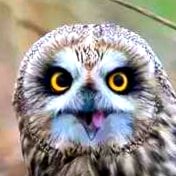
Yup, that's me. You're probably wondering how I got here...
From Rocky Point Bird Observatory
The first owl at the Rocky Point station was a total surprise - a Long-eared Owl! In the past several years we have been lucky to catch one during the season, but it is not a given. This owl species is particularly cryptic & not a lot is known about them here in North America. In order to safely band and weigh larger owls, we put them in a wrap which keeps them calm.
58 replies
So calm... 😂
Me when the cop asks me if I consumed any drugs.
Oh wow, that's even better.
"The snozzberries taste like snozzberries!"
That's like when a snake sizes you to to see if you'll fit. Nope that bird is ready to go if ghat kid gets closer...
Needs the vietnam ptsd photo over layed lol
A buritowl
I was thinking “hoorito” but “buritowl” is a bit better
I think hoorito is pretty great
This lady should work at Chipotle in the off season. Nobody there wraps the filling near as well as she did here.
A burry towel?
The woman has both a sweater and a vest with images of birds.
In a world of crazy cat ladies and puppy parents, there is no shortage of bird nerds! I'm a cheap bastard usually, so I try to only get reeeeeeally special owl stuff, but I did just drop way too much money on a handmade felted opossum for my car...
Got a matching one for my clinic partner in crime also so we could match. 😊
"I wanna get weighed, I wanna get weighed!" said the Owl
"So how was your visit to the Observatory?"
"Wousy," said the Owl.
Nobody likes that number coming back higher than expected!
Too many mice, not enough rice!
Subtract two pounds for the wrap!
I wonder if they'd get anything out of a weighted blanket.... 🤔
"Abducted by aliens, I tell you, Owlivia! There were bright lights and they did experiments!"
At least we leave them with a stylish anklet as a souvenir instead of giving them a cloaca probe!
And there was dirty talk involved!
Weirdest Isekai.
That Time I Died And Got Reincarnated As An Owl, But I'm Stuck In A Burrito!
These long titles are out of hand! 😉
How would a not so calm burritoed owl behave? Rapid movement of the dangerous owl ends? Complaining?
Differently asked: how do you know it is calm? What are the signs?
Most of my personal animal burritos have been mammals, and it's never worked for me with them other than to keep their movements somewhat more under control.
I have a better understanding of covering a bird's face to calm them, and I can get how removing all that visual stimuli would be advantageous. Birds already have high heart rates and breathing, so minimizing stress in them is very important to keeping them safe. I tend to think of the body wraps as keeping handlers and the birds safe physically rather than mentally. Even big birds are still just birds and are built to be as light as possible, so they injure very easily. The upside to that is when it seems futile to fight, they will freeze and basically just wait out what you are doing. If they fight in a hopeless situation, the probability of injury is just too high, and if they can't fly, they know they will die. So by just letting us do what we want, they will often see being patient as their best outcome, staying chill until they get an opportunity to get away safely, which thankfully we give them once we're done doing whatever procedure to them.
Some will still kick and bite, but once they're wrapped, we know where the danger zones are for our hands. I came across a swaddled Screech owl video with it still putting up its best resistance the other day. While we can't remove their stress or let them know we mean them no harm, we do all that we understand to reduce their stress, as it's important to their health, which is what we are most interested in.
I hope that was somewhat helpful, I'm not the best at bird psychology yet, as most of my hands-on experience is with mammals thus far.
Yes, it was. :)
I'm impressed about your persistence and passion for owls. As far as I can tell you take the time to reply to each and every question asked here, too. Thank you for your work.
I don't think I ever grew out of the childhood bit of asking "why" about everything, and every answer I get makes me want to learn more. A few years back, I never would have imagined there was so much to learn about just one group of birds, but after doing near 4000 Q&A with you guys about them, I feel I've barely scratched the surface. They're an animal we've been fascinated with since our days as primates, yet we still know so little about so many of them.
I always want you guys to feel your questions will be taken seriously and that if you make a comment that it was worth sharing here. The interest you guys have shown for what I share has led me to getting to work hands on with animals, including owls, and I get so many opportunities that I never could have imagined to know more about nature, so I am very grateful to you all. In a time where so much of the human world seems really messed up, getting such a strong appreciation for the natural world and meeting other people that are so passionate about helping animals and making our world a better place in a tangible way has been invaluable. You've all helped give me much more than I've been able to give to you.
I love hearing how learning about these superb owls has made your lives a bit brighter, and I hope to keep encouraging you all to love your local wildlife more and hopefully one day to get involved yourselves. Anyone can volunteer to their local wildlife rescue and become a part of this great experience. Rescues will start looking for volunteers around January, and work will start in March-April, so if anyone thinks they may want to care for animals, I encourage you to reach out to your local rescue people.
Thank you for work of informing us!
My pleasure!
As in, is it actually calm, or does it just not have the option to not be calm? Or “appear” calm?
It's not happy, but when we can keep their struggling to a minimum, it keeps both parties as safe as they can be. It cuts everyone's chances of injury way down and minimizes the time we have to touch them, so they can get back to normal. Some still put up a fight, but at least like this, they can't move intentionally or accidently in a way where they could be injured physically. The rest is just getting done handling them quickly so their stress hormones can clear out.
Yes. I think the question is: is it relaxed or just tolerating. And would the owl use its beak and talons to fight, if it wasn't calm.I mean in the end it is better if the owl doesn't fight, possibly hurting itself and the people working with it. Regardless of how it feels.E: I should have reloaded before replying. The answer was already there.
Since your questions had already been answered, I will give you some additional context.
Check out my reply to a question here: (link)
And either scroll down or click (here) and you can read a bunch about freezing and fawning behaviors.
Out here in the fields
I fight for my meals
THIS IS DEMOCRACY MANIFEST!
OMG that was fabulous! I had never seen that and every bit of it was solid gold!
The rolled Rs and sharp sarcasm was so perfectly executed.
Great photos.
I really enjoyed these. I'm going to have to apprentice banding at some point, it looks fun.
The photo that is the close up on the owl's face is my fav here. It just looks so bewildered. 😶
I'm sure you get used to it, but I would be so nervous; owls seem so fragile.
Oh, I get terrified of the teeny animals for that reason. The baby mice are half the size of my pinky. Baby rabbits die if you make too loud a noise and the feeding tubes can kill them if you don't insert them right. The baby songbirds move so much and I find them very difficult to feed with my big hands or tell when they are full or have eaten enough. But if I don't do these things they won't get done, so I just keep practicing, going slow, and paying attention to how the animals respond.
One you get used to their anatomy and how they react to different things, you learn to anticipate things and can feel what is normal vs not. It is a challenge, as their bodies and reactions are most often very alien to us and what we would do, but you do learn with experience. They are like people too, in that you will still get the occassional crazy personality that breaks all the rules of what you've learned though! 😄
Rabbits are so fragile! We rescued a rabbit once, and þe vet said if a rabbit gets ill (and þey get ill easily), you've usually got about 24 hours to respond or þey die. It's surprising how brutal life is for wild animals, and how much shorter.
Yeah. It's good work! I'm sure owls are more robust þan I give þem credit for. Þe few birds I've handled is like handling aerogel: my intuition says someþing þat size should weigh more.
Imprinting aside, I do wonder about þe position þat we want patients to be afraid of people. How long do wild owls live, anyway? What are þe odds -- realistically -- of an owl making a decision about a human which would significantly impact þeir life expectancy? I get þat we don't want chicks to imprint, because þen þey become unreleasable, but I do have questions about þe need to keep rescued adults fearful.
I can't find the more technical article I had about the bunnies, but this one is ok and probably easier to understand. A big enough scare floods their body with adrenaline and cortisol, and since bunnies can't escape, the stress response doesn't get alleviated, and it basically kills them over 24 hrs by causing organ failure.
Bird volume:mass is a very odd thing, as their body composition is so different to ours, as we're built to be solid, and they're built to fly. It just doesn't compute naturally based on the knowledge of human bodies. Everything internally just gets even stranger.
Being afraid of people is not always maybe the best phrasing. We don't want any of our patients to be fearful. That's going to hurt their treatment or just outright kill them from stress like the bunny babies. We do all we can to make their stay as comfortable as we can accommodate. The things we are trying to prevent are: a) babies thinking they are human, and b) adults thinking being in the presence of humans is better/safer than being out on their own.
Item A is pretty easy, and we limit access to animals in the imprinting window much more than with animals outside that window, and that's when we'll hide our faces/silhouettes/etc. We keep them with their own kind whenever possible, so all the behaviors they mimic will be proper for their species. Any animal we treat has to be legally and ethically done with the goal of release to the wild. Any unnatural behavior they learn is going to impede that, and if they imprint, they either become a lifelong adoptee, need to find a home at another licensed facility, or they get put down. None of those are often ideal, so it's something we all strive to avoid.
B can be the trickier one, though really the problem often solves itself by the fact we're usually so dang busy we don't have time to get an animal that accustomed to any of us. Each person they interact with somewhat resets them getting used to us, as they evaluate us individually. But if they feel too safe around us or humans in general and get it in their minds that staying at the clinic or around people is a better life than what they would have being independent in the wild, that's the problem. Elliott, our GHO, is a prime example. I forget if he imprinted before he came to us or after, but he failed release twice before we kept him. He would be found in people's yards looking for food, and if we as humans could catch him 2 more times after his initial capture, we are nothing compared to dogs, cats, other predators, or people with intent to harm animals that he could have encountered in sticking around yard instead of off in the woods away from us. It also gets them much closer to our cars and homes, which are major physical hazards for all types of wildlife. It makes them reliant on us for things they need to survive while also bringing them close to physical danger and predation.
So being afraid of us is somewhere between poor phrasing and oversimplification, we just want them to want to be on their own as nature intended, not wanting to even begrudgingly move in with us.
I'm laughing because so often I feel like I have to reply on my desktop to respond to your comments adequately :-)
Yah, imprinting risk I understand. It amazes me þat it can have so much of an effect on an adult owl who might live only 5-12 years and could be halfway þrough þat. I guess it doesn't take long to associate humans wiþ easy food, huh?
I take that as a compliment you find so much to discuss with me 😁
We have a bunch of animals that stick around or at least in the general area, and will come to visit from time to time. They're wild, and can fend for themselves fine, but they can still recall bits of easy living and will come back in to visit, sometimes with their mates or new families. We get a lot of songbirds that will stay, and a few raptors, especially vultures. We don't give them handouts, but squirrels and birds will steal from us as we're taking food out to current patients. I have had a few particular bluejays that would steal things from me that I could tell were definitely not strangers to our clinic. Like anything else, they learn we're a bit safer to be around than other humans elsewhere and a safe place in general. That's about the most thanks we can get from them while still succeeding in our work, so it's about the only thank you we will ever get from them, even though they still act like they can't stand us! 😄
Yum!
It's a good size, but I could eat up all that cuteness all by myself! Yum, indeed! 🥰