
Unwelcome Passenger
From Ronald Kotinsky
Look again. The mockingbird is standing on the barred owl.
Not chasing it. Not diving at it. Riding it.
This is mobbing, and it is how small birds handle a predator they could never fight. They harass it in the open, loudly, until it leaves. Damage is not the goal. Exposure is. An owl that has been found cannot ambush anything, and the whole neighborhood now knows where it is.
Northern Mockingbirds take it further than anyone. They mob hawks, crows, cats, dogs and people, and they do not appear to run the numbers first.
Then look at the owl face. Nothing. Not a flinch. A Barred Owl outweighs a mockingbird by roughly fifteen times, and the expression says exactly that.
March 2023. Canon R5, Sigma 500mm f/4, 1/1600, ISO 1250, with a stop of exposure compensation dialed in, because a dark bird against a bright sky will fool any meter you own.
Valrico - Florida
Buffy Dips Its Toes
From Kow Hao Rui
Buffy fish owl @ Sungei Buloh Wetland Reserve 20 September 2026
Do the Sooty Shuffle!
Put your left foot in.
Lift your left foot up.
Sway those wings from side to side.
From Andrew Martin
Last night while visiting Sydney Richard Jackson was kind enough to show me around the forests outside of the city where we encountered two Southern Boobooks up close and one Sooty Owl.
Thank You for Stopping!
From Umoya Khulula Wildlife Centre
This beautiful Barn Owl was sadly hit by a car and found lying injured on the side of the road.
Thankfully, a kind-hearted member of the public stopped to help. Instead of driving past, they took the time to carefully pick him up and get him to a vet.
On examination, it was clear that his wing was badly broken and would require surgery. A pin was placed to stabilise the fracture and give his wing the best possible chance of healing properly.
Thankfully, his surgery was successful, and he is now safely in our care where he can rest, recover and receive the rehabilitation he needs.
Never underestimate the difference one person can make.
If you find an injured wild animal, please don't drive past. Stop, get help and give them a chance. Thank you Wolkberg Vet for the treatment and care.
The Terrific Tawny Owl
From Owl and Raptor Station - Harringsee
Tawny owls, along with long-eared owls, are among the most common owls in Central Europe.
Their diet consists primarily of mice. However, tawny owls are not particularly picky when it comes to food: given the opportunity, they will also eat small birds, frogs, fish, beetles, or even earthworms.
Even harsh winters pose no major problem for the tawny owl. Thanks to its excellent hearing, it can even locate its prey under a blanket of snow.
The autumn courtship begins in October and November. During this time, existing pairs strengthen their bond, while unpaired tawny owls search for a mate. The actual courtship, followed by egg-laying, then takes place a few months later.
A fascinating native night hunter! You can find even more interesting information about this owl species on our website!
::: spoiler Original German text
Waldkäuze gehören - neben den Waldohreulen - zu den häufigsten Eulen Mitteleuropas.
Auf ihrem Speiseplan stehen vor allem Mäuse. Doch der Waldkauz ist bei der Nahrungssuche nicht besonders wählerisch: Wenn sich die Gelegenheit bietet, werden auch Kleinvögel, Frösche, Fische Käfer oder sogar Regenwürmer verspeist.
Auch strenge Winter sind für den Waldkauz kein großes Problem. Dank seines ausgezeichneten Gehörs kann er seine Beute sogar unter einer Schneedecke aufspüren.
Im Oktober und November beginnt die Herbstbalz. In dieser Zeit festigen bestehende Paare ihre Bindung, während unverpaarte Waldkäuze auf Partnersuche gehen. Die eigentliche Balz mit anschließender Eiablage findet dann einige Monate später statt.
Ein faszinierender heimischer Nachtjäger! Auf unserer Website könnt ihr noch mehr interessante Informationen über diese Eulenart nachlesen! :::
Barn Owl: Before and After
Before
From South African Wildlife Rehab Centre
You may remember the prehistoric looking little Barn Owl who arrived from Cullinan at the beginning of September...
Well, Calli has been busy proving that Barn Owl babies are quite possibly nature's most spectacular "before and after" project!
The tiny pink pterodactyl has been gradually disappearing beneath a very respectable covering of feathers, and she is now looking considerably less Jurassic Park and considerably more "Awww, look at that face!"
Her eyes and ears are open, her head is no longer in a permanent disagreement with gravity, and that once rather alarming little creature is rapidly turning into a proper young Barn Owl.
Calli is still in the very capable care of Leanne Hezlett, who has been nurturing her through these important early stages. As soon as she is ready, she'll head through to the Owl Rescue Centre to join other young Barn Owls for company, socialisation and, eventually, the rather important business of learning how to be a successful wild owl.
There's still a way to go, but the transformation is already remarkable.
From tiny pink pterodactyl...
to fluffy little owl...
to magnificent wild Barn Owl.
Thankfully the evidence of her earlier "I was not designed for this planet" phase is fading!
After
Researchers Ask: Will Owls Protect Deez Nuts? (Owl study assesses rat management in nut orchards)
By Vicky Boyd (California Farm Bureau)
For more than a decade, university wildlife researchers have studied how installing barn owl nesting boxes and accompanying owl predation help manage small rodents in vineyards. Now they hope to take a similar approach during a three-year study that examines the effects of barn owl predation alone or combined with trapping to potentially manage roof rats in nut orchards.
“We’ve documented that barn owls do indeed reduce the number of voles, gophers and mice, and we’ve learned a lot in the vineyard systems,” said Matthew Johnson, a Cal Poly, Humboldt, wildlife professor who led much of the research. “Now we’re really excited to try some similar approaches in orchards.”
Although many growers have erected owl boxes to control small rodents in vineyards, he said little scientific data existed until recently about barn owl predation and how cultural practices influenced it.
There’s been even less research into the feathered predator’s impacts on orchard rodents.
Funded by a $923,954 grant from the California Department of Pesticide Regulation, Johnson and fellow researchers will focus on roof rats in almond and pistachio orchards. Joining him is University of California Cooperative Extension wildlife management specialist Roger Baldwin, who conducted research previously into managing roof rats in citrus orchards.
In that project, Baldwin said his research team found that citrus trees’ dense canopies and evergreen foliage hindered barn owl’s foraging on rats. But the researchers had good success using elevated bait stations with a small amount of toxicant to knock down rat populations. Then they followed up with trapping to maintain the low numbers.
While nut orchards also provide an arboreal environment, Baldwin said they’re deciduous and drop leaves seasonally, unlike citrus. He theorized this may push rat activity onto the orchard floor in the fall, making them more vulnerable to owl predation.
“But there’s so much we don’t know,” Baldwin said.
During his years of vineyard studies, Johnson found barn owls hunt primarily using acoustics or sounds, allowing them to locate prey under mowed cover crops and other natural protection.
Previous work by Johnson and Baldwin noted that a single barn owl family can kill 3,000 to 4,000 rodents annually, frequently reducing rodent populations. In vineyards, field mice, voles and gophers are the dominant prey.
More recent work by Johnson, Baldwin and Cal Poly, Humboldt, doctoral student Karen Gallardo Cruz found that barn owls also create a fear factor, with rodents showing 16% to 38% increased fear of predators.
For their upcoming project, Johnson said they’re seeking cooperating nut producers willing to volunteer at least 40-acre blocks. The orchards would need what he described as the “Goldilocks” of rat issues.
They would need enough rats so researchers could observe potential population reductions with the different treatments. But the blocks couldn’t have so many rodents that the producers would feel a need to use a chemical toxicant to prevent significant economic damage.
He said they hope to have 12 participating blocks. Of those, four will be untreated controls, four will have only owl boxes, and four will have both owl boxes and traps. To learn how to participate, contact Johnson at [email protected].
The researchers will begin this fall and spend the first year collecting baseline data on resident rat populations. To do this, they’ll use tracking tunnels and ink pads, among other methods.
Johnson said they’ve already placed an order with a nonprofit organization that builds barn owl boxes and erects them. The nesting sites will be installed before the second year and monitored through the third year.
Using activity cameras and other types of surveillance, the researchers will determine owl predation levels, nesting success and progeny produced. They’ll also identify the types of prey brought back to the nest boxes.
Known scientifically as Rattus rattus, roof rats are agile climbers and frequently build nests in trees, attics or other elevated locations. They’re not a new problem either, having caused isolated infestations in rural and suburban locations for years, Baldwin said.
It’s only been the past two or three seasons that nut producers in some regions have experienced population explosions and related economic damage. The problem isn’t widespread throughout the Central Valley but is a scattered issue.
“The problem is there are pockets where it’s really bad, and in other locations, it’s kind of hit and miss,” Baldwin said.
Not only do roof rats cause economic damage by directly consuming nuts, but they also can injure trees by girdling branches, he said. One of the most common and costly types of damage is destroyed irrigation lines.
The California Department of Food and Agriculture in March estimated rat damage to almonds ranged from $118 million to $297.7 million, while losses in pistachios were between $48.1 million and $275.5 million. The estimate, which covers about 112,000 acres of almonds and 116,000 acres of pistachios in Fresno, Kings and Merced counties, does not include pest control expenses.
Baldwin said he and Johnson suspect much of the rat problem is tied to the increase in abandoned almond orchards, which provide food and habitat.
“You go two to three years without any management, and you start to see a buildup of rats on the property, and they spread out to adjacent properties,” he said. The problem may multiply when trees are taken out and the rats seek new habitat.
Baldwin also pointed to other possible causes, including further restrictions on chemical rodenticides and in-burrow fumigants that many growers have relied upon.
Three's a Crowd
From Jen Marie
Three's a crowd. The closer it got to dusk, the more these baby eastern screech owls perked up and started looking for their parents to fly in with a meal delivery several years ago.
A typical clutch size is 2-6 eggs, incubation time is 27-34 days, and nestling time is 26-30 days. This was the last time all 3 were in their sycamore tree nest cavity together. One fledged an hour after this photo was taken. - at Cuyahoga Valley National Park
A Hunting Hawk Owl
From Martin Elliot
Northern Hawk Owl hunting during the day but unfortunately no catch when I was around but what a beauty.
British Columbia
Four Eyes
From Kow Hao Rui
Before dawn, a Buffy Fish Owl was foraging at a nearly dried-up pond, 12 September 2026, Wetland Centre, Sungei Buloh Wetland Reserve
Startled GHO
From John Henson
Caught in the moment.
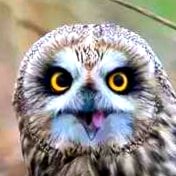
This was taken during last nesting season. This GHO was spooked by a hawk that was trying to harass its nest. The photo was a little overexposed, but I actually love how it caught her making this funny expression.
Subject: Great Horned Owl Location: Philippe park, Safety Harbor, FL
Gear: NikonUSA
Software: Affinity
Pre-Flight Boobook
From Rob Clay
A big flight for a small owl. Tasmanian Boobooks at Cape Liptrap preparing for their nonstop, overnight flight back to Tasmania. 29/09/26
That looks like a flight of at least 150 miles / 250 km. Those wings are going to be tired!
Pygmy Owl Prospects for Prey During a Period of Precipitation
From Henrik Nilsson
A pygmy owl looking for prey during a light rain shower. Pygmy owls are small but they're capable of taking down surprisingly large prey in comparison to their body size.
Canon 1Dx with a Canon 600mm f4 and 1.4x extender. 1/500 sec, f5.6, ISO 1250. Feb 2015.
School Helps GHO Stuck in Soccer Net
Sharing our spaces with wildlife is not always as simple as it sounds. The reality is that the human world is not perfectly designed with wildlife in mind. Everyday objects and activities can sometimes create unexpected hazards for the animals that live alongside us. Knowing what those hazards are and, just as importantly, knowing what to do when wildlife needs help can make all the difference.
At the end of August, staff at Erie Day School discovered a female Great Horned Owl entangled in a soccer net. Great Horned Owls often hunt for prey in open fields, and when they are flying at night in pursuit of prey, they may not see soccer nets in their path.
Thankfully, the school staff recognized that the owl was in trouble, knew to contact Tamarack Wildlife Center, and arranged for her admission.
Upon arrival, the owl received a full examination, including X-rays. Fortunately, there were no broken bones or serious injuries to her body. However, hitting a net headfirst at a high rate of speed can cause a concussion, and the owl was showing signs of traumatic brain injury. She would need rest, time, and medication to recover.
During her rehabilitation, she received daily anti- inflammatory and pain-relieving medication. She was an exceptionally spirited patient, showing a strong drive to return to the wild as soon as possible.
Once her course of medication was complete and she demonstrated physical fitness, she received a final pre- release examination. With rehabilitation successful, she was ready to return to her home in the wild.
Incidents like this remind us that sharing our communities with wildlife sometimes means being prepared for the unexpected. Knowing what to do and who to contact when a wild animal is in trouble can make all the difference for patients like this owl.
Stumbling onto a Spectacle
From Robert Arellano
The Spectacled Owl (Pulsatrix perspicillata) is one of my favorite owls in Costa Rica. I don't get to see owls very often, mostly because I'm terrible at spotting them, so whenever I get the chance to see one it feels pretty special. (Fun fact: this is only the second owl I've ever seen in my life, and the first owl I've posted)
These are large, powerful owls with dark brown heads and white markings around their eyes, which gives them their "spectacled" name. And, like many owls, he was giving me that intense death stare
Sarapiqui, Costa Rica
Buffy will be Eating Well Today!
From Chelvan P Tamil
Now that's a Fish Owl! Papa Owl, Hampstead Wetlands
Dramatic Flair
From Iowa Raptor Project
We are loving this photo of Little Horn sunbathing during his annual catastrophic molt! Many species of birds will molt all of their head feathers at once to replace them with healthy new ones. He looks very dramatic. 😀