
Wild Pikachu Appears (and a separate Lightning McQueen sighting)
Just saw this while leaving the gas station. No further details.
While I'm here, we've also had this Lightning McQueen in the neighborhood for a bit now.
Just saw this while leaving the gas station. No further details.
While I'm here, we've also had this Lightning McQueen in the neighborhood for a bit now.
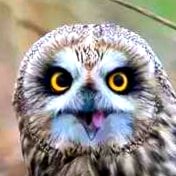
From Raju Karia
Short-eared owl [Asio flammeus]
Rajkot, India
Mar -17
From Rebecca Taylor
I can't go somewhere new without trying to find some new owls to photograph. This one was top of my list.
Spectacled Owl
Remanso Teles Pires Lodge in Brazil
From North Sky Raptor Sanctuary
One tuft up, one tuft down - life is all about balance. 🦉😀
Fun fact: Even though these tufts look like ears, they're just feathers with no role in hearing. The real ears are hidden openings on the sides of the face.
Went to toss the squirrels and birds their evening handful of peanuts yesterday, when this guy in the far end of the yard caught my gaze.
Photos aren't great, he was pretty far away, and the photos are my phone through cheapo binoculars, free hand.
Still a beauty, and a nice surprise for me.
It's a melanistic Eastern gray squirrel. They're some interesting theories on them in the black squirrel wiki, though a lot just seen to be guesses to me! 😉
From Dane D Ward
Female Eastern Screech Owl being woken up from sleeping by an early morning Male Northern Cardinal that was making a lot of noise.
You can see the mad look on her face even from a distance. "SOME OF US ARE TRYING TO SLEEP HERE?"
My yard
Dunnellon, Florida
From Julie Jay
Little Burrowing Owl family, I love how the parents are making a heart shape and their little baby down below.
From Henrik Nilsson
Although its near impossible to see, the short eared owl in front appeared to have something in one of its talons. The shortie behind came in for the steal.
British Columbia, Canada.
Canon R5 with Canon 600mm F4 III. Dec 2022.
From Jennifer Gordon
Someone attacked this snake with a shovel, severing his spine. Somehow, he managed to make his way to our rescue.
I write about snakes a lot. Particularly copperheads, which seem to bring out some pretty strong opinions in people.
But there's a reason I gravitate toward snakes.
They're probably some of the most misunderstood animals on the planet. And after more than two decades of rescuing animals, I've come to realize that people are often the cause of the very problems we're trying to solve.
Writing about these experiences has become somewhat cathartic for me.
For years, I kept so much of what I witnessed bottled up inside. Eventually, I realized how unhealthy that was, and I started writing about the things I encountered in my work.
As it turns out, we have some pretty interesting stories to tell.
Like this one.
Meet one of our eastern ratsnakes, formerly known as black ratsnakes.
I'm not exactly sure who gets to make all these decisions about renaming animals, but apparently someone decided that ratsnakes needed different names depending on where they live.
Because, you know, a ratsnake is a ratsnake. 😂
Anyway, I digress.
I've always had a particular fondness for these snakes.
I understand that people fear venomous snakes, even though I could never bring myself to kill an animal simply because I didn't understand it or was afraid of it.
But ratsnakes?
They're genuinely some of the gentlest creatures I've ever encountered.
Now, don't get me wrong. I've met a few feisty ones over the years, and any wild animal can become defensive when frightened, harassed, or threatened.
But I've encountered completely wild ratsnakes that were perfectly content to rest around my shoulders while I walked around.
They're fascinating animals.
And this particular snake has quite a story.
Somewhere near our rescue, we believe someone attacked him with a shovel.
The injury was devastating.
The back portion of his spine was completely severed.
And somehow, despite that injury, he managed to slither onto our rescue property.
One of our staff members spotted him, recognized that something was terribly wrong, and immediately brought him into our veterinary clinic.
I still find it remarkable that he was able to make his way to us.
And here's where his story gets even more interesting.
Despite the spinal injury, he can still move the back half of his body.
He can eat small meals, digest his food, and defecate.
Larger meals are more difficult for him because of the scar tissue surrounding the injury, but he's managing remarkably well considering what happened to him.
We recently brought him in for another evaluation while we were performing surgeries to see whether there might be an opportunity to do some corrective work.
Unfortunately, he's not quite ready for that yet.
Because of the severity of his injury, he'll never be released back into the wild.
But what strikes me most about this snake isn't just his ability to survive.
It's his temperament.
He is one of the gentlest ratsnakes I've ever encountered.
Even after everything he's been through, he's remarkably calm when we're caring for him.
I know people sometimes roll their eyes when I talk about snakes as though they have personalities. But spend enough time working with them, and you begin to appreciate just how different they can be from one another.
I can't tell you what this snake thinks about the people caring for him.
But I can tell you that he's safe here.
He's receiving medical care, he's eating, and we're continuing to evaluate what we can do to improve his quality of life.
And yes, he's loved.
I often wonder what goes through someone's mind when they pick up a shovel and attack an animal that was simply trying to exist.
I understand fear.
What I don't understand is cruelty.
This snake wasn't looking for a fight. He wasn't trying to hurt anyone. He was simply going about his life until someone decided that his life didn't matter.
And somehow, he survived.
He may never return to the wild, but his story isn't over.
From Dane D Ward
Female Eastern screech owl pulling up her pant legs to check out her fuzzy little raptor legs. **I know its a female because the babies got too big inside the nesting cavity so she perched outside of it just a few feet away. 20 feet away from her was the even smaller male.
*She's actually biting at the brood patch. But it looks like shes pulling pant legs up...I dunno. That's how I see it.
My yard
Dunnellon, Florida
From Henrick Tan
" Ochre-bellied Boobok " (Ninox ochracea)
It is endemic to Sulawesi
A medium-sized brown owl with a rounded head. Note the rufous underparts, clear white eyebrows, and striking yellow eyes. Upperparts chocolate-brown with bold white spots on the wings. Found in understory in lowland and foothill forest. (Excerpts from eBird)
Tangkoko, North Sulawesi
Indonesia
Aug, 2026
Nikon Z6 III Afs 400mm f2.8 TC 1.4
Manual, tripod
No additional lighting was used.
From Christopher Navarro
Saw whet owl
Autumn
Lethbridge, AB
Yesterday, I found a rare Melanistic Black Chipmunk! My neighbors have seen him, but this is my first sighting!
Black chipmunks are extremely rare, with melanistic individuals appearing only occasionally in the wild.
A melanistic chipmunk is simply an Eastern chipmunk with a genetic anomaly that results in excessive melanin, giving it a solid black coat instead of the usual dark-and-white stripes - in Wellsboro, PA.
From Rocky Point Bird Observatory
The first owl at the Rocky Point station was a total surprise - a Long-eared Owl! In the past several years we have been lucky to catch one during the season, but it is not a given. This owl species is particularly cryptic & not a lot is known about them here in North America. In order to safely band and weigh larger owls, we put them in a wrap which keeps them calm.
From Lewis Slavin
🦉The encounter I'll never forgot🦉
It doesn't get any better than this 🤯 Me and Ryan (the local lad) decided to wander off into the forest yesterday and after not even 5 minutes he looks at me smiling then points by a tree and there she was! 😮Just sat there relaxing, she wasn't fussed at all, just kept looking around for her next meal, so we got a couple shots & then left her be & about 15 minutes later she comes out & hunts right in front of us & then flies right over Ryan's head 🤯
This has been the 1st time I've ever seen a long eared owl let alone photo 1 and these past couple days have left me with thousands of photos but also some memories that will Last with me for a lifetime 🤩
Canon r6 mk ii
Ef 500 mk ii
1x4 extender iii
700mm
ISO 1000
F 5.6
SS-1/500
Edited on Lightroom (on my phone)
From Misty Briggs
Burrowing Owlets, Arizona, USA
From Erin Rojek
The American Oystercatcher, with its bright orange bill and striking black-and-white plumage, is hard to miss along the shore. A true coastal beauty, probing the sand for its next tasty meal.
New Hampshire
From Billy Davidson
Choking down that protein
Momma said that this is breakfast take it or leave it.
Spending time in July with these little burrowing owls is always a highlight of the summer.
Always gives us a good excuse to visit the badlands in South Dakota
The badlands is home to a lot of wildlife but the transient owls are by far our favs.
Have you ever been to the badlands? What wildlife did you enjoy there?
From Hoosier Wildlife Rescue and Rehabilitation
I'm not even going to lie, sometimes this field makes you forget just how incredible the animals in front of you really are. You see so much heartbreak, and so many impossible injuries, that you start bracing yourself for the worst instead of hoping for the best.
People ask me all the time, "What's the coolest animal you've ever had?" And I never know how to answer. The alligator Kelsey transported to Michigan? A Great Blue Heron with a fishing hook in it? A river otter?
Lately, my answer is a perfectly ordinary male barred owl. Not particularly big. Not particularly flashy. But for a while, I genuinely didn't think he'd ever fly again.
Originally brought to us by VEG with a suspected soft tissue injury, further veterinary examination revealed something far worse. Affectionately named Hootie by our veterinary partners, this owl had a nasty fracture and dislocation involving his wrist. His radius, ulna, and wrist joint had apparently decided they weren't
interested in working together anymore.
For an owl, flight is everything. His initial X-rays gave us very little reason to believe he'd ever return to the wild.
But Hootie had other plans.
Follow-up X-rays showed healing. Not perfect healing, because with an injury like that, perfect wasn't really on the table. But enough to give us hope.
And wouldn't you know it? He flew. Not an awkward flutter, either. Actual, controlled, beautifully quiet barred owl flight.
Hootie has passed his flight assessments, and we're hoping he can return to the wild while barred owls are calling to one another this fall.
Sometimes the most incredible animals aren't the rare ones. Sometimes they're the ordinary ones who surprise the heck out of you.
Thank you to Dr. M for his initial diagnosis and dedicated care, Dr. C for his continued evaluations and outdoor assessments, our raptor expert for her guidance and support, and AAA Exterminating for helping build the flight cage this year.
From Steve Gettle
"How Crazy is This?" - Giraffe Weevil - Andasibe, Madagascar
Madagascar is filled with unique and interesting things found no where else on earth. This tiny insect is a giraffe weevil it is about 1.5 inches (4 CM) This one is a male, whose neck is roughly three times longer than a female's. During mating season the males will joust with their necks (much like a giraffe) trying to dislodge their rivals from the vegetation.
Good Luck and Good Light! Steve and Nicole
Image: Giraffe Weevil - Andasibe, Madagascar Nikon Z9, Nikkor 105mm Macro, 1/200th @ f16, ISO 200, Nikon R1 - C1 Macro flash, Image cropped 5% for final composition