

Belt Holster for USB Power Supply
My FPV goggles have no internal battery, they need to be run off a 2s-8s LiPo or 5v from a USB port. This lets me use a reasonably safe power supply instead of strapping a raw lipo to my body.
My FPV goggles have no internal battery, they need to be run off a 2s-8s LiPo or 5v from a USB port. This lets me use a reasonably safe power supply instead of strapping a raw lipo to my body.
I bought a Cetus X kit last October and an Air65 shortly after, since then I have flow about 1K packs and loved every one. Learning to fly smoothly and calmly was a huge challenge in the beginning so I am pretty satisfied with 45m/week of progress. This is the Air65 in my favorite park, though the Cetus X is a pretty good fit there as well.
Photo taken at 6:32UTC from Burlington Ontario with a 4" f/9.8 refractor.
 https://www.flickr.com/photos/nicholas_m/54386723940/Open linkView original on lemmy.ca
Warning there are some tall-ass images in this post.
A few years ago I got mad enough at the temperature gradient in my town house that I designed and build a bunch of ESP8266 sensors to feed data into an RRD so that I could have some pretty graphs to be angry about as well. (As of this week I have also started logging stats from my UPS and server.) Using the minimum of HTML and CSS I threw those graphs, a map of the previous day's incoming network traffic, and some convenient links onto a homepage that I use on all of my devices. At a glance this tells me if the furnace/AC is working, if my server is having a fit for unknown reasons, and if the local power grid is playing it fast and loose with the voltage and frequency (which I suspect they do).
Clicking the temperature/humidity data leads to a long term data page covering 2 years of data in varying resolution. The gap last fall was when the garage sensor failed and I was waiting for Aliexpress.
There are also long term trends for the server load and UPS but they have only been logging for a few days so there is not much to look at.
Clicking the map on the home page leads to a text file containing a summary of all incoming traffic to apache and ssh. The ssh server is on a high port number and doesn't see much traffic but occasionally a persistent bot will find it.
Everything but my landing page (this animation in p5.js https://old.reddit.com/r/cellular_automata/comments/1djwjbu/waves_processingorg/ with the text "Hey this isn't where I parked my car" overlayed) is behind basic auth or better and I have push notifications set up for every ssh login (even my own), in 5 years I have never had a successful login from an attacker, this is not an invitation, have mercy.
All the data is gathered with python scripts and stored in RoundRobinDatabases or, in the case of network data, digested down into a CSV. The climate sensors respond to requests on port 80 with the temperature and humidity separated by a comma to allow for easy polling. The map is generated by looking up the IPs' information on Shodan then plotting the location data if it was present.
Absolutely none of this is the ideal solution, there are existing projects that cover literally every aspect plus a dozen extra features I could never hope to implement. I wrote as much as I could from scratch just to see if I could, it's more fun to drive a shitty car that you built than one you bought from the dealer.
Aaaand I accidentally made the UPS database only 24hrs instead of the 10years I had intended. Lucky for me rrdtool has a function to expand an rrd without wiping out the data!
Using a vinyl cutter and mini-sand blaster I made some alternate universe corporate schwag! I like the idea that someone might have swiped these during an interview before both companies had their 'accidents.'
I got my hands on some really weird EL panels and did a little dive into how they work. I still have no idea where to get more but I think they may be DIY-able.
I was gifted an unused Ender 3 Pro two weeks ago and managed to model and print an adapter to connect Sony E-Mount cameras onto a 42mm dovetail used by microscopes.
Bed adhesion, leveling, stringing, clearance issues, blobs and permanently welded supports, I got to battle it all but thanks to the massive volume of community support I worked my way though.
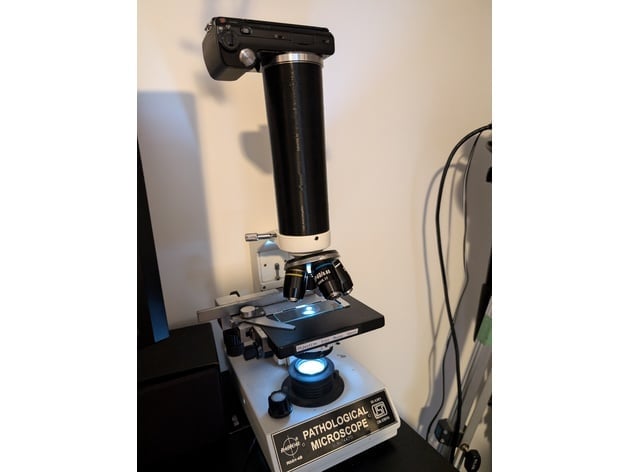 https://www.thingiverse.com/thing:6736146Open linkView original on lemmy.ca
I was given an Ender 3 Pro last week and after a few bumps managed to successfully CAD, slice and print a booster seat for my phone. The caddy as it was would grab the volume down button on my phone, this little wedge solves the issue!
I learned this week that many high speed CD-ROM drives used balancing balls on the spindle to stop discs from vibrating at 10Krpm.
Between the platter that supports the CD and the motor there is a puck with a toroidal void containing a few ball bearings. When an out of balance CD is spun up the spindle and disc together rotate around their common center of mass, some point between the spindle and the edge of the disk. This means that the void containing the balls no longer rotates around it's center, it spins like a hula-hoop around the spindle/DC center of mass. With the "lighter" side of the system being farther from the center of rotation the balls roll 'down hill' towards the side of the void that is experiencing more centrifugal force. Eventually enough balls will collect on the light side to perfectly cancel out the heavy side. If there are too many balls they will distribute themselves inside the void until they cancel out each other's weight!
The link leads to a scaled up demo of this using an empty water bottle and steel BBs.
// Randomly spawn drops
// Take a random fraction of each cell move it down, or down and to the left or right
// The remainder of the fraction stays where it is
// Subtract a constant small value from all cells to prevent rain from accumulating
// Randomly spawn drops
// Take a random fraction of each cell move it down, or down and to the left or right
// The remainder of the fraction stays where it is
// Subtract a constant small value from all cells to prevent rain from accumulating
I found a box of CD-Roms and floppy disks in my mum's basement and damnit, I want to play them! I could use emulators, DosBox or VMs but it's never quite the same as having the real thing, so between an eBay mobo and a box of old parts I managed to build my new gaming rig to cover 1990-2005.
Its running a P3 at 1GHz, 512MB of ram, and an ATI Xpert98 with 8MB of memory. As I didn't want to run an old IDE drive with a million hours on it, I tried an SATA-IDE adapter, it caused some issues during the install but that just felt like the standard Windows experience.
Though unpopular, I went with ME for 2 reasons, the first was Dos support, the second is that I went from W95 to ME as a kid, 98 wouldn't have felt the same. The install bricked twice with video drivers but I finally got it up and running with the default drivers and an 18" Samsung flat CRT (runs up to 1600x1200 at a nauseating 60hz).
So what were your favorite games from the 90's and early 2000s?
In the ruling, the judges argued the application could not be successful because of a new law, Rebuilding Ontario Place Act, 2023, that the government passed days after the court application was filed last November.
wow
Repaired some broken solder joints, sanded out the biggest scuffs and polished most of the scratches out of the screen. Oh yeah, and the paint job.
I tried to go for an 80's NES theme. Not perfect but not bad.
The two hemispheres are electrically connected to each other and to an AC power supply, the ring is connected to the same AC supply but 180 degrees out of phase. Particles are charged and then injected into the trap, they are then alternately attracted to the ring and hemispheres causing them to oscillate and become trapped! As the voltage is increased lighter particles pick up more speed until they are finally thrown free from the trap. In ideal conditions ions are all charged the same amount allowing the trap to sort the ions from lightest to heaviest, allowing you to determine the atoms that make up a particular substance.
In this model I can not control the charge on the particles but it is possible to roughly sort them from smallest to largest.
Notes: This trap is scaled WAY up, the ring had a diameter of about 24mm. I'm trapping non-dairy creamer not individual ions. The frequency this trap runs at is WAY lower frequency than that of a real ion trap. This trap runs at a much higher voltage than a real trap. Otherwise them mechanism of operation is identical to the real thing.