

Majority of Americans continue to favor moving away from Electoral College
65% of U.S. adults say the way the president is elected should be changed so that the winner of the popular vote nationwide wins the presidency.
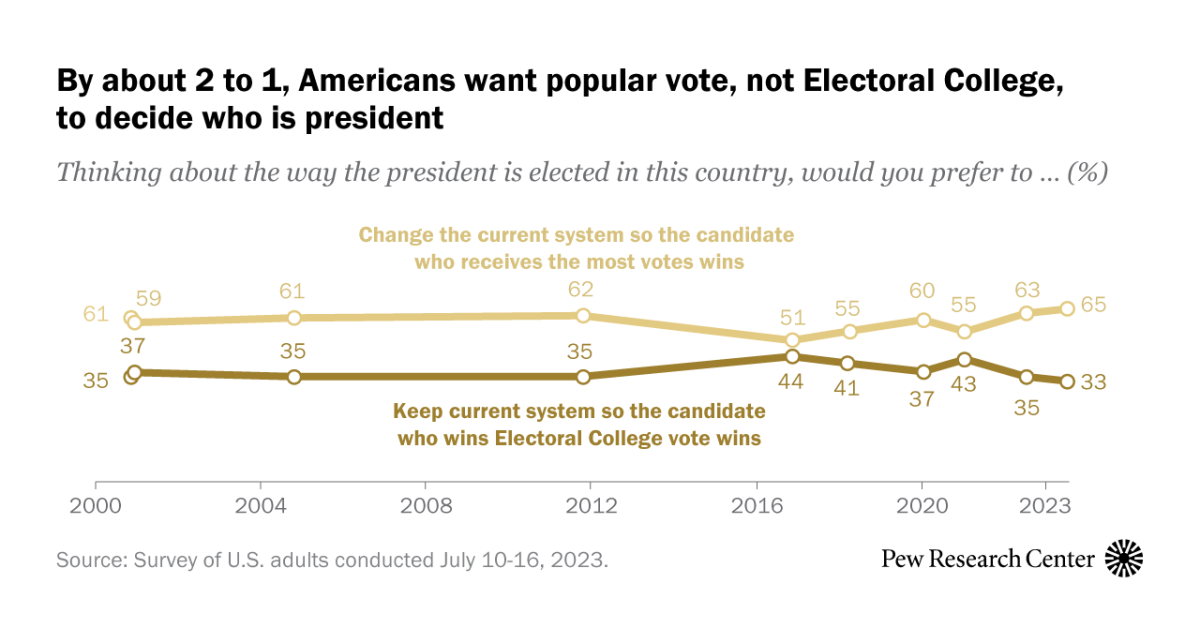 https://www.pewresearch.org/short-reads/2023/09/25/majority-of-americans-continue-to-favor-moving-away-from-electoral-college/Open linkView original on kbin.social
321 replies
It'd be nice to go beyond and have some sort of ranked voting while we're at it. Essentially being forced to pick between two parties or risk having your vote being wasted sucks.
I don't know how the american system works, but voting for small parties should not considered a wasted vote. It helps the party even if they don't get elected
It's worse than wasted. It's effectively a half-vote for the major candidate you like the least.
Works in places with coalition governments.
If a party receives 5% of the popular vote, they start to receive funding from the FEC. That hasn't happened in a while for a third party.
Well then people should organize. I don't understand why americans only vote for two parties if they don't like either of them
First past the post incentiveses two party systems, which is why people are desperate for ranked ballot, or something that can allow other parties to exist.
Because in first past the post voting, whomever gets the score first, wins. Combine that with mostly voting against a specific party, and you're railroading people into a de facto two-party system when people vote for the "best bet against _____".
45% of the country doesn't vote at all, so.
Part of that is due to the feeling that one's vote doesn't matter. IMO having the president be elected by popular vote would bring a lot more people to the polls.
Yup. In states that are not swing states, why would those voters even bother?
But even if a party gets, say, 5% of the vote and gets funding, that level of vote splitting can influence who gets a seat now. That might be fine and dandy when the short term doesn't matter too much, but right now, the stakes are very high in the US, since the right straight up wants to dismantle democracy, kill trans people, and completely ban abortions.
Those are high stakes just to likely get some more funding for a third party (much less win even a single seat).
IMO any political pressure that could go towards pushing third parties should first to towards electoral reform. Only then can third parties be voted for without putting a lot of people at risk.
Not in America. In America it's an utter waste. The elections are too close.
Unpopular opinion: ranked choice voting will do little to solve the USA's democracy issues.
For starters, there are plenty of countries that do use FPTP and still have plenty of third parties in their parliaments (Canada, UK, Taiwan, Australia off the top of my head). So FPTP does not inherently preclude third parties - rather, the USA simply doesn't have any culture of multilateralism. I'd say this is mostly a byproduct of various cultural phenomena - the wealth gap, corporate media ownership, private campaign financing, win-or-lose mindset, etc.
But the greater issue is that RCV doesn't really ensure proportionality. As long as you have a single winner from each district, there will be distortions between the proportion of parties for whom people vote and the ultimate parliamentary body. For example, even if you implemented RCV across the entire USA today, I'm pretty sure most legislative bodies would still be entirely dominated by a single party because of gerrymandering and single-member districts.
So if you want to fix the USA's core issue, what you really need is a more proportional system - either have fewer, larger districts with multiple representatives from each one, or adopt something like MMP which is what Germany has (where you also cast a party vote to declare your preference for which party you most want represented in parliament and distribute proportionally along this tally across all voters). Not only does this make the final representation more fair, but it also does a much better job of making all votes matter, instead of only the lucky few in swing states or the rare competitive Congressional race.
But RCV on its own won't do much. It is still a small improvement, and if you have the opportunity to adopt it, I say go for it. But at best, I think it would take decades, or maybe even generations, before it starts to improve things.
Also, while I know this doesn't pertain quite so much to Presidential elections as the electoral college is used for, the USA is also fairly unique in that it has a directly elected head of government with much more power than other countries that also have a directly elected head of state. This is also a part of the problem - the executive branch is supposed to be the weakest of the 3 Federal branches - but it's a discussion for another time.
Canada and UK third parties are still smaller parties, they have no possiblity of electing a head of state.
While also true in Australia, we have preferential voting as well and whilst smaller parties dont have the numbers or votes to become the ruling parties you can vote 1 for a smaller party and 2 for a major party so the smaller party gets a funding boost for future campaigns.
And also if enough people vote for a smaller party them a larger party may have to team up with a smaller party to get the majority numbers to hold government.
Then the smaller party may have a bit of clout to get some of their values and opinions into parlimertary debate or passing bills meaning we get a wider variety of input than the major party line and its members falling into line to vote with their peers blindly.
Same as I wrote on the other sibling comment. I think these countries all have terrible electoral systems. But the point is, they're still ahead of the USA in terms of the fact that they will still have an awareness and understanding of third parties, whereas >90% of Americans are just programmed to believe there are only 2 options.
As a thought experiment, ask yourself what would happen if you could wave a magic wand and make every city, state and national legislative election use RCV over FPTP. Do you really think anything would change? I'm pretty sure 95% of the results would be exactly the same. Like I said above, RCV may make things better 20+ years from now, but there's also a very good chance that so few people actually use their second options that it nothing ends up changing at all. This is why I think multi-member districts or MMP are better solutions.
Are you forgetting Ross Perot almost won? There is constant talk of Trump starting a third party, libertarian and green parties get a fair amount of attention, and not to mention the fact that the two major parties actually consist of many smaller factions in a coalition. There's a reason primaries happen, and often congressmen vote against the majority of their party and votes are split on other lines than party lines. Most people are smarter than is popular to say on the internet, they just understand voting the lesser of two evil is their best option right now from a certain perspective. I prefer to vote third party to increase the viability of third parties in later elections.
Look at third parties and their success in the UK and Canada.
The last general election in the UK was 2019. Conservatives got 43.6% of the vote but 56.2% of the seats. Labor got 32.1% of the votes and 31.1% of the seats.
The biggest national third party, the Liberal Democrats, got 11.6% of the vote but a mere 1.7% of the seats.
In comparison, look at regional third parties. The Scottish National Party got 3.9% of the vote and a whopping 7.4% of the seats. Irish regional parties like Sinn Feinn and the Democratic Unionist Party got a combined 2.3% of the seats with a combined 1.4% of the seats.
Previous elections have been quite similar. In 2015, the far right UKIP won only a single seat after getting a whopping 12.6% of the vote.
Canada is quite similar. The Bloc Quebecois consistently gets more votes than the national New Democratic Party, despite having gotten less than half as many votes.
Understood, all of these countries have terrible electoral systems, that was not my point. My point is that Americans only have a culture of voting for one of two parties, so switching to ranked choice voting will likely change nothing at all, because Americans already practically never even consider alternate options. Hell, I doubt even 10% of them could even name a third party, so why would they consider voting for them all of a sudden just because of the switch to RCV? They're constantly blasted with the same message that you have one of two options, so chances are that they'll just pick one and ignore the rest, just like they do now.
Parties work a bit differently in the US vs e.g. Israel.
In Israel, party insiders choose their politicians. If you want different candidates than an existing party is offering, you have to make your own new party with your own new list.
By contrast, in the US, parties run primary elections where voters pick the candidates. The specifics depend on the state, but in most states the election is held for registered members of that party.
Americans aren't idiots. Most know third party candidates don't do well in plurality elections. So smart progressives, alt-right etc. politicians don't run as a third party candidate against mainstream Democrats and Republicans. Instead, they primary an incumbent Democrat or Republican, like Alexandria Ocasio Cortez, or join the primary when the incumbent retired like Marjorie Taylor Greene.
Somewhere like Israel, Alexandria Ocasio Cortez and Joe Manchin would be in two very different parties. In the US, they're in the same party.
In places where RCV is passed, you absolutely see more candidates running and getting decent percentages of the vote. Because that isn't a terrible strategy any more. Someone like AOC might have run as a Progressive or something rather than primarying the Democrat.
It might give independents more of a voice.
I contest your usage of Canada as an example. While it's certainly not as polarized as the US, the effects of FPTP are still prominent. There's a ton of vote splitting at the federal and provincial levels. Eg, conservatives rule Ontario despite the majority of people voting for one of the two left-er leaning parties, since the two parties basically split the left vote down the middle, while conservatives only have one party.
I do completely agree that propositional voting is waaaaay better than ranked choice, though. Personally, I will take almost anything over FPTP, but some form of PR is vastly superior, as you noted.
But at least with ranked choice, people can start to vote for another party without it feeling like a penalty. As a Canadian, I basically have to vote strategic. I don't get to vote for my favourite party because of FPTP. Ranked choice would at least remove that issue.
I think the two party system of the US is basically where FPTP systems are all at risk to end up, especially since voting strategically gradually results in that. But the US GOP is so crazy that it's almost a necessity for any progressive to vote strategically, whereas at least in Canada, things aren't quite as bad, which makes it easier for people to take the risk of voting for who they really want to.
For anyone living in Utah, a bill to enable Ranked Choice voting will be in November 2023.
So anyone there please register to vote sooner rather than later.
Currently people are being told it's too confusing and too liberal, so they really could be more young people votes to help the cause.
RCV is a rebrand of the voting method IRV, which was used by many cities in the early 20th century. Due to inconsistent results, it was repealed. So, unfortunately, conservatives have a leg to stand on when they attack RCV.
For clarity: their specific attacks take things to the extreme and often have some racist underpinnings, but there is a kernel of truth to attacking specifically on the method itself.
That is why I support something like STAR voting, it doesn't suffer from many of RCV's issues
I wish your ballot measure luck however, because at the end of the day it still is, mildly better than FPTP
I wish for something like STAR as well, but much like voting now it's all about the lesser of two evils between current voting and anything besides the current voting method haha
Well the thing about that is, RCV has been repealed in 6 states and counting for producing poor results. And it's also given right wing groups like the heritage foundation a foothold to attack it. I'm actually seeing negative RCV sentiment on the ground when I talk to people about STAR so their message is spreading. When I explain STAR and how it fixes several of RCVs issues they come around to it, so it may in fact be better to push that instead of tag along with RCV if it's going to end up being a waste of political capital
Neat! I am all for that? What are the left or rights views on STAR currently?
I don't see it being on the radar of the major parties at the moment. RCV is in the spotlight so far. But that can change very soon because in Eugene, Oregon this week they are finishing up getting STAR on the ballot for their elections, then they're also pushing for it to appear on the state ballot in May. The effort is led by non-partisan groups like the equal vote coalition.
So far my conversations with both sides of the aisle have been fruitful, and I hope that is how it continues
Not "while we're at it" - RCV is the real change we need.
Approval/STAR would be even better, but I'd take RCV over FPTP
RCV will do nothing to break the duopoly in America. RCV will basically allow you to vote for the Democrats or Republicans without bubbling their name on your ballot.
Contrary to what is stated, RCV falls apart as soon as more than 2 parties become viable. It suffers from the spoiler effect.
RCV, like plurality voting, only reflects your preference for one candidate at a time. In fact, it's relatively accurate to say that RCV is just plurality with (literally) extra steps (rounds).
One of the better ballot changes we can make is to move to something like STAR voting, which can capture the nuance of magnitude of preference for ALL candidates at once.
However, changing voting method alone is not enough. Proportional representation and expanding the number of elected officials are two powerful ways to introduce new ideas and break up power structures.
And, of course, campaign finance reform such as democracy vouchers
I don’t think I get it.
As I imagine it it would be: Republicans HATE Democrats. Democrats HATE Republicans. If all Democrats rank the R candidate dead last and Republicans do the same for the D one, their votes pretty much nullify each other, and whatever third party that got less First-choice votes but also way less Last-choice votes has a better chance at winning. Isn’t that how it should work?
Mostly. Yes, RCV tends to elect compromise candidates, ones who may not be anyone's first choice, but that most people can live with. I think Joe Biden is a good example of this. Everyone was rah-rah for some else during the primaries: Elizabeth Warren, Bernie Sanders, Rand Paul, Mike Huckabee... but Joe Biden has broad tepid appeal.
I prefer score ballots over ranked ballots, expressing magnitude of preference is important!
Ranked choice specifically is one of the worst ranked ballot options out there and I hope we can push for something else
Isnt that what ranked choice is? Expressing magnitude by ranking your choices?
No, it's not.
Given ballot options of Socialists, Democrats, and Republicans, I'd rank them 1, 2, and 3, respectively. However, when expressing my feelings about the election: I love the Socialists, dislike the Republicans, and prefer the Democrats slightly over the Republicans.
This nuanced opinion isn't captured on a ranked ballot.
With a score ballot, like STAR voting, I'd give the Socialists 5 stars, the Democrats 1 star, and the Republicans 0 stars. This method not only captures my preferences but also the depth of my feelings for each party. This is then reflected in both the final score and the automatic runoff step of tabulation.
Ah. Gotcha. That makes sense, thanks for explaining!
Reminds me of the Blackadder episode where Baldrick won by 16,000 votes, even though there was only one voter:
Let's just cut out the middleman and go straight to direct voting.
Vote directly on the issues that matter to you. Representative democracies only exist to protect the ruling class.
Ranked choice still doesn't solve the winner-takes-all situation that is the presidential election. Instead it should be appointed by a group of competent people, who in turn are voted in by something like ranked choice or whatever.
The original intent from the Constitution was that the winner was president and the second place was vice president. Since the vice president also is the tie breaking vote in the Senate, that doesn't sit very well with the president. So they changed it to the running mate system.
The group your talking about would essentially be the cabinet? Right? They get approved by Congress. So indirect approval by the people.
The cabinet doesn't appoint the president, so no. More like Congress members members get voted in by ranked choice, and they vote on someone to represent the country in international affairs.
BREAKING: group of people whose only chance of getting elected is relying on the Electoral College not thrilled about the idea of abandoning the Electoral College
It's a great idea until it affects them lol
Yeah, dawg forbid they change their platform to, you know, appeal to a majority of Americans...
Ranked choice voting please.
My state Congress is getting ready to vote to outlaw Ranked Choice....
Probably because they know if it gets implemented they will get tossed out. What a shame.
What the point of that? Since you'd need the votes to make it a thing anyway you'd have the votes to change the law too, right?
Came here to say this.
Part of this piece has an excellent insight into the dichotomy of the Republican Party. Of those highly engaged with politics, only 27% want to ditch the electoral college! These people understand the party is unpopular and the tactics used to hold power are a necessary way to get their policies.
The rest of the group feels otherwise, probably NOT because they don’t care if their candidate gets elected, but rather that they don’t understand how crucial it is to their party (along with gerrymandering). And their first gut instinct is that popular vote is justified/rational/logical whatever.
Now for a little thought experiment: What would happen if this became an actual campaign issue? I’d put my money on those 27% being able to convince the rest of the party how important it is, flipping their view. Maybe I’m wrong, but since many R voters tent to put self interests above all else, it logically follows that they’re just not understanding how critical the electoral college is. If their talking heads went on air/TV each day and stopped talking about how immigrants are stealing jobs or poor people are taking their hard earned money, and instead focused on the importance of the electoral college, they’d flip. Not because they think it’s right or justified. Because they think it’s best for themselves and their party. And it’s the current rallying cry.
Now apply this across an entire party, with those highly engaged telling the others how to vote, what to think about policy, and what the outcomes will be. Bring together uneducated people already susceptible to misinformation, and pair them with intelligent and extremely vocal/active groups who can sell snake oil like the best of them. Take that minority vote and put some real numbers behind it… likely not enough to get a majority, but enough to win a sophisticated electoral college or gerrymandered district.
they probably wouldn’t even try and hide it: they’d literally just come out and say the electoral college helps keep the democrats out and they’d vote for it
Good point. It’ll likely take three words to get a lot of those people to flip: own the libs.
Sometimes I forget how little value some people place in consistency of beliefs. Small government! Except ____. Ad nauseam.
They already have these talking points. They used them when Hillary won the popular vote.
Tyranny of the majority, nobody would have to listen to rural Americans ever again.
It's all bullshit obviously. But it cut through to moderates last time it made the rounds. And these are swayable voters I'm talking about.
The (European) centrist part in me think the “less engaged” Republicans are those who like the central right-wing ideas (small government, less taxes etc.), but don’t like how crazy the current Republican party is, and since they have no real representative they identify themselves as “less engaged”. Those people would probably prefer for the electoral college to be abolished so that the current Republican party never gets elected again and they’re forced to shift to candidates that are actually sane in order to win back votes.
…but yeah, your analysis might be correct too, those “less engaged” people could also be MAGAs that just don’t understand how they wouldn’t win an actually democratic election.
I’m sure you’re right about some people. They’re feeling abandoned and disgusted by what’s supposed to have their support and ideologies in mind, therefore not as active. That makes sense.
I know there are a lot of good/reasonable people who just want the government to play a smaller role in society and I think that’s a necessary part of any well-functioning system. And I agree with the sentiment in specific applications. Hopefully there is a way forward for those types to force a change for the better from the current GOP. Because it’s gone off the rails.
Yes, I think the rabble would quickly fall in line against changing the electoral college. We saw them growing more accepting of LGBT people for a few years only to whiplash back to homicidal hatred once their high priesthood started ranting against the gays again. These poll results are kind of like an interesting Freudian slip though: like you said, when they're not paying attention a majority of Repubs can organically move to the reasonable opinion before the elites can apply their brainwashing again.
Americans, lobby your state to join the National Popular Vote Interstate Compact!
https://en.wikipedia.org/wiki/National_Popular_Vote_Interstate_Compact
The better plan would be institute the Wyoming Rule or something similar to it. The HoR is simply too damned small which not only limits the number of EC votes it also has the representative to citizen ratio fucked up 90 way to Sunday.
We broke the EC in 1929 by capping the size of the HoR and it's well past time to fix it.
Republicans would never win a nationwide election again. They'd actually have to come up with policies people want. Not gonna happen anytime soon.
I've had family that votes Republican say this, they will literally defend the minority vote winning. They see democracy as "mob rule." Well, if a bunch of rich assholes getting to decide who's president, and a system where the people with the least votes win, how is that not mob rule?
We have lots of minority protections in place to avoid mob rule and the tyranny of the majority. The Electoral College is the tyranny of the minority.
And yet, none of them will support using an Electoral College to elect the governor of their state. I guess mob rule is fine when it comes to governors, senators, mayors, and sheriffs, but not presidents.
"As long as the party I identify with is in charge then it's fine."
It's really not surprising when they support going full dictator.
The cons really showed their hand more recently when arguing over things like suppressing the vote, and mail-in voting and telling everyone that "voting is not really a right enshrined in the Constitution".
Well, tell us how you really feel.
Wait, are you implying that only crafting policy around what the elitist of the elite want and waging stupid performative culture wars for the clueless gop base is unpopular with most Americans?
If the president was chosen by popular vote, I think you could make a reasonable case that the last Republican president would have been George H.W. Bush in 1988. George W. Bush did win the popular vote against John Kerry in 2004, but he lost it to Al Gore in 2000 so it's debatable whether or not he would have beaten an incumbent Gore in 2004 I think.
And now you see why the Republicans are so against it. They can’t win in a straight vote.
I could also make a reasonable case that election strategies would have changed to more populist stances to accommodate for that.
Bush did say if the popular vote mattered he'd have campaigned in Texas. Changes the entire landscape.
And Gore in California, New York, hell the whole east and west coast (aka where voters live)
That's the whole point of this discussion
Pro-citizen means democracy
National Popular Vote Interstate Compact
Napavointerco
The Wyoming Rule, or something like it, would solve a lot more problems than just the EC.
My vote would finally matter. My state already knows who it's supporting with or without me.
yeah, the 'vote!' stuff is hard to stomach living where i do, which went red on TV literally the minute polls closed
And so, neither party is going to bother trying to court your vote: one can take you for granted, and the other will write you off. So I hope you have the same concerns as Pennsylvania, Michigan, and Arizona, because that's what you're getting.
And the votes of the flyover states become an after thought.
Tue votes of the flyover states would matter exactly as much as the votes of any other arbitrary subsection of the country with the same number of people. That's the point.
Exactly. Now any Democrats in flyover states actually have their vote matter.
Fun bit of trivia: which state had the most Republican voters in the 2020 election? Answer: California had more R votes than Texas or Florida or any deep-red state. But neither party gave a shit what California Republicans wanted: Democrats knew that the Electoral votes would go for Biden no matter what, so they didn't need to campaign there or court anyone's vote. And Republicans knew that there was no way to get even one of those Electoral votes, so their time and money was best spent campaigning elsewhere.
Y-you're telling me that gasp LAND DOESNT VOTE?!?!
You are so obtuse i would be amazed if you can find a chair that fits.
Exactly!
Why would you want people to decide their countrys future when empty landmass could do it?
I hate this argument. There are still a lot of votes in the flyover states. The electoral college doesn't disadvantage flyover states anymore than not having an electoral college disadvantages those living outside of the major cities in a state wide election.
Republicans still win the Ohio governor's election despite 5 major metropolitan areas in the state.
Also there are Republican votes in New York and California that get discarded currently.
This isn't a game, this is just making the thing fair.
When you've become accustomed to privilege equality feels like oppression.
The "fix" for the problem of equality isn't removing voter power from the flyovers it's ADDING voter power to the large coastal states like California and doing it is so damned simple. Uncap the size of the House of Representatives by changing the Re-Aportionment Act of 1929.
The Wyoming Rule doesn't go far enough in my mind but it's a good starting point.
Maybe, maybe not. It would depend on the districting process in each state. We'd certainly see new Republican's in Congress from California but we'd also see new Democrats in Congress from Texas.
I think what they're speaking to is how such a change may alter the course of a presidential campaign. As it stands, there's this notion that a candidate has to try and have broad appeal; they need to spread their campaign out a bit in order to "capture" the electoral votes of a state.
Sans the electoral college, I see presidential campaigns becoming even more polarized and exclusionary. The Democrat campaign will become the "big city loop." Continually visit Los Angeles, San Francisco, Chicago, NYC, and Miami. Maybe they slide in a few secondary metros if it's convenient. The candidate won't have to worry about any non-urban messaging, and if they're particularly incendiary could even preach "dumping those hicks in the sticks."
Conversely, the Republican campaign (not even considering the existing insanity) becomes "everywhere else." They can push the message of "big city Democrats want to destroy you" even more convincingly.
Such an outcome strengthens the "not my president" sentiment (on either side), and just further aggravates partisanship. I'm not saying eliminating the electoral college is a change that could never be made, but I definitely think this is a bad time. It will feel like exclusion and alienation and in politics perception is reality.
For the obvious follow-on question "when is a good time," I don't have a pat answer and I can't even speculate if that will be in 4, or 12, or even 20 years. But it needs to be a time when there's far less immediate friction between the two leading parties, or it's just going to be another wedge opening the divide.
The problem with your whole argument is that ultimately it comes down to the fact that the literal minority might be unhappy that they didn't get pick the winner over the will of the majority, and that might make them feel that it's exclusionary to them.
By definition, the majority will actually get their chosen candidate as president. Do you know what strengthens "not my president" sentiment? Having a privileged, autocratic minority choose the president, overriding the will of the voters.
That's currently not the case: in most states, the vote isn't close, so we know before the campaign even begins how most states will vote. There's no reason for Republicans to appeal to Kansans, because Kansas will vote R no matter what. Likewise, there's no point for Democrats to appeal to Kansans because it won't do them any good.
There's a word in politics for a candidate who wins in big cities, and nowhere else: "loser".
Check the demographics. Get a list of the 20 biggest cities in the US and add them up. You'll see that's only about 30% of the vote. So even if you somehow managed to get everyone in the big cities to vote for you, including children under 18, felons, and people on student visas, that still wouldn't be enough to determine the election.
Just in passing, there are more Republicans in the California sticks than the total population of several other states. If the president were elected by popular vote, candidates could no more ignore those voters than California gubernatorial candidates can, today.
Well, our campaigns are ridiculously antiquated with the campaign season being kicked off in....Iowa? And silly photo-ops of them eating county fair food and so on, as if that is somehow representative of America in the past several decades.
Sorry, most people are not farmers, and it's absurd to pretend as if that is "middle America".
It would make far more sense to kick things off on the coasts. Where all the people are.
I think it's a farfetched concern.
If you're still voting based on whether or not someone visited you or not I'm also giving you exactly 0 sympathy. It doesn't matter, that's just a show. Jason Aldean can visit all the county fairs he wants, that doesn't make him a real country boy or mean he's "with you." The same is true of a politician. What you should care about is how their policies affect you and the rest of the country.
Not to mention areas already have disproportionate representation via the Senate. If you can't get your case across to the majority of the county or by senate representation... maybe you don't have a very good case.
We should be trying to convince a majority of people about something, not forcing some arbitrary "win" that allows a minority to have disproportionate power over the majority in multiple areas of the country. We're closer than ever to having "taxation without representation" as is, and it's getting worse (Gore only had ~500,000 more votes, Clinton had ~3,000,000).
That's 3,000,000 people that didn't get their voices heard at all, and that Trump promptly told to go pound sand (even in the face of a natural disaster https://www.forbes.com/sites/alisondurkee/2020/10/16/trump-administration-refuses-to-give-california-federal-aid-for-wildfires/?sh=304cb4cb3416).
Except they can say whatever politics they feel like that day, and the average American is neither smart nor informed enough to predict how policies will affect them.
The only solution is to go back to supporting ethical politicians instead of the ones who are best at saying what you want to hear. And that will only happen if we start actually educating citizens instead of just teaching them to check educational boxes.
Well on that I can agree
They are already advantaged in both the house and the senate. Why do they need advantages in literally all elections to feel they are treated fairly?
How?
Everyone gets 2 senators, and then 1 house rep for every so many people.
Not quite, the number of house reps is not strictly proportional to the population of each state. California has 704,566 people per house seat, while e.g. Wyoming has 568,300 per house seat. This means a Californian house vote is worth roughly 80% of a Wyoming house vote.
That's a great joke.
Right, because Kansas's vote should hold the same weight as New York or California even though there's less people that live in Kansas?
No, but a Kansan's vote should have the same weight as a New Yorker's or Californian's, or even a Pennsylvanian or Michigander. Not all Kansans vote the same way, and it would be nice to have a system that recognizes this.
And that's okay.
So its bad if peoples votes in densly populated places don't matter, but it doesn't matter if people voting in sparely populated areas don't matter?
But those people's votes each matter the same without the electoral college?
The money and politicians will focus on the large urban areas, because that will maximize time and money invested.
People in rural areas will not have the capacity to affect things at all.
They get to vote, don't they? They just don't get to have their vote given extra privileges just because they live in a sparsely populated area, that's all.
What extra privlages?
Everyone gets 1 vote as it is now.
Two things I'd love to see. Eliminating the electoral college and then getting rid of superdelegates. Two fundamentally anti-democratic concepts.
Well superdelegates aren't exactly something the government can legislate away because they're just an internal thing of the DNC.
Abolish parties.
How?
How do you do that without violating the First Amendment right to freedom of association?
Ranked-choice voting.
Don't forget "ranked-choice voting".
My goodness, yes.
Under the 2018 rules, in the Democratic National Convention superdelegates can't participate in the first vote and can participate only in a contested convention. Seems reasonable to me.
Wikipedia also reminded me about this little bit of Bernie hypocrisy that I'd forgotten about: "Sanders initially said that the candidate with the majority of pledged delegates should be the nominee; in May 2016, after falling behind in the elected delegate count, he shifted, pushed for a contested convention and arguing that, 'The responsibility that superdelegates have is to decide what is best for this country and what is best for the Democratic Party.'" Talk about unprincipled political opportunist.
Yes Bernie is an unprincipled political opportunist.
Who’s this dude like casually smoking a cigarette in what appears to be some kind of war zone.
I can disagree with something Bernie said, but still be a huge supporter of his for his many other things I fully agree with. I maintain that superdelegates being in place to deal with a contested convention is still a bad thing and undemocratic. The real unhelpful part was when the DNC chair stated that it can also quell unintended grassroots efforts. I thought grassroots efforts were an example of a good thing about democracy, not a bad one.
Bernie Sanders is emphatically not a Democrat and doesn't want to do any of the work of building or supporting the party, but when he decides to run for president, he suddenly wants the party's money and infrastructure, only to abandon the party ASAP after the election. He may be fine as a senator, but as a presidential candidate, he's just so utterly loathsome. He's got major entitled old white man syndrome and it makes me lose absolutely all respect for him.
If you're on to a contested convention, you can't directly reflect the will of the primary voters in the first place (because they didn't pick a winner) so I can't really find any reason to object to superdelegates, most of whom are elected Democrats and already literally representing their constituents in Congress, etc.
They will never allow that because it'll kill the entire republican party lol
Won't be good for Democrats either. System is rigged for two parties and two parties only.
This would not really change the two party system. All it would mean is that you genuinely need a majority of votes and not the majority of a weird convoluted combo of states.
It would destroy the party system. Suddenly there's a progressive democrat party and the freedumb caucus becomes it's own thing.
I'm game for that.
First-past-the-post voting systems result in two conflicting parties. This would entrench the two party system. The current system is not good, but popular vote is only slightly better.
The difference is in what the voters want.
Both parties wouldn't be for it, but liberal voters would be for it. Conservative voters would be against it.
You'll have to pry it from their cold, dead hands.
You mean their hands the way they are now? Glitch McConnell had a death grip on that podium....
Right. Their cold dead hands.
You can't convince me Joe Biden is actually alive. You can't. He died on the campaign trail, and he's being Weekend at Bernie's-ed by his staff.
There's not a substantive difference in his policies if he's alive or dead...his whole platform is not Trump.
The electoral college was created at a time when faster-than-horse communication didn't exist. It made sense then, but has not grown with the times.
I fail to see how it ever made sense.
The year is 1780. The printing press is the pinnacle of technology, there's no such thing as an adding machine. Most correspondence is done on parchment with a quill pen. The majority of Americans cannot read or write. Information cannot travel beyond earshot faster than a galloping horse. Elect a president by popular vote. You have four months.
That's not even it. At the time the Constitution was adopted, there were states like Virginia that had a lot of people, but rather few voters. They were afraid that they wouldn't have a real say in who the president was. The Electoral College was a way to inflate slave states' power, and entice them to join the Union.
The whole thing is absurd and overly represents rural areas and Republicans. We already have a huge problem with the "2 senators per state" thing and the House representing Republicans far too much in relation to their numbers.
I'm 100% okay with the 2 senators per state thing. That's a feature, not a bug. Even though cities are on the right side of history right now, I don't want to completely silence the rural vote forever.
However, arbitrarily limiting the number of House reps is absolutely absurd and counter to the purpose of the House. That is a bug.
Well, then, maybe we should start considering splitting up some states and joining others together then. A place like California is more future-minded and it's where a great deal of the people are, as well as much of our economy. Also, it's where a lot of our food is grown. And it gets 2 Senators.
The 2 Dakotas have more than that, and what do they really represent for the future of America and the world? More fracking?
Maybe states with really large masses and hardly anyone in them are combined. Idaho, Montana and Wyoming - one state. North Dakota, South Dakota and Nebraska, another.
Again, you're intentionally defeating the purpose of the Senate. The entire point is to give rural, less populous areas more of a voice.
Seems like giving one group more power than another group would be bad for equality.
That's why we are supposed to have House members representative of pure population, and not land. Senate gives more power to rural areas, House gives more power to urban areas. It's supposed to even out. Checks and balances.
It's crazy how many people in this thread don't seem to know the absolute basics of how their own government is structured and why.
The only reason the Senate is such a problem right now, is because the House of Representatives needs to be properly reapportioned so it's actually representative.
On this, we definitely agree. The House is being held down to an arbitrary number and it is patently absurd.
It feels like a compromise from a period of time that is no longer relevant to these times when we are trying to push this country into the future. I don't want rural regions to have more of a voice, FFS. Look at what it is doing to this country. Having fewer people have an equal say with the majority of the people is also not great, the majority should win out. Why the fuck should tracts of land be voting?
We should never completely silence the voice of a group of people for all time, even if right now they're pushing some heinous shit.
Part of the reason for the phenomenon of Trump was the failure of politicians to care about the legitimate problems that rural voters have.
In any case, if the House and Electoral College functioned like they should, the majority would win a lot more often. Don't focus on the Senate, focus on the two institutions that weren't designed to give rural people an outsized choice but have been manipulated to do so.
I don't think anything proposed here by anyone would do that? What is being proposed is to stop prioritizing the votes of people occupying vast tracts of land over the majority. To have a vote cast by someone in the hinterlands equal someone's vote in more populous parts of the country is putting them on par with everyone else. I'm not so sure what is so magical about someone living in a remote area that their interests should not align with everyone else's.
It's nothing magical. They will inherently have different priorities, and they deserve a voice in the political process.
How is it no longer relevant? Do you know where your food comes from?
You seem to have a fundamental misunderstanding of how the legislative branch of the US government is structured, and why.
Your concerns are valid, but you're not aiming them at the correct House.
I'm not understanding the food part here.
I understand the history of compromising with states that had less (free) people because of slave states; I'm saying it's no longer relevant in modern society. It turns out rural areas are usually better represented by Democratic policies in any case. Ironically.
That'd be an easier sell if the rural areas less consistently used their voice to shit up the world.
True, but it's not always guaranteed to be that way. We should never give one group absolute power.
The Republicans are the main reason we still have it .. they know they'd never win if they had to play fair.
But but but why should cities get to determine everything? Don't you know that not only does land vote, everyone in a patch of land votes the same? So, why bother giving everyone in a city a vote, you know?
Also, be sure to let the vice president cancel the whole thing if they don't like the results.
(Please tell me my sarcasm is obvious.)
We should just abolish the Senate. With the current formulation of the US government there's no reason why a State should have extra power like that. Let the people make the rules. Expand the House, abolish the Senate, and remove the electoral college. And since we're wishing for things that will never happen anyway, go ahead and use some kind of proportional vote (ranked choice, star, whatever, just literally anything but FPTP).
Instead of tilting at the windmill that is removing the EC how about we do something much easier and simpler and simply expand the House of Representatives? Not only would this add votes to the EC and make the Presidential Elections more representative it would also, you know, make the HoR more Representative! For extra fun it would also diminish the returns of gerrymandering since there would be so many more districts.
All we need is a change to the Re-Apportionment Act of 1929. There is no good reason that the size of the HoR is fixed at 435. None.
you should lead with this
In 1929, each representative represented about 283k Americans. Now each representative represent about 762k Americans. That's almost a 300% increase. This means each American's voice is only about 1/3rd as powerful as it was in 1929. To have as much political power as they did in 1929, we'd need about 1200 Representatives.
And yet, having more representatives fundamentally reduces the power of each as well. Your vote is fundamentally worth less as the population increases. Something you're just gonna have to come to terms with.
I'm ok with my vote meaning more or less as long as it's the same vote everyone else gets...that's not the case with the current system.
I don't see a problem with that.
Would there be any way to have everyone keep the same voting power while the population tripled?
Sure, you just define the problem differently. Instead of saying that there are X representatives in total, you just say there should be 1 representative for every 283K citizens. In this way the number of representatives naturally scales with the population.
This is basically what the Wyoming Rule does. It sets the ratio in the lowest population State, currently Wyoming, as the ratio for everywhere. Wyoming currently has 500,000 people and 1 Representative. That means the HoR would expand to something like 580 Seats.
We could change the math, and the name, to the "1929 Rule" and set the ratio 280,000 to 1. I'm actually fine with an HoR that has 1,200 people in it but either way the Re-Apportionment Act of 1929 needs changed and the HoR needs expanded.
Good point - it's not about power because everyone else also gets that extra power up. It's about equity.
And we can achieve now that through fairness in redistricting.
That's a long way around to get to fair representation. It amounts to a distraction from the real issue.
We can achieve that now through fairness in redistricting.
There are only so many ways to divide 435 seats while still guaranteeing at least 1 seat per state.
No you can't.
Your way doesn't return the ratio of EC votes between the HoR and the Senate to what it should be. It keeps it stuck in 1929 and every year that goes by makes it worse.
Your way doesn't scale the number of total EC votes as our population grows.
Your way ALSO doesn't return the ratio of Citizens to Representatives to anything resembling sanity. Ratios of nearly 800,000 to 1, and growing, are irrational and break Democracy.
You could redistrict the ever loving hell out of the other 49 States but Wyoming would keep it's 3 EC votes and its outsized vote for President. It would keep it's outsized influence in the HoR and it would keep it's ranking as #1 in the Citizen to Representative Ratio.
So much of what everyone hates about our Federal Government today is DIRECTLY tied to a vastly undersized HoR. The body is simply too small to adequately represent a population of over 300,000,000 people.
Unfortunately the elected representatives don't care what the majority of citizens want.
Hell, a good chunk of the citizens vote for people that don't support their lives or values. It's fucked top to bottom.
That good chunk would be democrats and republicans
I don't disagree. The only real power us peons have is voting, and we are really, really shitty at voting.
We are not shitty at voting, we are shitty to keep supporting the right wing duopoly. Not voting is a choice, and voting 3rd party is a choice. If the 76% of democrats that do not want Biden to run voted 3rd party they would win. People choosing to vote their fears instead of their conscience is whats holding us back
Otherwise described as: being shitty at voting.
When you say majority, do you mean by popular vote, or...
I propose the National Popular Vote Interstate compact. Cgp grey has an amazing video on it. It's a "petition" of sorts that basically says that states that sign it will have its elective representatives vote with the majority vote of their said state.
Here's the video if anyone wants to watch it: https://youtu.be/tUX-frlNBJY
The "founding fathers" would be against the electoral college today too. The electoral college was an idea to try to get the people to directly vote for the president.
The electoral college was necessary because it would have been logistically impossible for people living in 18th and 19th century America to be able to participate in a single-day one person one vote election, given their level of technology at the time.
We live in the 21st century. We have instantaneous means of communication via the internet making designating an elector to travel to Washington unnecessary, a greatly expanded infrastructure via roads and mass transit for people to travel to polling places in a reasonable amount of time in a day, computers that can tally the ballots many hundreds of times faster than a human being can, and vastly expanded capacity for handling the logistics of running a nationwide election including a complex bureaucracy dedicated to oversight and enforcement of voting laws and regulations.
The electoral college is an archaic system whose only purpose has been completely supplanted by modern technology. Any notion of rogue electors defending the republic from authoritarians and populists is not only historically false, but given the fact that they failed to prevent exactly that situation from happening once already, laughably ineffective.
That had nothing to do with it. It would have been extremely easy for people in each state to count the votes for that state, then bring those vote totals to the capital where those state-totals are added together to get the final country-wide count. The problem is that that kind of simple, one-person one-vote system means that each vote would be weighted equally, and in some states there was a large portion of the population that couldn't vote but the state's decision-makers still wanted that portion to affect how much say that state had in choosing the President.
So basically, the Electoral College is there because of slavery.
You are correct, of course. Based on the writings of the founders at the time they established the system, it was clear that the system was never intended to be a democratic one in the first place. They didn't trust each other and they certainly didn't trust uneducated rural Americans with the power to select the chief executive.
The fact that they couldn't agree on whether or not to count a slave as a full person for the purposes of counting population is all the more reason the system should have been swept away ages ago.
They could, however, agree that a tax on tea-smugglers was worth starting a war and killing thousands over.
The election is not and has never been a single day affair. People like Trump are just trying to make it into one because it gives them a better chance at winning.
I didn't mean to imply it was. Just that before America was well developed with sophisticated infrastructure, it would have been a tall ask to have voters in rural areas show up at a specific location at a specific time to vote. It would have taken counties several days to collect all of the ballots, tally them, and hand them off to someone who then had to report those results to the state, and then after all the counties reported in the state would appointed an elector to go to Washington on horseback to deliver the results in person. Electors made sense at the time - it funneled the communications down to a single official entity, rather than trying to organize the election centrally and delivering ballots from the far corners of the United States delivered to Washington DC to be counted and certified.
We could cut out the electoral college and very little about our voting process would change, it would just eliminate an archaic and historically anti-democratic system that works behind the scenes to contribute nothing of value in our current society, aside from being a very tantalizing point of failure that has already been targeted by election fraudsters.
Also, there have been times where electors got the names wrong lol. Imagine losing because somebody put your name wrong. I mean I guess there's precedent for the supreme Court picking a winner already. God I hate this country.
The electoral college exists because the founding fathers didn't want normal people voting for president. The whole point is to isolate people from directly choosing a president.
There was also the little problem of logistics back then.
Which is why there's still a ton of delay in the process. There's about a month between voting for electors and them voting, and several months before the president was inaugurated.
And it worked better before information was so easy to obtain.
I don't think this is true. The commonly cited reference is James Madison's Federalist Paper No. 10, I'll provide the relevant excerpt and a Wikipedia link, though I'll urge caution as they aren't authoritative sources by any means. Bolding is mine.
Preamble
Cherry-picked quote cited by Garry Wills
EDIT: Here's where I first heard of the argument that the US is not a democracy (in the sense it's thought of by everyday use, as opposed to the Greek which involves the concept of demos. He's a Marxist, thought it might be relevant and wouldn't want to waste your time only to figure it out later.
EDIT EDIT: I didn't even make my point, whoops. I think the founding fathers were not unaware of the current state of affairs of the electoral college being probsble, rather it was included by design.
I feel like while the electoral college is an issue, it's the gerrymandering that is ultimately the biggest issue.
And in fact probably also contributes to the electoral college issue.
The senate is pretty bad too.
In theory we could expand the number of house seats so that more populous states get more reps and everyone has a more equal number of voters per congressperson. I think that would not only help make the house more fair but would also make the electoral college more fair (since the # of electors increases with the number of house members). Not as good as the popular vote, but it’s an improvement that doesn’t require a conditional amendment.
Although it’s somewhat inconceivable to some people that the US can have more than 50 states (and that DC isn’t what it once was), don’t forget about representation for DC and Puerto Rico.
Both which operate very much like state entities now, making a pretty good argument for true federal representation with proper voting power.
Representation for DC would be harder to justify, but if a party actually pushed for it Puerto Rico statehood would have a fair chance.
The US has less representation per capita than most developed nations.
To be fair, it's also the most populous developed nation.
What you're talking about is the Wyoming Rule or something similar to it. We fucked up our Government and we really really need to get rid of the Re-Apportionment Act of 1929.
Gerrymandering only directly impacts the House, while the EC biases the presidential vote, and state sizes bias the senate. All three elected branches are badly selected and all three are biased towards the Republicans. Hard to say the House is more important than the presidency though.
Some more fuckery with the house: Each state is supposed to get at least one representative, plus another representative per every so many people, right? And historically the house has expanded to fit the growing population, right?
That's not how it works anymore. They stopped expanding it when it was obvious the Republicans would never have a majority in the house ever again. Go look at the algorithm they use to determine how many representatives each state gets.
No.
The size of the HoR was set in 1929 and since then the Democrats have controlled it for multiple years at a time. Heck at one point they were in control of it for 45 straight years! There's been a number of multi-year stretches since 1929 where Democrats controlled BOTH bodies.
https://www.spokesman.com/stories/2020/jun/25/control-house-and-senate-1900/
The Re-Apportionment Act of 1929 that fixed the size of the HoR at its current 435 is a big chunk of the problem with the EC and quite a few other things. It needs to be undone.
That was entirely intentional though?
It was a bad idea necessary to bribe the small states into joining to keep the colonies together in a time with more important issues. The EC's population bias was also intentional, it doesn't make it not fundamentally undemocratic.
And the admission of states has always been very political. They have been often admitted in pairs to maintain political parity of the time and other proposed states (the state of Sequoyah) were rejected for political reasons (balancing east-west states or just racism, you decide). There's a reason statehood for Puerto Rico, a territory with more than enough people and no historical impediments like DC, isn't just a formality of waiting for a request by its people.
The Founding Fathers made a quite good first draft for modern democracy, but they weren't oracles and they made compromises based on the political needs of the day. There's a reason we don't install American democracy in countries we regime-change.
Democracy wasn't intended, I agree with that, but I don't think many wanted an entire democracy either, it wasn't just about states wanting power but also about minority representation. I personally prefer a constitutional system to a democratic system.
I mean, sure. They were also slaveholders. This is just trivia not something speaking to what should happen in the current day.
Because the constitution was the charter, the binding contract underwhich previously separate political entities agreed to be governed. You can't just change my rental contract to kick out my roommate midway through my term without following an established process we both signed on.
Talking about the constitution protecting minority representation at anything but the state-vs-state level or acting like it's a personal contract any of us at any point voluntarily entered into or could have rejected if not structured in this way is a laughable diversion. How it was made and that it exists as the current law of the land is irrelevant in a discussion of its current failures.
Again, there's a reason we don't implement it in other countries. It persists here because of inertia and cynical resistance by a minority party that can't win governing power without it, but it's not a good system in a country that purports to gain moral justification for its government through all of its citizens being equal.
I don't really understand how we fix gerrymandering. Districts can sue the state for making their elections more competitive, less competitive, or a perceived slight. Every time maps are drawn, 99.9% of districts become less competitive, offering a safer win for both of the two major parties where they expect to win. Strategically voting for third parties that can put Ranked Choice in place is... Possible, but incremental.
So yeah it seems like ending the electoral college is less complicated. It seems very popular with most people and half the politicians.
First we need a federal initiative/ referendum system. Because the existing politicians will never vote to limit their own power.
After we have this, we can start with initiatives that set maximum ages, fix the voting systems. Fix Roe. Dismantle the terrible stranglehold the two party system has on getting anything done.
Do all the things that are popular but politicians will never do.
there is absolutely no valid argument to do anything that isn't simply tallying all the votes. because of course that's how it should work
It makes sense from the perspective of early America, which initially wanted a confederate system.
It doesn't make sense now that most people consider themselves American first and their state is just the place they currently live.
The EC can work but make it a contest for each electoral vote, and remove the states from the equation entirely. California being safe blue and Texas being safe red don't matter, each district is counted for one electoral vote, and the states don't get extra votes anymore.
That just seems like popular vote with extra steps. I'm not sure, but I feel like mathematically there would be no way in which the result of the EC would differ from the popular vote under such a system. I suppose it might still be possible to skew it far enough to shift the outcome using some extreme gerrymandering.
It is a popular vote with extra steps. That's literally what it is.
The extra steps mean that politicians can't purely focus on population centers, rural communities would count for the same vote. each district should be of similar population size, and every district counts for one.
This:
seems to run counter to this:
As an example, lets say you have a rural area with 1000 people in it, and you decide that each district should contain 1000 people, so that entire area is one gigantic district. Nearby you have a city with 10,000 people, so you split the city into 10 districts. That city still counts 10 times what that one giant rural area does. The only way I can see where you could make the rural area count for more is with extreme gerrymandering where you snake little bits of every rural area in to include a chunk of the city population thereby diluting the strength of the cities vote by smearing part of it over the rural areas.
I see absolutely no reason why we should adopt a system that exists solely for the purpose of making gerrymandering possible, and I see no reason why doing things this way would make any difference over just using the popular vote if you aren't gerrymandering.
Apparently you are unaware of ranked choice voting systems, because there are certainly reasons that electing by popular vote is a bad system.
Not a fan of the EC, but this is a bad take imo.
Many democracies don't have the people directly vote on their leader. Parliamentary systems typically have the people voting for a representative who will then vote for the Prime Minister on their behalf.
Representative Democracy exists for a reason.
Something something, “Never be deceived that the rich will allow you to vote away their wealth.”
I would modify the electoral college rather than get rid of it. Make it so that states are obligated to assign their electoral votes to candidates in proportion to the number of votes received. For example, Maryland might go 60% blue and 40% red, so they would give 6 of their 10 votes to blue and 4 to red.
This would de-emphasize the importance of swing states, not completely disenfranchise rural voters, and would return a result that more closely mirrored the popular vote. It might also pave the way for a 3rd party to be relevant if the stars aligned elsewhere.
Might work for MD size states, but most smaller even EV states would split their EVs evenly, even if the state voted 60/40 one way or the other -- while odd EV states would always cast a net vote for the winner.
For example, using the 2020 election numbers Trump would win if the election included only the following states:
I don't know that it's any nobler to for electoral influence to discriminate on the basis of even states and odd states than swing states vs safe states. Unless you're also one of the group wanting to expand the legislature until there are no 4 and 6 EV states ...
Direct voting should be the end-goal of a democracy.
You mean referendums?
Not sure what the guy you replied to meant, but I don't think we should have referendums about every little thing. I know some of the stuff that pops up in my friend's state's referendums they say they don't feel qualified at all to vote on. But I agree that major stuff, like who gets to be President, probably should be direct voting.
I asked what kind of direct voting. Referendum is direct voting on laws.
It's direct elections. Direct voting is more broad.
Gotcha, I misunderstood.
Why?
What differentiates it from mob rule?
By "the electoral college" most people seem to mean that each state has influence disproportionate to its population, because every state gets two electors regardless of size. Ignoring that that is independent of the electoral college, disproportionate power isn't where most of the problem arises. The problem is that most states do not allocate their electors proportionally to how their citizens voted. Almost all states give all electors to the majority winner in the state. It's not required to do it that way, and Maine and Nebraska allocate at least some of their electors based on the proportion of the vote.
If states allocated their electors solely based on the proportion of votes in the state, that would achieve what a national popular vote would achieve and more. For example, Trump won despite losing the poplar vote, but if states had instead allocated their electors proportionally to voters within the state, Trump would have lost.
Why do this instead of a national popular vote? First-past-the-post voting systems result in two party systems with a lot of conflict. Ranked choice systems elect representatives that are more agreeable to everyone. A national popular vote entrenches a bad system, making it harder to ever get a rank choice system.
More importantly from a pragmatic standpoint, it's much harder to get a national popular vote implemented. To work, almost all of the states would need to get on board, but there's no individual-level incentive for citizens of a state to agree to it. Why would the majority of citizens of Montana agree to send their electors to the national popular vote winner when it's likely not the person they voted for? How are you going to convince them to join? The majority of people there won't want that, so they won't pass the law.
If states allocate based on proportion, individuals won't be concerned that their votes will ever support a candidate they don't like. It also doesn't matter whether other states hop on board. Maine and Nebraska are proof of this. They changed their allocation schemes without regard for any other state. At the individual level, the choice is easy; no one wants their vote to go toward a candidate they don't like, and the current system AND the national popular vote system both do that. If you think about your own views, are you in a state that the majority of the time the majority of people vote for a candidate you don't like? Wouldn't you rather have your state allocate proportionally? Are you in a place where the majority of the time your state goes the way you do? Are you happy that your neighbors' opinions are suppressed? It's pretty easy to get on board at an individual level, so that makes it easy to pass within a state.
People should give up on national popular vote and focus on getting their state to switch to proportional allocation. If you really want progress, target some key states: Florida, Ohio, Texas, Michigan, Arizona, Georgia, California, New York, Pennsylvania, Illinois.
They told me in high school that the electoral college was still necessary because counting the popular vote was too hard...
Every other country in the world manages it but the Americans fuck it up. Like healthcare.
Every other country in the world?
Did you forget places outside Western Europe, Canada, and Australia exist?
And Japan, and New Zealand, and Eastern Europe, and…
I live in a Central European capital with worse healthcare than the US. (I have lived in both countries and have elderly relatives living under state funded healthcare in both systems.)
First, there’s a big difference between cities in both places. I could believe that if you compare California to Bratislav, but Oklahoma to Vienna would already be a different matter.
And in any case, it depends how much worse it was. In the US, even if it’s “state funded”, you have to pay for it, and quite a lot. Chances are if you went to a private clinic in Central Europe paying that same amount of money you could’ve gotten the same, if not better treatment.
I might as well just say it, I'm mostly comparing Louisville, KY and Los Angeles to Prague, Czech Republic and a midsized city in Poland. I have relatives who travel to the US for treatment because at least in CZ the elder care in hospitals is abusive/negligent.
Edit: To clarify I've lived in Kentucky and Czech Republic, but spend a lot of time in Poland and Los Angeles because of family/personal ties.
I mean, I can believe public hospitals in Prague not being top-notch, but flying to America to get treatment seems surreal. Like, that’s a lot of money and I can’t believe for that amount they couldn’t find a private to do it better in CZ or at least in Germany.
I haven’t personally been in America so you’re probably more knowledgeable than me under that aspect, but from all the shit I’ve read online I don’t get why should anyone from Europe go get treatment there instead of a Scandinavian country.
Did your teachers perhaps get their college diplomas in the 1870s? Because that predates the first tabulating machines being invented. Add that invention to the telegraph machine (ca 1837), and you've got a stew going.
I wish I was kidding! My school district wasn't too bright.
You're either in your 90's or 100's, or that was a complete lie.
Oh I know it was a lie. My school district sucked.
No. It's because states that have huge populations would choose the president with basically zero say from most others. Technically a non representative government.
Except using the popular vote means that States wouldn't decide who was president like they do now, the people would.
Under the current system if I vote Red in Chicago I just completely wasted my time. Cook County is so blue that I don't have a voice. Get rid of the Electoral College, however, and now my vote worth just as much as everyone elses.
People seem to think that if we moved away from the College that the population of a blue state will 100% vote blue or a red state will only have red votes. It's just not true. The northern half of California or the southern half Illinois votes way different than their counterparts.
The Electoral College is an outdated system designed for a time when the US had relatively low Literacy and the public couldn't be reliably counted on to be informed. There is no excuse for it nowadays.
You solve the 'problem' of 'tyranny of the majority' by having a strong constitution and good rights and protections for minorities, not by switching to the indisputably worse option of 'tyranny of the minority'. Because that causes the exact same problem, but for even more people instead.
The version of the tyranny of the majority that he's warning against is already solved in the American system. The ward against it is the Senate. Every state has exactly 2 votes in the Senate and no legislation can be passed and enacted into law without passing a vote in the Senate.
The senate is a terrible way to deal with it though. But it's at least better than the EC.
The issue is while a strong constitution is nice, it's necessary to have at least some people in office who would respect the constitution to be effective, including at least a partially originality supreme court.
Alternatively, more clearly written constitutional laws. It's wild that you have judges who cannot agree on what an article of the constitution really means, and the language should have been amended years ago.
In the Netherlands, we have a clearly written constitution, but no real 'supreme court' in the American sense. And that setup seems to work quite well.
Agreed some should be clarified, but a lot are pretty clear but are denied as unclear for political reasons. One obvious example is the 2nd amendment of the bill of rights. Also, keep in the mind the US constitution is the oldest constitution still in use, so language does evolve somewhat.
So instead, states with populations smaller than some cities get to completely override the will of the majority of the country.
What do you mean? They do matter? A democrat doesn't campaign in California not because it doesn't matter but because they know most Californians will already vote for them, same with Republicans in Texas
Every vote past 50% just then wouldn't matter at a national level. Yes it would increase the total number of votes that voted for the winning candidate, but it would also centralize power more into cities.
States with more diversity of opinion have more say. Seems reasonable to me.
Why should states have more say? We elect the president nationally. It's not a state election, or it shouldn't be.
Because we have 50 of them and not 350 million. It's a simple and effective way to get a weighted average.
Why should there be a 'weighted average' for a federal election?
Because there's a lot of people that don't live in cities and they need different things from the people that live in cities.
What we have now is non-representative. Rather, it's representative of land, not voters.
Horse feathers. There are 535 total EC votes and only 100 of those come from the Senate. The other 435 are come from the House whichis based on population.
The solution to this mess is to upsize the HoR and tilt the ratio back to where it was prior to 1929 when we fucked it up.
Whatever else, I'm sure we can all agree that the current performative, pro-forma electoral college meetings are not what was intended by the framers.
This could be either a fake or a real ad by those people. It is amazing how hard it is to distinguish parody and real news theses days.
UPDATE: For some unknown reasons, this comment appeared under the wrong article. I've seen the "Electoral College" article, but didn't even open it, so this is not even a case of "postet in the wrong window" or so.
What? Seriously, what? What are you talking about? Who is “they,” the Pew Research Center?
For unknown reasons, my reply appeared under the wrong article. So no, there is no connection of what I said to the topic of "Electoral College".
Ok, no worries! Kbin and lemmy sometimes just freak out, so it’s all good. Thank you for clarifying!
I fucking hate how Americans divide politics between liberals and conservatives. The pollster could have at least given a third 'neither' option.
This was more of a valid argument when Republicans were winning elections. I think we should keep the electoral college as long as there's a republican candidate that wants to overturn our democracy.
I don’t think it should be eliminated completely. I think each state should award their points proportionately. That way no one is disenfranchised.
Noone is disenfranchised. By choosing to elect an executive nationally it only makes sense to popularise the vote. Why should Wyoming citizens have more sway than California (per capita)
That's only happening because the size of the HoR was set at 435 in 1929. Fix that and suddenly Wyoming's 3 EC votes would be a drop in the bucket...even per Capita.
Yes and you'd have a giant congress with an inflated salary budget. The problem is definitely the ec.
Democrats in Texas might as well not even vote under the current winner take all system. If the electoral points were awarded proportionally then Clinton would have won against Trump.
EC needs to go lol
Yep
Pure popular vote = only large population centers matter because most of the people live there, meaning politicians can safely ignore rural areas that provide all of the food to the cities because they don't matter votes-wise. Terrible idea for a large country that doesn't (net) import its food. This also ignores the fact that stupid, easily manipulated people are also allowed to vote.
Electoral college = rural areas have a disproportionately large voice as they should, but large cities are now neglected. Rural votes are also easily influenced by bad actors, like how China is trying to buy African votes to have a bigger say in the UN.
Except nowhere is homogeneous. There are red voters that live in cities and there are blue voters that live in small farming towns. Right now they don't have a voice because they are separated into districts that are overwhelmingly red or blue
but get rid if the College and now suddenly your vote is worth just as much as your neighbors, regardless of where you live.
They already do. Politicians only focus on swing states, and the cities within those swing states.
They may on occasion visit rural areas, but 9 times out of 10 they are in a city when they are campaigning.
All votes should count equally. Anything less is bullshit.
I don't understand this common argument and the framing that comes with it - as if they are doing it for free or for altruistic reasons.
Oh for fucks sakes, it isn't going away, so you can stop fantasizing about something that won't happen.
Learn to win by the rules of the game.
In basketball you don't win a game by scoring the most 3-throws. The game is won by scoring the most points. Period. Stop acting like we don't have a way to win. If one side is gaming the system, then find a way to work around it. Clearly they were smart enough to game the system, so find a way to game it back. Goddamn it these polls are incredibly annoying. Americans will find any excuse not to vote.
Every day we get closer to the National Popular Vote Interstate Compact getting triggered, effectively killing the electoral college. Doomerism isn't going to get us anywhere.
If the system is gamed then it needs fixed. Which it is and does. Our elections should not be gamed.
That's not really what's happening here. Americans are frustrated that their votes are essentially meaningless if they are not in a swing state, and that the value of your vote is dependent on where you live.
All votes should be equal.
One more time.... It. Will. Never. Happen.
The electoral college is here to stay and it isn't going anywhere. All the downvotes in the world aren't going to change that. So either learn to win elections with it, or shut the fuck up and go away.
That's what people said about landing on the moon and airplanes.
No. It's the NPVIC that'll do it.
Nope. I'm always going to advocate for an electoral system that makes sense instead of the abomination we have now.
People want something better, telling the majority of Americans to shut the fuck up and go away is childish. We need reform.
I've heard a lot of "nevers" in my lifetime. Legalizing cannabis. Overturning Roe.
Sorry dude, I just replied to another one of your comments that I totally agree with you on, but I do not see this ever, ever, ever happening.
Here's why: It takes more guts to break such a long held tradition than the Democrats would ever be willing to show. If they win power again, they will always kick the can down the road.
And it isn't going to happen if Republicans are in power. No way. Because they know it helps them win, so why would they ever change it?
This is similar to the talk 2 years ago about expanding the size of the Supreme Court to dilute the conservative vote. There was seemingly a new article on it posted every other day and how supposedly it could be done, blah, blah, blah... then the second that Biden got into office, everyone forget about it.
Eliminating the electoral college would be a far bigger change, so the chances of it happening are zero. People need to move on and the Dems need to find a way to win with the EC in place.
The electoral college is good because it stops mob rule from taking over America and doing tyrannies against the minority of wealthy entrepreneurs.
💀
It's an extremely tiresome troll account.
You're a stupid dumbass.
America wasn’t set up to be run by popular votes, for a reason, by the wise founding fathers. Do you hate the foundational tenets of liberalism?
From what I can gather, and this is after reading the letters from John Adams to his family and between himself and Thomas Jefferson, the wisdom of the founding fathers is suspect at best. They were neither fools nor geniuses, and they were contending with the issues of their time they best they could.
Many decisions were seriously entertained such as allowing George Washington, or rather the office of the President, as a lifelong term. They seriously considered the most oddball and seditious concepts we would revile today. They also changed the goalposts on what we think of as sacred tenets. They did not create the perfect union or the perfect republic. They simply did the best they could and adjusted their views as situations arose. I think that was perhaps the wisest thing they did out of everything.
To sit there and set in stone the concepts from 200 years ago under circumstances that look little like what we face today, is incredulous and idiotic.
For those reasons, I called you a stupid dumbass. Historic tenets are great and all, and widely vary. The United States of the late 1700's was not the United States of the mid 1800's, and is radically different than our United States of today.