
Spyke

Posts

privacy·Privacybyvarsock

Unveiling the Surveillance Potential of Targeted Advertising Data

The article discusses the use of targeted advertising data by government agencies, particularly focusing on how a technology consultant demonstrated the security risks posed by Grindr's data to national security agencies. It highlights the widespread availability and potential surveillance applications of advertising data, as well as the government's interest in obtaining and utilizing such data for intelligence purposes.

Why is this worth the read? It goes into detail how these data exchanges work and the mechanisms of obtaining such data. We often hear about the result of these actions, but how these actions are performed are described within.

(clear your cookies to read the paywalled article)

Unveiling the Surveillance Potential of Targeted Advertising Datahttps://www.wired.com/story/how-pentagon-learned-targeted-ads-to-find-targets-and-vladimir-putin/Open linkView original on programming.dev


72

What are some pros and cons of your DIY cable labeling approaches you have tried?

Hey everyone,

I wanted to poll the community and pick up tips on DIY cable labeling and management.

At work, we label both ends of Ethernet cabels using a Brady Label maker. They are awesome but run about $200 USD.

I don't need such an expensive device to create (one-time) 40ish labels.

I was hoping for DIY suggestions that balances durability and ease of installation. Was thinking tape, sharpies, or even thick zip ties etc. Some forums even suggested bread ties (but I'm concerned they will fall off in hard to reach places). And sharpies are great but can wear on some materials (like those plastic sticky tabs for books and notes)

What are some pros and cons of approaches you guys have tried?

EDIT:

I was pointed to this video which suggests you:

  1. Grid up a piece of paper so each rectangle's height is the size of a circumference of a cable. It will later be wrapped around the cable.
  2. Then hand write the labels.
  3. Cut out each label/rectangle.
  4. Then use clear masking tape slightly larger than the label to secure it to the cable by wrapping it around the circumference of the cable.

The finished product looks like those shrinking labels where the label is flush against the cable and text is behind a clear film and can't be smudged.

For those that suggested borrow the label maker from work or print them at work: that has occured to every one of our engineers on staff and now our printers are locked away and are signed out bc we would always find them either low on ink/toner or more frequently out of lable paper. Yes, ordering those supplies is negligibly cheap for a budget at work but the issue lied in whenever you picked up the label maker at work, you immediately had to either change the roll or ink. sigh this is why we can't have nice things :)

View original on programming.dev
privacy·Privacybyvarsock

Data broker’s “staggering” sale of sensitive info exposed in unsealed FTC filing

Below is a disturbing amount of information data brokers have ammased from buying your data from trackers in ads and apps.

"a staggering amount of sensitive and identifying information about consumers," alleging that Kochava's database includes products seemingly capable of identifying nearly every person in the United States.

... can access this data to trace individuals' movements—including to sensitive locations like hospitals, temporary shelters, and places of worship, with a promised accuracy within "a few meters"—over a day, a week, a month, or a year. Kochava's products can also provide a "360-degree perspective" on individuals, unveiling personally identifying information like their names, home addresses, phone numbers, as well as sensitive information like their race, gender, ethnicity, annual income, political affiliations, or religion, the FTC alleged.

... target customers by categories that are "often based on specific sensitive and personal characteristics or attributes identified from its massive collection of data about individual consumers." These "audience segments" allegedly allow advertisers to conduct invasive targeting by grouping people not just by common data points like age or gender, but by "places they have visited," political associations, or even their current circumstances, like whether they're expectant parents. Or advertisers can allegedly combine data points to target highly specific audience segments like "all the pregnant Muslim women in Kochava’s database," the FTC alleged, or "parents with different ages of children."

Data broker’s “staggering” sale of sensitive info exposed in unsealed FTC filinghttps://arstechnica.com/tech-policy/2023/11/data-brokers-staggering-sale-of-sensitive-info-exposed-in-unsealed-ftc-filing/Open linkView original on programming.dev
105
privacy·Privacybyvarsock

US lawmakers introduce surveillance reforms intended to curb FBI spying

For all you USA peeps:

A bipartisan team of U.S. lawmakers has introduced new legislation intended to curb the FBI's sweeping surveillance powers, saying the bill helps close the loopholes that allow officials to seize Americans' data without a warrant.

The bill follows more than a decade of debate over post-Sept. 11, 2001, surveillance powers that allow domestic law enforcement to warrantlessly scan the vast mountains of data gathered by America's foreign surveillance apparatus.

US lawmakers introduce surveillance reforms intended to curb FBI spyinghttps://www.reuters.com/world/us/us-lawmakers-introduce-surveillance-reforms-intended-curb-fbi-spying-2023-11-07/Open linkView original on programming.dev
106
privacyguides·Privacy Guidesbyvarsock

US lawmakers introduce surveillance reforms intended to curb FBI spying

A bipartisan team of U.S. lawmakers has introduced new legislation intended to curb the FBI's sweeping surveillance powers, saying the bill helps close the loopholes that allow officials to seize Americans' data without a warrant.

The bill follows more than a decade of debate over post-Sept. 11, 2001, surveillance powers that allow domestic law enforcement to warrantlessly scan the vast mountains of data gathered by America's foreign surveillance apparatus.

US lawmakers introduce surveillance reforms intended to curb FBI spyinghttps://www.reuters.com/world/us/us-lawmakers-introduce-surveillance-reforms-intended-curb-fbi-spying-2023-11-07/Open linkView original on programming.dev
102
rust·Rustbyvarsock

The First Stable Release of a Memory Safe sudo Implementation

The sudo-rs project improves on the security of the original sudo by:

  • Using a memory safe language (Rust), as it's estimated that one out of three security bugs in the original sudo have been memory management issues
  • Leaving out less commonly used features so as to reduce attack surface
  • Developing an extensive test suite which even managed to find bugs in the original sudo
The First Stable Release of a Memory Safe sudo Implementationhttps://www.memorysafety.org/blog/sudo-first-stable-release/Open linkView original on programming.dev
64
privacyguides·Privacy Guidesbyvarsock

Any benefits in buying and setting up a cellphone while traveling to a country with strong(er) privacy and RF emission laws?

I have a device that reached end-of-life support and I'm burned out loading ROMs to extend it's support. Upon from my return from the trip I plan on purchasing a new device anyway, so buying one while traveling is also an option.

I'm traveling to a European Market that has stronger privacy rules GDPR and their devices must have lower SAR (regarding phone RF emissions).

Regarding RF and SAR

My carrier frequency bands in my home country are supported by European phones I'm looking at (Android and Apple). But do the phones dynamically manage the RF emission based on locale or are the limited at hardware or software?

Would purchasing the device abroad have an effect I think it does when I bring it home?

Regarding Privacy

This one is tricky, typically the account (gmail or Apple ID) is associated with the locale. If I were to create a new account and set up my device while abroad, will this have lasting effects? I have a friend who have immigrated and set their devices up abroad and their locale is still their OG country. One of them changed locales (for android) because spotify (app) wasnt available in their home country locale. So I speculate this is a solid approach if I were to do so.

I know I might have issues with availability of content (downloading from app stores). But as far as accounts go, my Spotify (and netflix if i stil had it) account is associated with my home country so I will still be able to watch shows in my locale. Being able to download the app is the limiting factor but there are ways to get around that with side loading.

So yeah, if anyone has experience with this and could call out some things I didn't consider or validate my expectations, would be appretiated.

View original on programming.dev
17
c_lang·C Programming Languagebyvarsock

What are approaches to write unit tests on code whose function is dependent on the underlying system or configuration?

Unit tests are meant to verify the functionality of isolated units of code. When dealing with code whose output depends on the system or system configuration, what are approaches to write effective unit tests? I feel this problem plagues lower level systems languages more so I am asking it here.

I solve this by writing "unit tests" that I then manually compare to the output of my terminal's utilities. It is the quickest way to verify units work as expected but it is obviously not automated.

Making a container or a VM to run integration tests seems like the next easiest way, not sure if there are other cost effective ways.

Scenario

Say I have a function called

get_ip_by_ifname(const char *if_name, struct in_addr *ipaddr)

Inputs:

  • string of interface name
  • pointer to variable where the returned IP address will be

Returns:

  • -1 if interface does not exist,
  • 0 if interface exists but has no IPv4 IP
  • 1+ if interface exists and has at least 1 ip addr (some interfaces have multiple addresses, only 1st is written to ipaddr buffer)
Test Cases and their dependencies
  1. Interface doesn't exist
    • easy to test, use uncommon interface name
  2. Interface exists has no ipv4 ip address
    • requires the underlying system to have a unique interface name which I need to hard code and compare to in my unit test
  3. interface exists, has 1 ipv4 ip address
    • requires underlying system to have the uniquely named interface with exactly 1 uniquely defined ip address. Both of which I need to hard code into my test
  4. interface exists, has 1+ ipv4 ip addresses
    • similar to item 3.

The way I might test something like this works is write a test that logs each case's output to the terminal than run ip -c a in another terminal and compare the info in the 2 outputs. I verify it works as expected manually with very minimal setup (just assigned multiple IP addresses to one of my interfaces).

I would like to test this in an automated fashion. Is there any way that wont be a time sink?

View original on programming.dev
9
auai·Actually Useful AIbyvarsock

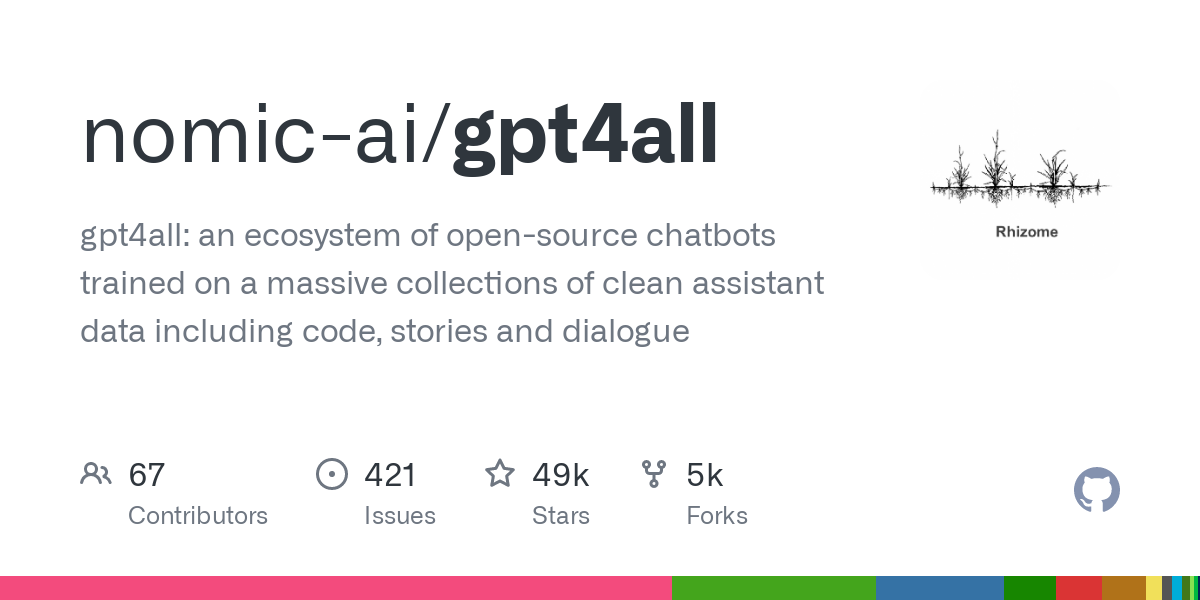
GPT4All is a free-to-use, locally running, privacy-aware large language model that is a 3GB - 8GB file that you can download and query. No GPU or internet required

Wanted to share a resource I stumbled on that I can't wait to try and integrate into my projects.

A GPT4All model is a 3GB - 8GB file that you can download and plug into the GPT4All open-source ecosystem software. Nomic AI supports and maintains this software ecosystem to enforce quality and security alongside spearheading the effort to allow any person or enterprise to easily train and deploy their own on-edge large language models.

GPT4All is a free-to-use, locally running, privacy-aware large language model that is a 3GB - 8GB file that you can download and query. No GPU or internet requiredhttps://github.com/nomic-ai/gpt4allOpen linkView original on programming.dev
210
meta·Programming.dev Metabyvarsock

FYI: Lemmy.world and other instances were hacked. Beehaw.org took itself down to mitigate risks

Drawing attention on this instance so Admins are aware and can address the propagating exploit.

EDIT: Found more info about the patch.

A more thorough recap of the issue.

GitHub PR fixing the bug: https://github.com/LemmyNet/lemmy-ui/pull/1897/files

If your instance has custom emojis defined, this is exploitable everywhere Markdown is available. It is NOT restricted to admins, but can be used to steal an admin's JWT, which then lets the attacker get into that admin's account which can then spread the exploit further by putting it somewhere where it's rendered on every single page and then deface the site.

If your instance doesn't have any custom emojis, you are safe, the exploit requires custom emojis to trigger the bad code branch.

https://lemmy.world/post/1292303Open linkView original on programming.dev
419
programming·Programmingbyvarsock

Twitter traffic appears to be declining since the beginning of the 2023 calendar year

https://radar.cloudflare.com/domains

Source of this is from Matthew Prince, Co-founder & CEO of Cloudflare posted at 11:34 Jul 9,2023. It was posted to his twitter (@eastdakota). Not linking to twitter bc don't want a deadlink next time twitter makes API changes. And not to drive traffic to twitter :D

Edit: July 11th update, arstechnica published a detailed explanation

https://arstechnica.com/tech-policy/2023/07/twitter-is-tanking-amid-threads-surging-popularity-analysts-say/

View original on programming.dev
438
asklemmy·Asklemmybyvarsock

With rumors Meta wants to federate with ActivityPub instances, what say you about instances having Terms of Use policies preventing use of volunteer contributed content being monetized (for example)?

I am not one for policies restricting choice but I fear the situation where Meta sets up instances that become big, say like Lemmy.world. Then one day when their instance is popular, they decide to charge other instances to federate with Meta's instances.

Big corps like YouTube, twitter, Meta, etc are known to offer services at a loss to grow their service and then drop the hammer and demand payment to use what people already rely on.

I feel a policy that prevents federated corp instance from profiting early on from FOSS, self hosted, and volunteer federated servers is something to think about - though I do not know the best approach.

I like what Open Source software does with their licensing approach where you are free to view, use, and contribute but if you take you must distribute the source code to others. Some outright ban usage for profit without a license.

Obviously licensing applies well for software to prevent abuse, and I would like a discussion about what Terms of Use policies can prevent volunteer work from being abused - if any are desired.


see the following cross-post from: https://programming.dev/post/427323

Should programming.dev defederate from Meta if they implement ActivityPub?

I'm not suggesting anything, just want to know what do you think.

Here is a link if someone don't know what Meta's Threads is: https://blog.joinmastodon.org/2023/07/what-to-know-about-threads/

https://programming.dev/post/427323Open linkView original on programming.dev
108
regex·RegExbyvarsock

PSA: Use Chat-GPT for writing and interpreting regex patterns for your convenience.

With all the strengths and shortcomings of Chat-GPT, I wanted to share one consistent strength I found it has when working with regex.

  • You can ask it to generate regex patterns for known and custom things.
    • If you are skeptical it is correct (like me), you can ask it to break down the pattern and inspect why the decisions were made. If I don't understand some fields, I type up a quick test and make sure it covers all edge cases.
  • And my personal favorite, you can paste a regex and ask it to tell you what it matches to. No more writing regex and forgetting what they are for!

I don't always have the opportunity to use regex when I work and would shy away from it because it can become illegible, but now that it is so easy I find I am slapping it everywhere and I cutting down on logic when sanitizing inputs/data. The bonus is now that I'm using it more, I am becoming less reliant on having it be generated for me.

View original on programming.dev
-1
no_stupid_questions·No Stupid Questions (Developer Edition)byvarsock

what is the meaning of posts with "via programming.dev" ?

I'm still getting the hang of Lemmy and federated services.

I'm browsing the programming.dev instandce in the Liftoff app and I can choose to view:

  1. my subscribed communities on the server (currently none)
  2. Local communities on the server
  3. All (?)

I know All is not "all communities on Lemmy" but what perplexes me is I can see posts from another community that is hosted on a different server and it appears because it is "via programming.dev".

At first I thought it was because a user registered on " programming.dev " posted on another instance but I opened my eyes and saw the user's origin is no way related.

Any ideas?

EDIT:

After reading all the comments I’m pretty sure “via programming.dev” should read in the context of the post as !community@instance is known via programming.dev instance. I guess it makes it explicit which “all” I am browsing if I pick up browsing where I left off and forget I am not in the “all local”.

At this point I have only seen this on the Liftoff App for Lemmy but still trying other. Must be in the metadata and Liftoff decided to display it.

View original on programming.dev
10

You reached the end