Spyke

Replies

Comment on

we are creators

And destroyers.

Just a few months into its reign, the US regime intends to ruin decades of progress in science and space exploration:

On May 30, 2025, the White House Office of Management and Budget announced a plan to cancel no less than 41 space missions — including spacecraft already paid for, launched, and making discoveries — as part of a devastating 47% cut to the agency’s science program. If enacted, this plan would decimate NASA. It would fire a third of the agency’s staff, waste billions of taxpayer dollars, and turn off spacecraft that have been journeying through the Solar System for decades.

Shutting down a working, completely functional mission like New Horizons, in particular, that may just be on the cusp of a huge discovery - it has seen signs of a new, second "ring" to the Kuiper Belt - is the ultimate repudiation of the American self-image as explorers of the frontier. And all of this at a time when the Chinese are just about catching up to "the West" in space science prowess.

As a kid, I never understood what the Romans were trying to say with their Janus myth. Turns out that Orange Janus is simply the god of endings.

Comment on

inspired to find a man to take you for a ride to space

Reply in thread

It wasn't even a trip into orbit. Their rather short voyage was a sub-orbital hop. A low orbit of Earth requires a speed on the order of 8 km per second - Blue Origin can make about Mach 3, from what I read, which is circa 1 km per second. You go up, you go down. That's it. They don't even go particularly high (~100 km), and the apogee doesn't keep you "above the atmosphere" (LOL) for long. Given the risks, I'm not sure it's worth it, personally.

If we really want to inspire people by pointing out women's accomplishments in spaceflight and space exploration, maybe we should be talking about people like Eileen Collins (astronaut on key shuttle/station missions), Lindy Elkin-Stanton (science lead for Psyche, the first to a metallic asteroid), Maria Zuber (lead the GRAIL mission to the Moon, co-discovered the rifts in the Ocean of Storms), or Mimi Aung (lead engineer for the Ingenuity 'copter on Mars 2020). And I've only mentioned a few Americans with recent work here; the rest of the world has plenty of enterprising female space scientists and aerospace engineers.

I share the general distaste in this thread and on Lemmy generally for this sort of celebrity stunt, and I'm glad to see the criticism. I do sometimes think, however, that for a certain kind of person, Bezos and Musk are becoming associated or even synonymous with spaceflight/exploration generally, which is a dangerous association to make. People have many, diverse and very legitimate reasons for going to space - there's a lot more going on than joyrides and ego trips.

Comment on

HD 137010 b

Well. This is quite a pearl.

I don't have time to read a 16-page paper in detail, but I did want to know how the host star compares to everyone's favourite local solitary K-type dwarf, Epsilon Eridani. It's slightly less massive (~0.7 solar mass versus 0.8 for ε Eri) and quite a bit less bright (difference of about 0.1 solar luminosity), but I especially wanted to know about the age of the star. ε Eri is quite young and frothy, but the investigators here infer from the star's motion that it belongs to the thin disk, up to a whopping 10 billion years old.

So we are definitely not talking about an ε Eri-type system. So that should be mean no dust disks, no crazy activity from the star, and no newish planets still carving out their places through the system.

You've really got to wonder about such an old planet, however cold and quiescent it may be. The potential paths for climatic evolution on such a world boggle the mind, however cold it is. You could get an episodically or formerly active world like Mars, a beautifully unstable oscillatory world like Earth, or something completely different. Assuming any atmosphere, of course (safe assumption?). And that's without considering whether there are any other planets in the system.

I really wouldn't spend too much time thinking about this candidate detection, as we have literally seen just the one transit, and we will need to observe this fellow for a while to confirm the discovery, learn about other planets in the system, and so on. The investigators themselves note that the transit was shallow (meaning difficult to detect), but the good news is that the host star is fairly bright, well within reach of amateur equipment. I wonder if citizen scientists will be able to follow the transits.

Exciting times.

Comment on

Welp straight to the bin

my 250 million year old salt has expired

laughing in Martian

Yup, that's Earth alright. Rookie numbers, as usual.

well‐preserved, clay and carbonate‐bearing sedimentary fan deposit located on the western edge of the crater

This fan is estimated to have formed approximately 3.2–3.8 billion years ago when ancient streams flowed into the Jezero crater lake

Comment on

Dust devils in Arabia Terra

This is one of the best dust devil videos ever captured, IMO. Spirit used to catch whole packs of them roaming the great prairie-like floor of Gusev Crater (back when that rover was perched up in the Columbia Hills, I believe), but this devil in the foreground here shows a lot of detail, and is quite close to the camera, unlike those in old shots from Spirit. From what I recall, Percy has been able to capture some nearby dust devils in similar detail, which is unsurprising given that the Jezero region is supposed to be the windiest site we've visited on Mars... but awesome nonetheless.

Just looking at the shadows it casts is very revealing, and watching the thick white patches of the vortex really gives you an idea of the turbulence involved here. It's really cool that we can see the entire length of the shadows being cast; I wonder if this is one reason why these shots were taken near noon, rather than later in the afternoon, around the time of maximum daily heating.

For scale, the crater at the bottom left is 300 m across from left to right, so you can tell that the "foot" of the foreground devil is quite a bit bigger than Percy itself. So much to see here!

Comment on

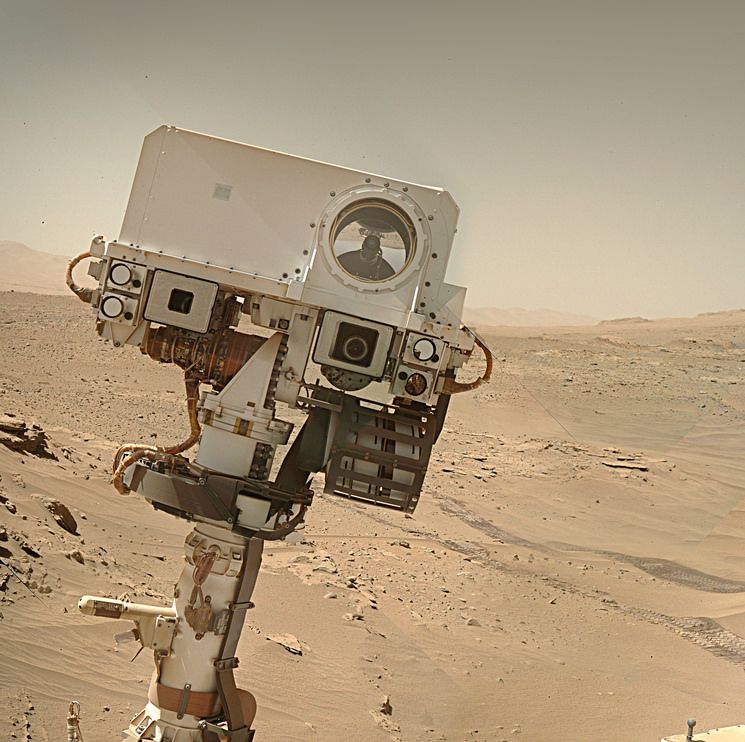
1,500 sols on Mars - Selfie

Reply in thread

Sky colors are generally weather-dependent, even seasonal in nature. During dust storms (see, for example, the disastrous global storm of 2018) the sky gets darker and muddier. Cloudy days and evenings can add some different colors, and then of course there are the famous pale blue sunsets.

The question of whether Mars gets blue skies has been debated for decades. Personally, aside from the sunsets, I don't see what conditions could produce the blue skies you find on other worlds with much thicker atmospheres; the dust just never completely settles out enough to wash those reddish tones away altogether. The debate will continue, but there's probably only one to settle it - sending humans.

I should add that there are plenty of shots with the horizon included from every landed mission, in case you're curious.

Comment on

we are creators

Reply in thread

In the USA we wasted time, money, and media resources going to the moon while black people were treated as less than citizens and millions were living in abject poverty. Not much has changed on that front for the countries entire history. What good did the moon landing do for the average man?

I'm sincerely wondering if you'd like an answer to your question. I can provide you the science perspective, if you like, not to mention a political one. Not interested in an emotional debate here, you're entitled to your point of view and your polemic, if that's all you prefer.

Comment on

Fascinating community - but why is Mars so smooth?

😃 I hope some rover drivers get to see this question - it's a very good one, just funny if you've seen the whole mission.

In the past - before Curiosity landed - NASA definitely chose rover landing sites based in part on their (presumed) smoothness and traversability (e.g. Opportunity). This was also true for the first Chinese lander.

In the case of Perseverance, the "rockiness" in this region actually varies quite a bit over fairly short distances. The terrain we've been exploring since late 2024 was chosen for two reasons: ease of traversal (when we were climbing out of the Jezero Crater) and science (our current location, Witch Hazel Hill). When we were down on the old river delta last year, though, the rover drivers had a very difficult time with terrain like this and this.

Witch Hazel Hill is smooth in part because the bedrock here is soft and easily eroded. Quite a bit of it has significant clay content, like you'd find in Earth soils, due to heavy interaction with water in the geologic past. Down on the crater floor where we landed, where the terrain is made of volcanic rocks, there are scenes like this. In the end, the rover drivers are pretty protective of their vehicle, so we tend to prefer smooth stretches for driving.

Comment on

World would be a better place

Everyone in this thread is approaching the question from the perspective of the passive resident role, and not the traveling science minstrel role.

Given that I am definitely more inclined toward the latter - which apparently makes me a tiny minority, even in this thread - I feel confident saying that I would have far more to fear from all of you than the reverse.

You may all point and laugh now.

Comment on

1644 - Another puzzling rock in Jezero

Reply in thread

It's a small boulder, comparable in length to the diameter of Percy's wheels, I'd estimate - so the long dimension is roughly 50 cm. Here's one of the HazCam shots that Paul Hammond assembled, from sol 1642:

Please keep the questions coming, everyone - they're helping me put together my link dump reference list! (I'm not promising a FAQ any time soon, but that's the way this really should go, ultimately...)

space

Comment on

Spacecraft Images of Asteroid Donaldjohanson

Always so strange and wonderful to see how these objects, entirely free of atmosphere or storm, can have such a "soft" look - with craters seemingly buried under a layer of snow or paste, or something. I wonder if that would be that be due to the phenomenon of regolith moving via "seismic shaking", which is supposed to partially bury smaller features in these asteroid landscapes. Even these preliminary images have enough detail and apparent features to beguile the eye.

DJ definitely doesn't appear as "soft" as Deimos or Atlas (out by Saturn), but those two moons are quite a bit larger than this inner main belt asteroid. A lovely reminder that there's a lot to see in the Belt.

Comment on

1,500 sols on Mars - Selfie

Reply in thread

Those four selfies that Paul links to above all represent significant mission milestones - the deployment of Ingenuity, our first sampling attempt, our finding of a "potential biosignature" down in the valley, and the rover at the sample depot.

Perhaps this latest one can be labeled "Perseverance's Pre-Budget Cut Selfie".

Comment on

A Striped Surprise (Mission blog about "Zebra rock")

The idea that this "zebra" or "bad camo" rock could be metamorphic is really something, an interpretation I didn't even seriously consider. If this is metamorphic, one would think at first glance that it isn't more of the same material we've sorta-detected on Mars already, which is probably the hydrothermal or shock metamorphic kind. Mars Guy considered metamorphic rock in his last video only to discard it...

Then again, the Nili plateau region just beyond the crater rim is supposed to be so damned old, even for Mars, that it could preserve evidence for all kinds of craziness, and I'm not sure we can rule out that this rock isn't impact ejecta from the plateau. Maybe this thing doesn't preserve evidence for something as Earth-like as plate tectonics, but that banding pattern needs a deeper look. It may not be a match for the neatly-striped metamorphic rock of Earth, but Martian metamorphism that may have occurred deep within the crust is something we shouldn't ignore. At the very least, I'd like Mars Guy's comparison of this rock to freaking dolomite to be put to the test. There's more evidence for plate tectonics on Mars than there is for that stuff!😅

Comment on

Quartz discovered for the first time on Mars by the Perseverance rover, attesting to ancient water circulation on the Red Planet

Reply in thread

Shortest answer: quartz has to be separated from other rocks/minerals. Water action is one of the easiest ways to manage that. In addition, opal/chalcedony is actually quartz with water directly attached on a molecular level, so that's a direct discovery.

Medium answer: Igneous ("volcanic") rock already contains the silicon and oxygen that quartz is made of, but they're usually bonded with other elements, not just each other. In other words, they don't exist as "free quartz" - meaning independent grains that are made of pure SiO2. As @athairmor alluded to, free quartz can form directly from magma when it solidifies and forms igneous rock. However, that is what you would expect from particular kinds of volcanic rock, which are absent or rare on Mars (e.g. granite). The igneous rock around Jezero Crater is not the type to contain "free quartz". If the regional geology hasn't served up any free quartz grains directly, you can still separate out the silicon and oxygen by breaking down the larger, more complicated minerals they're attached to, but that would take a significant amount of chemical breakdown - i.e. significant amounts of water. This process is quite common on Earth, of course, where it yields up "white sand" on beaches - which is simply rounded grains of quartz.

Longest reply: I should probably just read the EPSL paper, and I'd be happy to summarize it here if people are interested.

Comment on

New abrasion patch (#47, sol 1631)

Reply in thread

You mean the objective of the abrasion? The point is to remove the outer surface of the rock.

As you can see, the abraded part (inside the circle) is very different from the unabraded/natural part (outside the circle). The natural surfaces of these rocks have been sitting out in the weather for billions of years - they've been worn down by endless wind, sandblasting, radiation and even the tiny bits of moisture that the Martian atmosphere still has to offer. The geologists generally want to analyze the original, "fresh" parts of the rock which haven't been exposed to weathering, which you can get by drilling into the inside.

Hope this is clear enough. Feel free to ask if you've further questions.