We have migrated the community to [email protected]
Please join us at ![email protected]
We have migrated the community to ![email protected]

Observations from NASA’s James Webb Space Telescope have provided a surprising twist in the narrative surrounding what is believed to be the first star observed in the act of swallowing a planet. The new findings suggest that the star actually did not swell to envelop a planet as previously hypothesized. Instead, Webb’s observations show the planet’s orbit shrank over time, slowly bringing the planet closer to its demise until it was engulfed in full.
“Because this is such a novel event, we didn’t quite know what to expect when we decided to point this telescope in its direction,” said Ryan Lau, astronomer at the National Science Foundation National Optical-Infrared Astronomy Research Laboratory in Tucson, Arizona. “With its high-resolution look in the infrared, we are learning valuable insights about the final fates of planetary systems, possibly including our own.”
 https://science.nasa.gov/missions/webb/nasa-webbs-autopsy-of-planet-swallowed-by-star-yields-surprise/Open linkView original on lemmy.ca
Hack-a-Day Summary
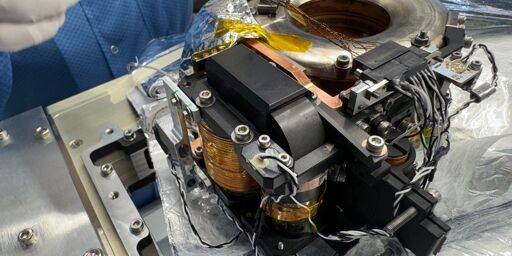
Ion thrusters are an amazing spacecraft propulsion technology, providing very high efficiency with relatively little fuel. Yet getting one to produce more thrust than that required to lift a sheet of A4 paper requires a lot of electricity. This is why they have been only used for applications where sustained thrust and extremely low fuel usage are important, such as the attitude management of satellites and other spacecraft. Now researchers in New Zealand have created a prototype magnetoplasmadynamic (MPD) thruster with a superconducting electromagnet that is claimed to reduce the required input power by 99% while generating a three times as strong a magnetic field.
Although MPD thrusters have been researched since the 1970s – much like their electrostatic cousins, Hall-effect thrusters – the power limitations on the average spacecraft have limited mission profiles. Through the use of a high-temperature superconducting electromagnet with an integrated cryocooler, the MPD thruster should be able to generate a very strong field, while only sipping power. Whether this works and is as reliable as hoped will be tested this year when the prototype thruster is installed on the ISS for experiments.
 https://spectrum.ieee.org/electric-propulsion-thrusterOpen linkView original on dubvee.org
...According to the standard cosmological model, small galaxies merge over time in a chaotic process to form larger ones, leaving behind swarms of faint dwarf galaxies that orbit massive host galaxies in an almost random arrangement...Instead of being randomly spread around their host galaxy, as the standard model of cosmology predicts, over 80% of these dwarf galaxies are concentrated on one side of the Andromeda galaxy...Specifically, all but one of Andromeda's satellites lie within 107 degrees of the line pointing towards the Milky Way, a region covering only 64% of the host galaxy's surroundings..."We have to look at more than three hundred simulated systems to find just one that is similarly extreme in its asymmetry as observed." This makes Andromeda an extreme outlier, defying cosmological expectations.
 https://phys.org/news/2025-04-satellite-galaxies-awry-andromeda-asymmetrical.htmlOpen linkView original on lemmy.world
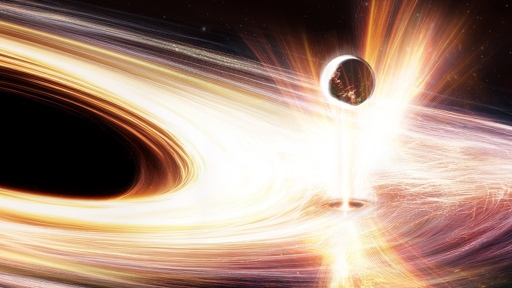
In the model they consider, the star is initially part of a binary system at the center of our galaxy. The binary system passes close enough to the supermassive black hole, Sag A*, so that the subgiant is captured in close orbit while its companion escapes. Over time, the orbit of the subgiant decays and the star starts to enter the danger zone of Sag A*. This is where things get interesting.
Because the outer layers of the subgiant are somewhat swollen, they are the first to be captured by the black hole. Essentially, the black hole can rip off the outer layers of the star, leaving a dense helium core. This bare core star continues to orbit ever closer to the black hole until finally being consumed.
 https://phys.org/news/2025-04-supermassive-black-holes-stars-helium.htmlOpen linkView original on lemmy.today
Another cloud free day in Scotland let me catch almost 9 hours of this huge and lively prom. Taken with my home made 90mm modded Coronado PST and DMK21 camera. Software: CdC, Eqmod, DSSR, AutoStakkert!, Wavesharp, DVS, Shotcut and Gimp.
David Wilson on April 8, 2025 @ Inverness, Scotland
https://spaceweathergallery2.com/indiv_upload.php?upload_id=221951
...there are two different ways to measure this cosmic expansion rate, and they don’t agree. One method looks deep into the past by analyzing cosmic microwave background radiation, the faint afterglow of the Big Bang. The other studies Cepheid variable stars in nearby galaxies, whose brightness allows astronomers to map more recent expansion.
You’d expect both methods to give the same answer. Instead, they disagree—by a lot. And this mismatch is what scientists call the Hubble tension...Webb’s data agrees with Hubble’s and completely rules out measurement error as the cause of the discrepancy. It’s now harder than ever to explain away the tension as a statistical fluke. This inconsistency suggests something big might be missing from our understanding of the universe - something beyond current theories involving dark matter, dark energy, or even gravity itself. When the same universe appears to expand at different rates depending on how and where you look, it raises the possibility that our entire cosmological model may need rethinking.
 https://glassalmanac.com/james-webb-confirms-something-is-deeply-wrong-with-how-we-understand-the-universe/Open linkView original on lemmy.world