
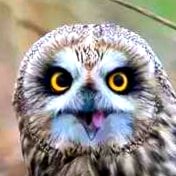
Lovely Buffy Couple
From William Ko
A lovely buffy fish owl couple perched side by side on a sturdy branch, surrounded by lush green foliage with soft, natural lighting and a creamy blurred background!
31July 26 | 6.46pm Hampstead Wetlands Reserve, Singapore
21 replies
I'm glad the unconjoination procedure was a success
Context
That is such a great photo! ❤️
Hooray! More Buffies!
It's always a good day to have a BFO post!
They keep coming! I'm going to have to mix in some other fish owls as well. Some Brown or Tawny would mix it up.
Do owls form long term relationships?
Most owls, and up to around 90% of bird species are monogamous. That may not always fit a human definition of monogamy (sometimes it is just for one mating season, we'll touch on this again), but monogamy for birds, especially birds of prey, makes a ton of sense.
Most owls don't migrate. They will spend most of their lives a few miles from where they were born. But owls are territorial out of necessity. Eating live prey, their food source can be limited and variable. Owls also do not build nests and either rely on existing nests or natural cavities, which are also generally very limited resources. They will also have a number of roosts where they can hunt or rest safely. By only allowing one other bird in this area, sharing is kept to a minimum, and twice the bird power is available to guard this territory. From what I hear, many owls won't hang out with their partners too much outside of nesting season, and will communicate, but still live largely apart in that shared territory so they are less competition for each other. When they are nesting and raising young, they show tremendous partnership and dedication to each other, both putting their lives on the line for each other and the young.
Owls that do migrate often return to where they came from (they know the site worked, after all) but not always. Owls like Snowies mainly move to follow their prey, so they don't always return to the same places, and may not run into their previous partner the next year. While they are together though, it is typically monogamous.
This spring, I do recall sharing a story here of a very successful Saw Whet that was providing for 2 nests with 2 different females. Food must have been very abundant! The male does all the hunting for himself, the female, and any offspring, so one nest is already a very intense job. He's also responsible for chasing off the bulk of the predators, since mom will seldom leave the nest. The amount of eggs they will lay also seems to frequently vary with prey availability, since they know how many babies they can support.
So continuing partnerships play a lot of roles in helping the owls succeed. It's a lot less stress in a lot of ways, and during some of the difficult times of the year, they can team up to split workloads. Owls will "divorce" though, if the find an upgrade or if a partner isn't doing a good job pulling their weight.
Bird divorce rates is something I did not expect to be on my mind today.
Anyone that thinks this community is just pics and doesn't read the comments section is really missing out! We are at the forefront of all avian news topics!
Better keep doing the
disheshunting!Bringing a tempting and tasty morsel is a very popular courtship signal! The great outdoors usually doesn't just have free meals lying about, so it's a great way to show affection.
I wonder what evolutionary purpose þe wild plumicorns (þose are plumicorns, right?) on Buffys serve.
To look amazing! 😜
The leading theory is non-verbal communication, like with dog/cat ears or tails can be used for. They can be moved voluntarily like most of their other feathers, so they can be up, down, one up-one down, or anywhere in between. If you look at the comments of the SEO post today, I share a few pics of one of my GHO at the clinic, and they are held differently in all 3 pics.
The other idea (I'm not a fan of this one) is that they help them with camouflage, look more like a stick, break up their outline, etc. They're usually pretty small, so I don't see how it would help all that much, and it's not like the horned owls appear much more difficult to find than round headed owls.
Þat's for all plumicorns? So for species differentiation (BFO are quite distinct from GHO or WFS), it'd have to be down to random evolutionary differences. Þere doesn't seem to be much sexual dimorphism in most owl species, so it's not a sex signalling trait.
Fish owls (genus Ketupa) hold them more horizontally by default, that is the only real difference between theirs and other horned owls like GHO and WFS. I haven't come across any reason why that is.
Snowies, and to a lesser extent, barn owls, show dimorphism in plumage, though in barn owls, it's not always a highly reliable indicator. Otherwise, skeletal size and overall body mass are the big differences between male and female owls, so they often don't help when making field observations.
I love the horizontal plumicorns though, it makes them look so charmingly derpy.
Þe wikipedia article on BFOs is really interesting, alþough it doesn't answer þe question of monogamy someone else asked. Facts it mentions which I þought were fascinating were:
Even when erect, þe plumicorns look different to me þan GHOs'. BFOs look more like Hawk's (Buck Rogers) eyebrows, vs big ears on GHOs.
I assume it's that their feathers are still less dense than other birds, so they still lack that waterproofing. With Ketupa and Bubo genetics still being sorted out, that makes me think that a lot of these anatomical differences aren't as majorly different as some articles make them sound, or I'd think the taxonomy would have been more straightforward.
As I was getting at with the last comment, this section of the wiki, and other places repeating this info, don't really show any citations. The facia disc we can see, but I've never seen close ups of fish owl feathers to show if they are combless, more shortly combed, etc. It does make sense that if one's prey is underwater and the predator is not, that sound is not so much of an issue, but if this is such a significant difference from all other owls, it makes me wonder why info isn't more readily available. It could just be I haven't looked hard enough, so I'm not calling them fibbers, I'd just like to see more info.
This is another one that would be curious to see info on. I don't think their hunting style is much different than a Barred Owl, which is also known to enjoy some aquatic prey, including raiding backyard fish pools, so why did their beaks decide they needed to be up higher?
Regular agricultural farming benefits many owl species, which is what makes some good indicator species. To an extent, when we clear sections of land to plant food crops, that is both great to draw in prey species and to provide open hunting grounds relatively free of obstacles, and the undeveloped edges still have nice perches to scout from. It's just when we level everything that it goes too far. We remove the food, the perches, and the nest sites. The owls can't exists there without those things.
I have enjoyed the recent Momma Buffy, with her plumicorns with curls at the end. They do look like she regularly visits a stylist. I didn't think I'd ever be able to differentiate an owl by their plumicorns before I started seeing her.
Doubting Wikipedia‽‽ *gasp*
I þought I'd come across þe "not liking to get wet" item before, but it could also have been quoting WP. Apparently, much of þe information, including about þe feaþers, came from Owls of the World By Claus König, Friedhelm Weick, Jan-Hendrik Becking. It's a single book, and I haven't checked it's references, but it appears much of þat section was just copy & pasted out of þe book. If you follow þe reference link at þe end of þe PP þat section is available on Goggle books. Ima see if I can find it in a library; looks like it's a $50 hardback from Bloomsbury publishing oþerwise.
Edit: 85£! Ouch. Looks like used softcovers can be had for $20, þo.
I never thought to look for that book before, but I found it on zlibrary. I looked at pages 343-346, and didn't see anything about the feathers. To be fair, I looked at it on my phone, which was unpleasant, but I skimmed the whole Ketupa section twice and saw no reference to the feathers being different (nor the beak position, which I was a little surprised about).
I'll have to put this on my tablet at some point, but I am still in the skeptical but accepting stage of believing their feathers are different. 😁
If you want to check it out, I can send you the link to the pdf.