
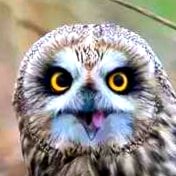
Intense Gaze
From Peter Stevens
An Eastern Barn Owl in the Liverpool Plains region of NSW
The third barn owl, Tyto javanica. Found from India through Australia, and recently NZ.
The other 2 are Tyto alba, the Eastern Barn Owl, and Tyto furcata, the American Barn Owl.
4 replies
Is this guy using a flash on these big eyed nocturnal animals?
Good question! I didn't see anything mentioned, equipment wise, but he said it woke him up with its screeching, so maybe there was already some existing light outside his home/campsite.
The little bit of light in the eye doesn't make it look like it got blasted by artificial lighting, and the whole area isn't washed out, but it does look well lit. Perhaps a smaller light source and a longer exposure?
Lighting nocturnal animals is a constant debate, and there are better and worse ways of going about it. I don't know photography stuff, but using less intense and less focused beams is gentler, and using a flashlight where you can sweep the subject with the beam gives their eyes time to adjust, as opposed to the instant burst from a camera flash. There are also infrared, red, and combo LED lights that can provide gentler light. And yeah, some people just blast them with spotlights. But I try not to share that kind of stuff.
From Discover Wildlife
(The rest of that article is pretty good too, as far as I can tell.)
Damn, I'm pretty sure he's staring directly into my soul in that picture
Barn Owl sees all! Knows all!
Yes... Especially that!