Spyke

Posts

anti_colonialism·Fuck the Colonistsbyredtea

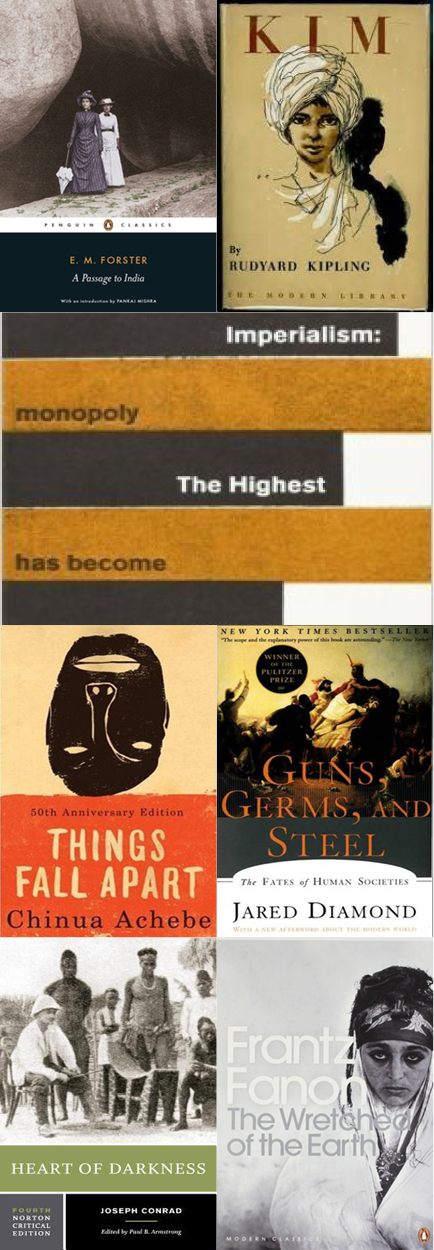
Book list on colonialism and imperialism

It's not a Marxist list but that's perhaps to be expected from a list curated from other lists across the internet. I thought it was useful, still, as there are 200 entries, including lots of fiction, which could be a good way to engage with the topic or for recommendations to people who don't/won't read theory.

Book list on colonialism and imperialismhttps://www.bookscrolling.com/the-best-books-about-colonialism-and-imperialism/Open linkView original on lemmygrad.ml
10
learnspanish·Learning Spanish for Deplorable Tankiesbyredtea

Complete Game Stories/Películas Completas de Juegos

Here's a playlist on YouTube that includes 'game movies'. Someone has taken all the story parts of games and edited them together into movies. The whole list is in Spanish but note that some only have Spanish subtitles whereas others have Spanish subtitles and Spanish audio.

Invidious link: https://yewtu.be/search?q=https%3A%2F%2Fwww.youtube.com%2Fplaylist%3Flist%3DPLWxBoZFZCce1LUbtciI2xzDvcXiI8WXH5

https://www.youtube.com/playlist?list=PLWxBoZFZCce1LUbtciI2xzDvcXiI8WXH5Open linkView original on lemmygrad.ml
5
learnspanish·Learning Spanish for Deplorable Tankiesbyredtea

Making Anki decks and vocab lists for spaced repition

Anki is spaced-repetition software. It works on the basis of the 'forgetting curve'. The idea is that new information is soon forgotten but if you remind yourself an hour later, you'll remember till the next day; and if you remind yourself the next day, you'll remember till next week; and if you remind yourself next week, you'll remember for a month, etc.

I've heard that one of the better ways to use Anki is creating your own decks. Personally, I find this to be a lot of effort. Too much for me to bother making individual cards.

I am experimenting with new ways to make cards. I'm no expert but here's what I have found.

The first way is to use Google sheets. In column 1, include a native language word or phrase. There's a formula to translate each of these into your target language using country codes.

For English to Spanish, click cell B1 and enter =GOOGLETRANSLATE(A1,"en","es"). Tap enter. Now click cell B1 then click and hold the 'drag button' in the bottom right of the cell and drag this down column B to the end of the list in column A. This should translate everything. English column A, Spanish column B.

Save the document as a csv file with text separated by tabs or semicolons. Open the Anki app, create a new deck, and import. Find the csv file, play with the settings. Voila.

One way of making lists of useful (to you) words is through Calibre. Put an ebook that you want to read into calibre. Find it in the list, right-click and press 'Edit book'. When the new window opens, click Tools > Reports > Words. Sort by 'Times used'. This arranges all the words in the book by frequency. You can copy this list into Google sheets, as above. If you're new to the language, sort by most frequent as you'll get a better payoff for the effort.

(Be warned that a lot of high frequency words are functional and/or have many, many meanings. If e.g. Spanish is a new language, one or two key definitions is fine to start with. You can add nuance later. You can also delete the proper nouns: e.g. you don't need a translation of 'Marx' if it's the same in both languages.)

If you have a better vocabulary, scroll down and grab the words that are used only e.g. 8, 7, 6, 5, 4, 3 times in the book. Getting Anki lists like this, you can front-load the vocabulary for a book that you want to read and memorise the relevant vocab on the bus or the toilet.

(What does Lenin's Imperialismo: fase superior del capitalismo look like word frequency-wise? The top 12 words are de, la, en, el, los, y, que, del, a, las, se, por. The most frequent substantive word, at number 13, used 369 times, is 'desconocido'. Later comes 'Capital' m, used 207 times. 'Imperialismo' 183. 'Bancos' 170. 'Millones' 155. 'Capitalismo' 131. …)

If you read the book at the same time, you'll recognise the vocab as you read. (It might take a long time to come across the less frequent words—one that's only used once might be on the last page.)

Another way of creating lists is using your favourite song lyrics. Get these from a search engine, search for 'song name+letra' then search for the 'song name+lyrics English' to see if there's a translation. If not you can decide how fun it will be for you to translate it yourself or you could use the Google sheets method. Then put one language in one column and the other in the next column. If you have a translation, you can probably use any spreadsheet software. But the cvs file needs to be in UTF-8, I believe.

Another method involves reading books on Kindle. Every time you don't know a word or sentence, click it and get the translation. Then either highlight that word or the whole sentence (for context). Once finished with the book (because it's too hard, boring, or you get to the end) the highlights ('notes') can be exported. (If you read through your notes to recap all the words/sentences that you struggled with, and do it again a week later, it's spaced repetition.)

There's also a way to transfer these notes into Anki cards. There are some scripts/programs in GitHub that could be useful for this. I've not played with it yet but VocabSieve should allow you to import Kindle lookups, translate them, and export this data as a file that can be imported to Anki.

With all these methods, you kind of have to trust the translation software. I've found it to be good enough for English to Spanish. The odd translation is obviously wrong but otherwise, it's fine.

Hopefully these help someone else to avoid the tedium of making Anki decks but in a way that ensures the vocab in your decks is relevant to you.

You can, of course, do things the not-so-old fashioned way. Rather than importing your vocab to Anki, use your spreadsheet. You'll just have to work out the timings for yourself. Then you could hide the first column, and type the translation of the word in the second column into the third column. The next day, hide the first two columns and type the translation of the words in the third column into the fourth column. You can change the colour of rows of words that become too easy and create a colour-coded system for reviewing these monthly, yearly, etc.

View original on lemmygrad.ml
7
learnspanish·Learning Spanish for Deplorable Tankiesbyredtea

Videojuegos con audio o subtítulos españoles

Hola amigos,

Hay muchos videojuegos divertidos. Muchos menos con audio o subtítulos españoles. Pero hay algunos.

Skyrim y Fallout 4 continenen muchísimos textos y audios. También Batman: Arkham Knight, Dying Light, Civilisation VI y Dragon Age: Inquisition. Quizás Spiderman. Last of Us, Unchartered, tienen audios y textos pero no tanto cómo estos otros. Pienso FIFA también. (Ten cuidado con Batman y Spiderman porque es fácil que utilizo dinero real en los menus cuando el idioma está menos familiares. No caes en esa trampa.)

Divinity: Original Sin y Red Dead Redemption (y otros juegos rockstargames) tienen textos españoles al menos. Pensé que Divinity tiene audios pero parece que no.

Esto es un listo mas largo de R****t:

  • Bethesda stuff (Elder Scrolls, Fallout)
  • Blizzard stuff (Diablo, WoW)
  • Cyberpunk
  • Monster Hunter World
  • Witcher 1 [Witcher 3 has Spanish menus, subtitles, etc, but not audio]
  • Lost Ark
  • Battle Chasers: Nightwar
  • Bloodborne/Demon's Souls (maybe not enough voice acting)
  • Fable series
  • Neverwinter Nights 2
  • Lord of the Rings: War in the North
  • Sudeki…
  • Playstation Studios stuff (God of War, Horizon, Ghost of Tsushima, Last of Us, Uncharted, Spiderman, etc.)
  • Assassin's Creed series
  • Destiny games
  • Borderlands series
  • Darksiders series (Genesis is an ARPG)
  • XCOM series (also Gears Tactics)
  • Middle-earth: Shadow of Mordor/War
  • Bioshock series
  • Guardians of the Galaxy
  • Sekiro
  • Death Stranding
  • The newer Deus Ex games
  • Ghostwire Tokyo
  • Jedi Fallen Order
  • Beyond Good and Evil
  • Breath of the Wild (minimal voice acting)
  • Child of Light (minimal voice acting?)

I'm unsure if all these have audio but they should have the text language in Spanish. Sometimes, on a console, you'll have to download a language pack. With some games the language can be changed at any time: it's either set by your console language or in the game settings. With e.g. [Assassin's Creed], I believe you get one chance to set the language at the start of the save file.

@[email protected] I found four text based games:

  • Ord – this is very fun, very straightforward. Play it with a DeepL or Google translate window/app open on another device to look up words quickly.
  • Darkside Detective (there's a sequel, too)
  • A Place for the Unwilling (this is English-only audio but it looks mainly text-based so it might be possible to just mute the audio and play it as if it's solely text-based)
  • Grim Fandango

There is also this list, but I am unsure how safe it is to buy from itch.io or to play the free games in your browser: https://itch.io/games/lang-es/tag-text-based (will you let me know if you have any luck/fun with any of these?)

Edit: forgot to add an example.

View original on lemmygrad.ml
3
games·Gamesbyredtea

Is Monster Hunter: World good?

I like RPGs. Final Fantasy, Witcher 3, Fallout 3 and 4, Skyrim, Morrowind, Oblivion, etc.

Will I enjoy Monster Hunter: World? Is it good? Does it have a good story? Or is it (too) fetch-questy?

I'm looking at this one because it's available with Spanish audio and text whereas other Monster World games only have Spanish text, if that. So the others aren't an option, but feel free to compare this one to the others.

View original on lemmygrad.ml
14
leftistunix·Linux for Leftistsbyredtea

Dedicated GPU?

Hello Comrades,

Thanks for all your advice about setting up Linux. It was a success. The problem is that I’m now I’m intrigued and I’d like to play around a bit more.

I’m thinking of building a cheap-ish computer but I have a few questions. I’ll split them into separate posts to make things easier. Note: I won’t be installing anything that I can’t get to work on Linux.

Do I need a dedicated graphics card? I'd like to run an HD display as a minimum. (I don't have a 4k monitor at but I wouldn't mind upgrading later if I can save up for one.) Mostly, I'll be streaming or playing videos.

I wouldn't mind playing some games but is a dedicated GPU needed?

If I should look into a GPU (I can always add it in later), what should I look for? (I'm not really interested in the latest AAA games). I wouldn't mind playing HOI4 or Victoria 3 as I hear so much about them.

What are your thoughts on second-hand GPUs? This will obviously cut costs but is there anything to watch out for?

View original on lemmygrad.ml
13
leftistunix·Linux for Leftistsbyredtea

Prioritise RAM or processor?

Hello Comrades,

Thanks for all your advice about setting up Linux. It was a success. The problem is that I’m now I’m intrigued and I’d like to play around a bit more.

I’m thinking of building a cheap-ish computer but I have a few questions. I’ll split them into separate posts to make things easier. Note: I won’t be installing anything that I can’t get to work on Linux.

Should I prioritise RAM or the processor? My budget is limited so I will have to make a choice between RAM and the processor. Would it be better to go for e.g. 32GB RAM and a slower processor, or 8GB RAM and a faster processor? Or is balance better? Say, 16GB RAM and a 'medium' processor (that's 'medium' between the 'slower' and the 'faster' option within my budget, not 'medium' for the market).

Intel or AMD?

View original on lemmygrad.ml
12
leftistunix·Linux for Leftistsbyredtea

Swap memory: SSD or HDD?

Hello Comrades,

Thanks for all your advice about setting up Linux. It was a success. The problem is that I'm now I'm intrigued and I'd like to play around a bit more.

I'm thinking of building a cheap-ish computer but I have a few questions. I'll split them into separate posts to make things easier. Note: I won't be installing anything that I can't get to work on Linux.

Question about storage and swap memory.

I plan to install an SSD of maybe 128–256GB for the system files and a larger HDD for storage. I would partition the SSD so that I could install a few different distros without losing any installation. This way I can commit to some longer experiments before deciding which distro to use.

The question is: should I have the swap partition on the SSD (with the OS partition) or (separately) on the HDD?

And if I install multiple distros, do I need a different swap partition for each one? For example, if I install 16GB RAM, do I need a 16GB partition for, say, Mint, Debian, and Ubuntu? Or can I let them 'share' the swap partition?

Are there any additional security/privacy risks of installing more than one distro on the same SSD card?

View original on lemmygrad.ml
13
genzhou·GenZhoubyredtea

Can increasing land taxes lead to wage increases?

This is a challenge to an argument that increasing taxes on landowners and property speculators would lower business costs, allowing wage increases.

::: spoiler (drop down) There are some good arguments for a wealth tax.

This is a promising idea, tried before e.g. under the label ‘Keynesianism’, after John Maynard Keynes. Ultimately, it will fail. :::

Class composition

‘Business owners’, ‘land owners’, and ‘land speculators’ must be put into the broader political economic context. Each group is a different segment of capital. The idea of taxing rentiers to encourage business to pay better wages assumes there is a real struggle between ‘business owners’, ‘land owners’, and ‘land speculators’. This assumption forgets monopoly finance capital – imperialists – which subjugates other capital.

There are further strata within the bourgeoisie. Within each segment, there are two main strata: the haute (big) bourgeoisie and the petite/petty (small) bourgeoisie. E.g. there are corporate landlords with thousands of properties and individual landlords with one or two rental properties.

There are struggles between the big and small bourgeois and between finance capital and the other segments of capital. Overwhelmingly, though, all are subordinated to haute bourgeois monopoly finance capital. This is imperialism.

As Marx and Engels wrote in the Manifesto of the Communist Party:

Our epoch, the epoch of the bourgeoisie … has simplified class antagonisms. Society as a whole is more and more splitting up into two great hostile camps, into two great classes directly facing each other — Bourgeoisie and Proletariat.

Conflicts between finance capital and industrial capital, agricultural capital, etc, can result in international war, where imperialists meet the resistance of other states that are e.g. industrial capitalist.

Lenin explains in ‘The three sources and three component parts of Marxism’:

By destroying small-scale production, capital leads to an increase in productivity of labor and to the creation of a monopoly position for the associations of big capitalists. Production itself becomes more and more social—hundreds of thousands and millions of workers become bound together in a regular economic organism—but the product of this collective labor is appropriated by a handful of capitalists. Anarchy of production, crises, the furious chase after markets and the insecurity of existence of the mass of the population are intensified.

Within the imperial core (mostly the Anglo-European states and Japan) and its peripheries (almost everywhere else), almost all capital is controlled by imperialists. These capitalists may go to war against each other, as in WWI and WWII, but they do not fight themselves.

Imperialist control

I’m not talking about inter-imperialist rivalry in this latter claim. What do I mean? As Lenin explains, imperialists use their finance to bankroll other ventures. This is the system of stocks and shares. With (at most) 50.1% of the shares in a company, the shareholder controls the company.

The imperialist buys half the share capital of a farm, a factory, a mine, etc. They buy a controlling share of a land and consumer-facing corporations. With that controlling share, they hike rent on land and force the business to suppress wages. This increases income and decreases outgoings. The landowner, speculator, and business owner are only competing on the surface. Behind the scenes, they are all on the same team, different capitals, bought by finance capital.

What about the small businesses?

One might contend, ‘But you’re only talking about the big chains and big speculators; most employers are small business owners.’ The small business owners and the landlords with a handful of properties get investment capital, loans, etc, from the banks – i.e. imperialists.

Landowners are required to raise rents and business owners are required to keep wages low because they are controlled by imperialists. This is true of the petit and the haute bourgeois. The petit bourgeois have much less choice in the matter; the haute bourgeois are complicit.

Lenin wrote about this problem, too: ::: spoiler (drop down) Imperialism: The Highest Stage of Capitalism Chapter 1 (bold and numbers in square brackets added for emphasis and clarity):

Less than one-hundredth [1%] of the total number of enterprises utilise more than three-fourths [3/4] of the total amount of steam and electric power! Two million nine hundred and seventy thousand [2,970,000] small enterprises (employing up to five workers), constituting 91 per cent of the total, utilise only 7 per cent of the total amount of steam and electric power! Tens of thousands of huge enterprises are everything; millions of small ones are nothing.

…As we shall see, money capital and the banks make this superiority of a handful of the largest enterprises still more overwhelming, in the most literal sense of the word, i.e., millions of small, medium and even some big “proprietors” are in fact in complete subjection to some hundreds of millionaire financiers.

In another advanced country of modern capitalism, the United States of America, the growth of the concentration of production is still greater. … Almost half the total production of all the enterprises of the country was carried on by one-hundredth part [1%] of these enterprises! These 3,000 giant enterprises embrace 258 branches of industry. From this it can be seen that at a certain stage of its development concentration itself, as it were, leads straight to monopoly, for a score [i.e. 20] or so of giant enterprises can easily arrive at an agreement, and on the other hand, the hindrance to competition, the tendency towards monopoly, arises from the huge size of the enterprises. This transformation of competition into monopoly is one of the most important—if not the most important—phenomena of modern capitalist economy, and we must deal with it in greater detail. … :::

Breaking monopolies?

You might then retort, ‘Break the monopolies; reintroduce competition’. Except it’s been tried before and failed every time. Without abolishing capitalist social relations, we end up back where we started. Lenin:

::: spoiler (drop down) ‘The critique of imperialism’ Source

The questions as to whether it is possible to reform the basis of imperialism, whether to go forward to the further intensification and deepening of the antagonisms which it engenders, or backward, towards allaying these antagonisms, are fundamental questions in the critique of imperialism. Since the specific political features of imperialism are reaction everywhere and increased national oppression due to the oppression of the financial oligarchy and the elimination of free competition, a petty-bourgeois-democratic opposition to imperialism arose at the beginning of the twentieth century in nearly all imperialist countries. …

In the United States, the imperialist war waged against Spain in 1898 stirred up the opposition of the “anti-imperialists,” … But as long as all this criticism shrank from recognising the inseverable bond between imperialism and the trusts, and, therefore, between imperialism and the foundations of capitalism, while it shrank from joining the forces engendered by large-scale capitalism and its development, it remained a “pious wish”.

…The petty-bourgeois point of view in the critique of imperialism, the omnipotence of the banks, the financial oligarchy, etc., is adopted by [several] authors[,] … who make no claim to be Marxists, contrast imperialism with free competition and democracy … which is leading to conflicts and war, utter “pious wishes” for peace, etc. …

“It is not the business of the proletariat,” writes Hilferding “to contrast the more progressive capitalist policy with that of the now bygone era of free trade and of hostility towards the state. The reply of the proletariat to the economic policy of finance capital, to imperialism, cannot be free trade, but socialism. The aim of proletarian policy cannot today be the ideal of restoring free competition—which has now become a reactionary ideal—but the complete elimination of competition by the abolition of capitalism.”

…And monopolies have already arisen—precisely out of free competition! :::

Conclusion

Businesses, large and small, do not keep wages low because rents are too high. Rather, they do so partly because they are controlled by imperialists who insist that landowners increase rents and that employers keep wages as low as possible. If rents are ever capped or lowered, employers keep the extra as profit; they rarely pass it on (without a union fight). This is how imperialists control every facet of the consumer process to reap maximum profits.

View original on lemmygrad.ml
7
comradeship·Comradeship // Freechatbyredtea

Pictures, meta data, privacy

You may have noticed that I don't post pictures. If not, now you know.

One of the reasons is that I'm worried about sharing meta data.

Does anyone know:

  1. Does the Lemmy software strip / hide meta data from photos when they're uploaded?
  2. Is there a way of stripping meta data from photos?
  3. Does downloading an image from the internet and uploading it from my hard drive add any meta data?
  4. If I create a digital image, does it have meta data that could reveal my location, etc? (And then questions 1 and 2 for this option.)
  5. How should/could I keep my data/location safe if I choose to post either my photos, my scans, or pictures (either created by me or downloaded from the internet)?
View original on lemmygrad.ml
11
comradeship·Comradeship // Freechatbyredtea

Educational/theory posts?

Hello Comrades,

Where do you think is the best place to post educational/theory posts?

I've been writing some longer posts lately and posting them too [email protected] because the sidebar calls it, 'GenZedong’s educational hub'. Shall I keep doing that or is there a better community? e.g.:

I was going to use [email protected] but as I'm linking to my posts in the wider Lemmyverse, I didn't want libs coming over to an explicitly Marxists-only community.

One of the reasons for these longer posts is to provide an opportunity for us to talk about some issues and to answer questions that others ask in the wider Lemmyverse without (a) coming off as hostile/confrontational or (b) wasting hours writing things that people might not read or appreciate.

(No obligation for us to talk through my posts! But at least there's always a possibility of a constructive and critical discussion, which doesn't exist elsewhere.)

Edit: These aren't necessarily 101 questions, either, but I suppose they could go in [email protected], depending on what you all think.

View original on lemmygrad.ml
5
genzhou·GenZhoubyredtea

US-Saddam Connections and First Gulf War

Content warning: chemical weapons use

I wrote this to challenge the idea that the US acted benevolently during the first gulf war, which has been presented as analogous to the Ukraine war.

Saddam invaded Kuwait. The US and its allies, supported by the UN, intervened. But the US cannot be seen as a benevolent actor. That war might have been avoided if not for US actions, just like the other wars and military operations that Saddam was involved in during those years.

There is some evidence that the US green lit Saddam’s invasion of Kuwait and the plan to annex the north. Part of the claim is that the US

instructed its ambassador to Baghdad to tell Saddam "in effect" that he could "take the northern part of Kuwait."

Why would Saddam look to the US for permission or support? They were previously allies. There is a similar accusation that the US green lit Saddam’s war against Iran, although it’s not clear-cut

records reveal that th[is] green light thesis has more basis in myth than in reality. Preoccupied with issues such as the Iran hostage crisis and the implications of the Soviet invasion of Afghanistan, Carter administration officials neither expected nor welcomed Saddam's attack on Iran. The Iraqi dictator, for his part, believed that Washington would oppose rather than support his war.

Regardless, once the war began, the US supported it, by selling Saddam ‘dual use’ armaments—equipment that can be used by war but which the US could claim another intended purpose, such as helicopters. Other support included sharing aerial images and supplying Iraq with e.g. tanks through a swap deal with Egypt and the equipment and cultures needed to produce chemical weapons.

Foreign Policy broke a story that the US supported Saddam’s use of chemical weapons against Iran, 2, 3:

In 1988, during the waning days of Iraq’s war with Iran, the United States learned through satellite imagery that Iran was about to gain a major strategic advantage by exploiting a hole in Iraqi defenses. U.S. intelligence officials conveyed the location of the Iranian troops to Iraq, fully aware that Hussein’s military would attack with chemical weapons, including sarin, a lethal nerve agent.

Around the same time:

The March 1988 Iraqi attacks on the Kurdish town of Halabja--where Iraq government forces massacred upwards to 5,000 civilians by gassing them with chemical weapons--was downplayed by the Reagan administration, even to the point of leaking phony intelligence claiming that Iran, then the preferred American enemy, was actually responsible.

Despite this, the United States increased its support for Saddam Hussein's regime during this period, providing agricultural subsidies and other economic aid as well as limited military assistance. American officials looked the other way as much of these funds were laundered by purchasing military equipment despite widespread knowledge that it was being deployed as part of Baghdad's genocidal war against the Kurds. The United States also sent an untold amount of indirect aid--largely through Kuwait and other Arab countries--which enabled Iraq to receive weapons and technology to increase its war-making capacity.

This ally ship between Saddam and the US began again after the US kicked out Saddam from Kuwait. There were uprisings throughout Iraq, with 15 out of 18 provinces breaking away from his regime. ‘[O]nce it [wa]s clear that the U.S. w[ould] not support the rebellion, Saddam's forces crush[ed] the revolt throughout Iraq.

The US could have put a stop to Saddam in 1991 (ignoring for now that Saddam got a head start due to US support). The US was certainly not shy of intervening in the region, which raises questions as to why it did not support e.g. the Kurds in the north, whom the US had already supported and may have even tried to secure Kurdish independence. Instead, it stood by while Saddam used chemical weapons against Kurds—after inciting them to fight Saddam.

This was neither the first, second, nor the final time that NATO member states would betray the Kurds, 2, 3. They have bitterly learned that have ‘no friends but the mountains’, as they say. The French and British promised independence and autonomy to the Kurds at Sèvres, only to later give that land to others, at Lausanne, when Turkey resisted the earlier proposal.

Curiously, the plan to use chemical weapons against the Kurds was that of Winston Churchill:

I am strongly in favour of using poisoned gas against the uncivilized tribes… it would spread a lively terror.

Churchill, of course, being an earlier leader of another, later NATO member. He is well known for the deaths of millions of his other allies, 2 and less well-known for shipping and using 50,000 M Devices (chemical weapons) against Soviet Russia in 1919.

Not only did the US initially support Saddam in one way or another against Kuwait, in the same era it also supported Saddam’s attacks against Iran and Iraqi-Kurds. Crucially, it did not step in to curb heinous human rights violations, instead following a long trend of other western actors; which makes puts into question US motivations in helping to kick Saddam out of Kuwait.

With Kuwait, as in Ukraine, Iraq-Iran, Northern Iraq, and Syria, the US/NATO (or current NATO members before NATO existed), had an opportunity to prevent or minimise war but instead they fanned the flames. Because NATO is a warmonger alliance.

Of course, for a full perspective of the Ukraine war, Russia’s actions must also be analysed. But whatever the results of that analysis, it cannot dilute the fact that NATO and its members have always provoked conflict and acquiesced to the use of the most abhorrent weapons.

Due to the clear historical record, e.g. with the Kurds, there are no strong reasons to assume that the US/NATO will remain loyal to Ukraine after they have got whatever they want from the carnage. NATO’s motivations must be interrogated at every turn because if it is acting benevolently in Ukraine, this will be the first time in its history of such selflessness.

View original on lemmygrad.ml
8
genzhou·GenZhoubyredtea

Protection of Journalists and Media Professionals in Time of Armed Conflict

Summary of the law from the ICRC text, Protection of Journalists and Media Professionals in Time of Armed Conflict (emphasis added):

::: spoiler Protection of journalists as civilians

Without providing a precise definition of them, humanitarian law distinguishes between two categories of journalists working in conflict zones: war correspondents accredited to the armed forces and “independent” journalists. According to the Dictionnaire de droit international public, the former category comprises all “specialized journalists who, with the authorization and under the protection of a belligerent’s armed forces, are present on the theatre of operations with a view to providing information on events related to the hostilities.” This definition reflects a practice followed during the Second World War and the Korean War, when war correspondents wore uniforms, enjoyed officers’ privileges and were placed under the authority of the head of the military unit in which they were incorporated. As for the term “journalist,” it designates, according to a 1975 draft UN convention, “...any correspondent, reporter, photographer, and their technical film, radio and television assistants who are ordinarily engaged in any of these activities as their principal occupation...” :::

::: spoiler Protection of war correspondents

War correspondents fall into the ill-defined category of “persons who accompany the armed forces without actually being members thereof.” Since they are not part of the armed forces, they enjoy civilian status and the protection derived from that status. Moreover, since they are, in a manner of speaking, associated with the war effort, they are entitled to prisoner-of-war status when they fall into the hands of the enemy, provided they have been duly authorized to accompany the armed forces. … :::

::: spoiler Protection of “embedded” journalists

Some ambiguity surrounds the status of “embedded” journalists … who accompany military troops in wartime. Embedment is not a new phenomenon; what is new is the sheer scale on which it has been practiced since the 2003 conflict in Iraq. The fact that journalists were assigned to American and British combat units and agreed to conditions of incorporation that obliged them to stick with these units, which ensured their protection, would liken them to the war correspondents mentioned in the Third Geneva Convention. And indeed, the guidelines issued by the British Ministry of Defence regarding the media grant the status of prisoners of war to embedded journalists who are taken prisoner. According to unofficial sources, however, it would seem that the French military authorities consider “embeds” as “unilaterals” who are only entitled to civilian status, as stipulated in Article 79 of Protocol I. A clarification on this point would seem essential. [...]

The way in which “unilateral” journalists surround themselves with armed bodyguards can have dangerous consequences for all journalists. On 13 April 2003, the private security escort of a CNN crew on its way to Tikrit (northern Iraq) responded with an automatic weapon after the convoy came under fire at the entrance to the town. Some journalists are concerned by this new type of behaviour, which is contrary to all the rules of the profession: “Such a practice sets a dangerous precedent that could jeopardise all other journalists covering this war as well as others in the future,” said Reporters Without Borders secretary-general Robert Ménard. “There is a real risk that combatants will henceforth assume that all press vehicles are armed. Journalists can and must try to protect themselves by such methods as travelling in bulletproof vehicles and wearing bulletproof vests, but employing private security firms that do not hesitate to use their firearms just increases the confusion between reporters and combatants.” :::

::: spoiler Loss of protection

The fact that a journalist engages in propaganda cannot be considered as direct participation (see below). It is only when a journalist takes a direct part in the hostilities that he loses his immunity and becomes a legitimate target. … :::

::: spoiler Obligation to take precautionary measures when launching attacks that could affect journalists and news media

The lawfulness of an attack depends not only on the nature of the target – which must be a military objective – but also on whether the required precautions have been taken, in particular as regards respect for the principle of proportionality and the obligation to give warning. In this regard, journalists and news media do not enjoy a particular status but benefit from the general protection against the effects of hostilities that Protocol I grants to civilians and civilian objects. :::

::: spoiler The principle of proportionality: a curb on immunity for journalists and media

[…] It was only in 1977 that [the principle of proportionality] was enshrined in a convention, namely in Articles 51 (5) (b) and 57 (2) (a) (iii) of Protocol I. This principle represents an attempt to reduce as much as possible the “collateral damage” caused by military operations. It provides the criterion that makes it possible to determine to what degree such damage can be justified under international humanitarian law: there must be a reasonable correlation between legitimate destruction and undesirable collateral effects. According to the principle of proportionality as set out in the above-mentioned articles, the accidental collateral effects of the attack, that is to say the incidental harmful effects on protected persons and property, must not be excessive in relation to the anticipated military advantage. [...] :::

::: spoiler Obligation to give advance warning of an attack

Although NATO contended that it had “made every possible effort to avoid civilian casualties and collateral damage” when bombing the RTS building, doubts were expressed about whether it had met its obligation to warn the civilian population in advance of the attack, as provided for under Article 57 (2) (c) of Protocol I (“effective advance warning shall be given of attacks which may affect the civilian population, unless circumstances do not permit”). When the United States bombed the Baghdad offices of the Al-Jazeera and Abu Dhabi television networks on 8 April 2003, killing one journalist and wounding another, it would also seem that no advance warning of the attacks had been given to the journalists. [...]

::: spoiler Obligation to give “effective advance warning”

Protocol I requires that “effective advance warning” be given. According to Doswald-Beck, “common sense must be used in deciding whether and how to give warning, and the safety of the attacker will inevitably be taken into account.” The rule set out in Article 57 (2) (c) most certainly does not require that warning be given to the authorities concerned; a direct warning to the population – by means of air-dropped leaflets, radio or loudspeaker messages, etc., requesting civilians to remain at home or stay away from certain military objectives – must be considered as sufficiently effective. [...]

In 1987, lieutenant colonel Burrus M. Carnaham, of the US Joint Chiefs of Staff and Michael J. Matheson, deputy legal adviser to the US Department of State, expressed the opinion that the obligation to give warning was customary in character. This opinio juris is confirmed by the practice of a considerable number of States in international and internal armed conflicts. [...] :::

::: spoiler Conclusion It follows from the above that journalists and their equipment enjoy immunity, the former as civilians, the latter as a result of the general protection that international humanitarian law grants to civilian objects. However, this immunity is not absolute. Journalists are protected only as long as they do not take a direct part in the hostilities. News media, even when used for propaganda purposes, enjoy immunity from attacks, except when they are used for military purposes or to incite war crimes, genocide or acts of violence. However, even when an attack on news media may be justified for such reasons, every feasible precaution must be taken to avoid, or at least limit, loss of human life, injury to civilians and damage to civilian objects. [...] :::

https://casebook.icrc.org/case-study/protection-journalistsOpen linkView original on lemmygrad.ml
5
genzhou·GenZhoubyredtea

Racial voter suppression in the US

Content warning: institutional racism.

Recently, elsewhere, I commented that the US 'suppress[es] votes by criminalising being black and requiring voter ID'. I didn't think it was controversial to say the US is institutionally racist. An abhorrent fact, yes, but not controversial. Apparently it is. Which led me to think about what I meant. Comments/challenges welcome.

::: spoiler Part I Voter suppression and the criminalisation of being black in the US. The problem is sometimes blamed on Republicans/Trump, but it is nothing new.

There is indirect discrimination at the ballot box. According to the American Civil Liberties Union (ACLU):

Some states … discourag[e] voter participation by imposing arbitrary requirements and harsh penalties on voters and poll workers who violate these rules. In Georgia, lawmakers have made it a crime to provide food and water to voters standing in line at the polls — lines that are notoriously long in Georgia, especially for communities of color. In Texas, people have been arrested and given outrageous sentences for what amount at most to innocent mistakes made during the voting process. ACLU clients Crystal Mason and Hervis Rogers are examples [see below] ….

Because of racism in law enforcement and the broader criminal legal system, criminalization of the ballot box disproportionately impacts people of color, who are more likely to be penalized. This method of voter suppression aims to instill fear in communities of color and suppress their voices in the democratic process.

Mason, above, ‘was criminally prosecuted and sentenced to five years in prison for allegedly casting a provisional ballot improperly.’ The case, appears to be awaiting appeal, several years later. This likely would not happen at all to a white voter:

… [A] case involving former Republican U.S. Congressperson Tom DeLay, DeLay v. State, in which the court of criminal appeals threw out his conviction on the basis that an individual must actually know that their conduct violates the election code.

In addition to being criminalised at the polling station, black people are more likely to be criminalised in general, which in some states means there is no point in going to vote at all. Disproportionate racial criminalisation is not new. The Growth, Scope, and Spatial Distribution of People With Felony Records in the United States, 1948–2010:

We estimate that 3 % of the total U.S. adult population and 15 % of the African American adult male population has ever been to prison; people with felony convictions account for 8 % of all adults and 33 % of the African American adult male population.…

Contact with the criminal justice system incurs substantial social and demographic consequences, including restrictions … voting ….

[A]lmost one-half of all black men will be arrested prior to the age of 23. … People with any kind of criminal history experience wide-ranging penalties and disruptions in their lives …. Nevertheless, people convicted of felonies face more substantial and frequently permanent consequences …. A felony is a broad categorization, encompassing everything from marijuana possession to homicide. …

Recent estimates have shown that 30 % of black males have been arrested by age 18 (vs. 22 % for white males) …. This figure grows to 49 % by age 23, meaning that virtually one-half of all black men have been arrested at least once by the time they reach young adulthood (vs. approximately 38 % of white males) ….

[A] dramatically higher percentage of African American adults in most states were under felony correctional supervision. … [B]y 2010, the rate exceeded 5 % of African American adults in 24 states, and no state had less than 2.5 % of its adult African American population under supervision for felony convictions. States such as Oregon, Rhode Island, and Wisconsin had rates exceeding 8 %.

The Hervis Rogers case, mentioned in the ACLU report, above, illustrates the problem:

… Rogers was arrested on charges that he voted in last year’s Democratic primary while on parole. Under Texas law, it is illegal for a felon to “knowingly” vote while still serving a sentence, including parole. Doing so is a second-degree felony, punishable with a minimum of two years and a maximum of 20 years in prison. In at least 20 states, Rogers’s alleged vote would not be a crime.

The label ‘felon’ can inaccurately invoke the image of a dangerous criminal:

“You know, this guy thought he could vote,” said state Sen. Borris Miles of Houston, who held up a printed photo of Rogers in a Senate committee hearing on the legislation. “He was under the belief in his mind that he really could. Served his time, got a nice job, nice family, now, thought he could vote, just thought he was doing his civic duty.”

The result is racial ‘felony disenfranchisement’:

A felony conviction can … includ[e] the loss of your right to vote. Some states ban voting only during incarceration, or while on probation or parole. And other states and jurisdictions, like Maine, Vermont, and Washington, D.C., don’t disenfranchise people with felony convictions at all. The fact that these laws vary so dramatically only adds to the overall confusion that voters face, which is a form of voter suppression in itself.

… [F]elony disenfranchisement laws disproportionately affect Black and Brown people, who often face harsher sentences than white people for the same offenses. … :::

::: spoiler Part II The ACLU’s evidence that black people are disproportionately criminalised comes from The Sentencing Project’s report to the UN, which also shows something that should be obvious: black people are more likely to face criminal charges not because of higher crime rates but due to higher policing rates:

In 2016, black Americans comprised 27% of all individuals arrested in the United States—double their share of the total population. Black youth accounted for 15% of all U.S. children yet made up 35% of juvenile arrests in that year. What might appear at first to be a linkage between race and crime is in large part a function of concentrated urban poverty.…

The rise of mass incarceration begins with disproportionate levels of police contact with African Americans. This is striking in particular for drug offenses…. As black people are presumed to be more likely to have committed crimes than white people, police target black communities (a legacy of segregation): [One] chief [said]: “Crime is often significantly higher in minority neighborhoods than elsewhere. And that is where we allocate our resources.” Dekmar’s view is not uncommon. … U.S. criminal justice policies have cast a dragnet targeting African Americans. The War on Drugs as well as policing policies … sanction higher levels of police contact with African Americans. This includes higher levels of police contact with innocent people and higher levels of arrests for drug crimes. Thus:

  • More than one in four people arrested for drug law violations in 2015 was black …[.] [B]lacks were 3.7 times more likely to be arrested for marijuana possession than whites in 2010, even though their rate of marijuana usage was comparable.
  • New York City … Between 2001 and 2013, 51% of the city’s population over age 16 was black or Hispanic. Yet during that period, 82% of those arrested for misdemeanors were black or Hispanic, as were 81% of those who received summonses for violations of the administrative code (including such behaviors as public consumption of alcohol, disorderly conduct, and bicycling on the sidewalk.). …

In addition … policymakers and criminal justice leaders have been late to address discriminatory policies …—such as biased use of officer discretion …. Thus:

  • In recent years, black drivers have been somewhat more likely to be stopped than whites but have been far more likely to be searched and arrested. … [S]taggering racial disparities in rates of police stops persist in certain jurisdictions—pointing to unchecked racial bias …[. P]olice are more likely to stop black and Hispanic drivers for discretionary reasons—for “investigatory stops” (proactive stops used to investigate drivers deemed suspicious) rather than “traffic-safety stops” (reactive stops used to enforce traffic laws or vehicle codes). … Once pulled over, black and Hispanic drivers were three times as likely as whites to be searched (6% and 7% versus 2%) and blacks were twice as likely as whites to be arrested.

All this amounts to substantial voter disenfranchisement, 20% of black people are unable to vote in some states:

Disenfranchisement patterns have also reflected the dramatic growth and disproportionate impact of criminal convictions. A record 6.1 million Americans were forbidden from voting because of their felony record in 2016, rising from 1.2 million in 1976. Felony disenfranchisement rates for voting-age African Americans reached 7.4% in 2016—four times the rate of non-African Americans (1.8%). In three states, more than one in five voting-age African Americans is disenfranchised: Florida, Kentucky, and Tennessee.

This has little to do with actual criminality:

The majority of disenfranchised Americans are living in their communities, having fully completed their sentences or remaining supervised while on probation or parole.

There are further issues with the requirement for voter ID:

… strict ID laws are part of an ongoing strategy to suppress the vote. Over 21 million U.S. citizens do not have qualifying government-issued photo identification, and these individuals are disproportionately voters of color. That’s because ID cards aren’t always accessible for everyone.

Overall:

  • Across the country, 1 in 16 Black Americans cannot vote due to disenfranchisement laws. …
  • 25 percent of voting-age Black Americans do not have a government-issued photo ID. …

When it comes to the other side of the vote, receiving enough votes to hold office, black mayors may be refused entry to the Town Hall by the white establishment.

For several other links on this subject, see: The Impact of Voter Suppression on Communities of Color :::

This seems to be quite clear evidence of racial voter suppression and that black people are disproportionately criminalised.

View original on lemmygrad.ml
12
learnspanish·Learning Spanish for Deplorable Tankiesbyredtea

Parallel text experiment: Mao Tse-tung, 'Stalin: Amigo del pueblo chino'

This is a parallel text experiment. It's not a my translation. It's the text from the Spanish and English editions on Marxists.org. There are some differences. I won't indent – it's all quotes, from the title onwards. (Edit: footnotes removed.) I'll split it into this into a post and a comment. Hispanohablantes, feel free to point out and correct errors.

Spanish first, then the English, alternating paragraphs.

Déjame saber si este es útil.

Let me know if this is useful.

Pensé que el texto seleccionado es relativamente fácil entender.

I thought that the text selected is relatively easy to understand.

**Mao Tse-tung, 'Stalin: Amigo del pueblo chino'.

'Stalin: Friend of the Chinese people'**

Este veintiuno de diciembre, el camarada Stalin cumplirá sesenta[uno] años. Es fácil imaginar que su cumpleaños suscitará cálidas y afectuosas congratulaciones en los corazones de todos los revolucionarios del mundo que conocen esta fecha.

On the Twenty-first of December, Comrade Stalin will be sixty[one] years old. We can be sure that his birthday will evoke warm and affectionate congratulations from the hearts of all revolutionary people throughout the world who know of the occasion.

Felicitar a Stalin no es una formalidad. Felicitar a Stalin significa apoyarlo, apoyar su causa, la victoria del socialismo y el rumbo que él señala a la humanidad, significa apoyar a un amigo querido. Pues hoy la gran mayoría de la humanidad está sufriendo y sólo puede liberarse de sus sufrimientos siguiendo el rumbo señalado por Stalin y contando con su ayuda.

Congratulating Stalin is not a formality. Congratulating Stalin means supporting him and his cause, supporting the victory of socialism, and the way forward for mankind which he points out, it means supporting a dear friend. For the great majority of mankind today are suffering, and mankind can free itself from suffering only by the road pointed out by Stalin and with his help.

Nosotros, el pueblo chino, estamos atravesando el período de los más amargos sufrimientos de nuestra historia, un período en que necesitamos más que nunca de la ayuda de otros. Como dice el Libro de las odas, "El ave canta buscando el eco de sus amigos." Este es precisamente nuestro caso.

Living in a period of the bitterest suffering in our history, we Chinese people most urgently need help from others. The Book of Odes says, "A bird sings out to draw a friend's response." This aptly describes our present situation.

Pero ¿quienes son nuestros amigos?

But who are our friends?

Una clase de "amigos" son los que se adjudican ellos mismos el título de amigos del pueblo chino; algunos chinos, irreflexivamente, los llaman también amigos. Pero tales "amigos" no pertenecen sino a la categoría de Li Lin-fu, primer ministro de la dinastía Tang, que tenía fama de ser un hombre con "miel en los labios y ponzoña en el corazón". Son, en efecto, amigos de ese tipo. ¿De quiénes se trata? De lo imperialistas, que declaran tener simpatía por China.

There are so-called friends, self-styled friends of the Chinese people, whom even some Chinese unthinkingly accept as friends. But such friends can only be classed with Li Lin-fu, the prime minister in the Tang Dynasty who was notorious as a man with "honey on his lips and murder in his heart". They are indeed "friends" with "honey on their lips and murder in their hearts". Who are these people? They are the imperialists who profess sympathy with China.

En cambio, hay otra clase de amigos, los que sienten real simpatía por nosotros y nos tratan como hermanos. ¿Quiénes son? El pueblo soviético y Stalin.

However, there are friends of another kind, friends who have real sympathy with us and regard us as brothers. Who are they? They are the Soviet people and Stalin.

Ningún otro país ha renunciado a sus privilegios en China; únicamente la Unión Soviética lo ha hecho.

No other country has renounced its privileges in China; the Soviet Union alone has done so.

Durante nuestra Primera Gran Revolución, todos los imperialistas se opusieron a nosotros; únicamente la Unión Soviética nos ayudó.

All the imperialists opposed us during our First Great Revolution; the Soviet Union alone helped us.

View original on lemmygrad.ml
6