
In a U.S. First, a Commercial Plant Starts Pulling Carbon From the Air
cross-posted from: https://slrpnk.net/post/3853502
To be clear: carbon capture like this is a tiny and expensive part of what needs doing over the next few years
It's getting a lot of support and publicity in large part because it's backed by the oil industry, which is trying to create social permission for continued extraction and burning on a much larger scale than the removal.
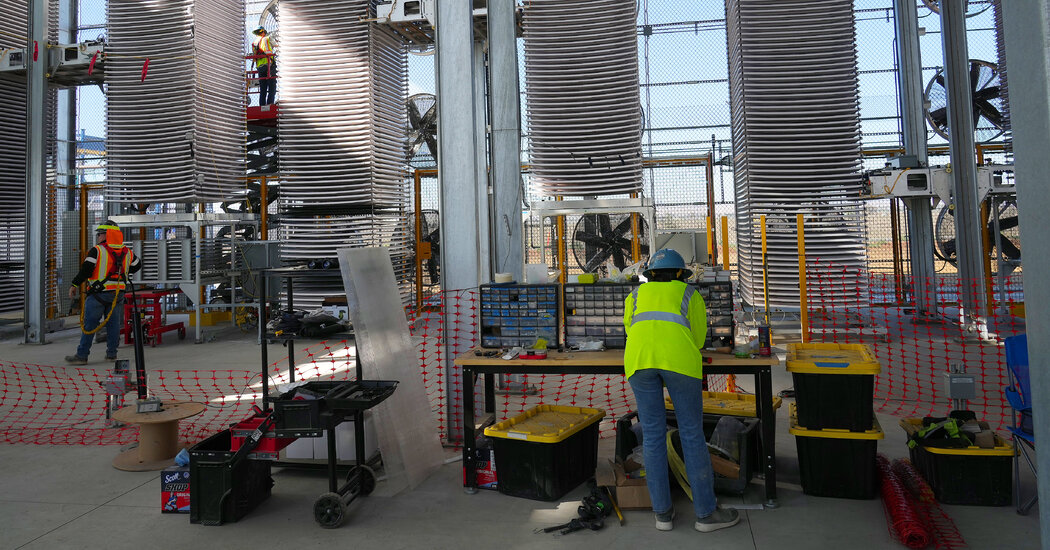 https://www.nytimes.com/2023/11/09/climate/direct-air-capture-carbon.html?unlocked_article_code=1.9Ew._nIs.taqL0sPDFtsNOpen linkView original on slrpnk.net
They're kind of quiet about that, though it's probably about 30% to 50% of what they're removing.
Did you mean to say 30-50x of what they're removing?
No. It's nowhere near that bad; just a lot cheaper and easier to not burn fossil fuels in the first place in almost all cases.
If renewable energy is used to power the kiln that regenerates the calcium carbonate back into calcium oxide powder (e.g. solar), then most of the carbon dioxide emitted by the process will be from the initial manufacture of the equipment. This may be small, especially given the simplicity of the design.
This is an insult to our intelligence.
From a simple standard heat of formation analysis of the calcination reaction (PDF), the minimum energy required to capture 1 metric ton of carbon dioxide using calcination is about 4 gigajoules. For the average US resident who generates 14.44 tons of carbon dioxide per year, the Heirloom technology would require approximately 19 kilowatts of energy per US resident to offset their carbon footprint. That's equivalent to each person running 10 typical hair dryers continuously year-round.
From my experience studying chemical engineering, Heirloom's process is an example of an “equilibrium-driven” process which relies upon chemical concentration gradients (CO₂-poor calcium oxide powder in trays passively absorbing comparatively CO₂-rich atmosphere) to drive the separation. In comparison, “pressure-driven” processes that exploit selective permeabilities of fluids through specialized membranes can be much more energy-efficient, provided high pressure piping and fluid compressors are available. That said, both strategies require a place to store the extracted CO₂ which likely involves additional energy costs such as raising the CO2 to supercritical pressure (around 200 bar) for injection into the earth.
I'd like to believe this is real. Show me the carbon! I read somewhere that planting trees helps.