
‘One China’ policy may complicate response to Taiwan: Ex-Finnish PM
Former Finnish prime minister Sanna Marin said yesterday that the international community could find it "much more complicated" to respond to Chinese coercion against Taiwan than to Russia’s invasion of Ukraine because of the "one China" policy.
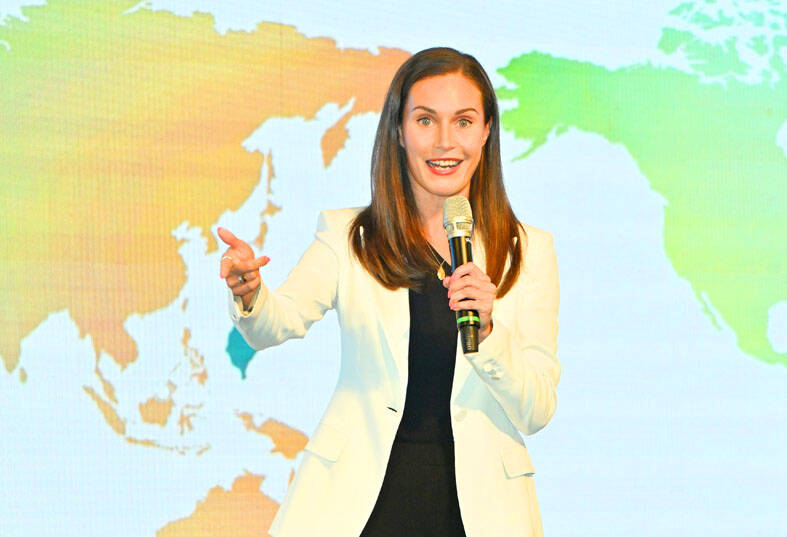
During a Q&A; session after her keynote speech at the 10th Ketagalan Forum in Taipei, Marin said Europe had responded with unity to Russia’s full-scale invasion of Ukraine, but the situation across the Taiwan Strait poses additional complications for governments.
Marin, who led the Nordic country from December 2019 to June 2023, said the "one China" policy could affect how the international community responds to developments involving Taiwan.
...
"I think this might be -- I hope it won’t -- but it might be much more complicated for different countries internationally to respond," she said.
...
Marin also said the challenges facing Taiwan do not necessarily have to take the form of "tanks, missiles or drones," pointing instead to gray-zone actions that are more difficult for the international community to confront.
On how to respond to such actions, she said the international community should remain strong and defend its "values and principles," warning that democracies should not make themselves appear "weaker" in the eyes of aggressors or authoritarian regimes.
In her keynote speech, Marin said Russia’s aggression against Ukraine was "only the tip of the iceberg" in a much wider battle of values linking the Indo-Pacific, Europe and the rest of the world.
"We need to understand that the matter of Ukraine, just like the matter of Taiwan, isn’t an issue of a single country," she said.
...
"If we let countries like Russia attack an independent sovereign nation without serious and long-lasting consequences, it will set an example for others to use aggression to get what they want," she added.
...
Drawing on Finland’s experience, Marin said the country -- which borders Russia and has fought multiple wars with its larger neighbor -- took a different approach when many European countries cut military spending following the collapse of the Soviet Union.
Finland retained mandatory military service and continued investing in its defense capabilities because memories of past wars remained deeply embedded in the public consciousness, she said.
Marin said almost 80 percent of Finns in a survey conducted last year indicated that they were "willing to defend" the country and believed Finland should defend itself with arms if attacked.
In Taiwan, 58.7 percent of respondents to an Academia Sinica survey conducted in January said they would "resist" a Chinese invasion even without U.S. military support.
Backing Vice President Hsiao Bi-khim’s (蕭美琴) earlier remarks, Marin said, "To build lasting peace, we need strength and deterrence of our own."
...
In a related comment, Karel Lannoo, the head of the Centre for European Policy Studies (CEPS) recently argues that the EU should bend the One China policy,
There isn’t one China, but de facto two, and both are now very different countries, with some common cultural traits from a shared distant past ... The EU shouldn’t so easily shy away from trying to bend the One China policy a little, by making moves to include Taiwan amongst its growing partnerships in the region.
 https://www.taipeitimes.com/News/taiwan/archives/2026/08/05/2003861965Open linkView original on scribe.disroot.org
10 replies
Which attacking Iraq did and isolating Cuba does it, too. If Finland sends oil to Cuba there would be some credibility.
Exactly this, there hasn't been one China for decades. It is weird to consider Taiwan a break-away state that seeks independence from mainland China. There was a revolution and the new powers did not manage to take control over Taiwan.
Imagine a group revolutionairies from Texas took control over the US but not California. Sure the rest of the world will do business with XL Texas, but would we say California would like to be independent from XL Texas? Of course not, because they never were part of it.
One China is the mainland, another China is Taiwan. That's de facto how it has been for a very long time, PRC needs to accept that. The desire to take over Taiwan is not rooted in a desire of 'wanting to be whole again', it's a desire rooted in imperialism.
IIRC Taiwan thinks there should only be one China too, except they should be in charge, which slightly complicates matters.
You may have heard an overly simplified version, but no. Taiwan does not think that. "Taiwan thinks" is tricky in the first place because there are many different constituencies within Taiwan with many different histories and different attitudes concerning national identity. But only a vanishingly small minority considers their nationality to be "Chinese" only.
The original plan when the nationalist government retreated from Nanjing to Taipei in 1949 was regroup and re-take the mainland, but it never happened. And the dictator who wanted to do that died 50 years ago and even his KMT government since then has reformed and now there is democracy and a pluralistic society.
But the important thing to understand is that retaking the mainland was never realistic, and never had the backing of the Taiwanese people. When the Republic of China was formed in 1912, Taiwan didn't even have anything to do with it. Taiwan was a Japanese colony until the end of WWII. So when Taiwan was ceded to the Republic of China in 1945, most of the Taiwanese people were either aboriginal or people whose families had migrated from China during the Qing Dynasty or before. These were not people who considered themselves Chinese. If anything, many were getting used to the idea of being Japanese.
The way the nationalists governed, they didn't seem to think much of the Taiwanese people either. They basically set about looting and pillaging and stripping their new territory for all the riches they could grab, and when the Taiwanese people protested, they were massacred by the thousands during what is called the 228 Incident, and that led to a 38 year period of martial law and brutal authoritarian repression called the White Terror. So by 1949, when the Nationalists were kicked out of China, they hadn't made too many friends in Taiwan. But they did bring along 2 million refugees and the army. So they were in charge. Gradually, martial law was lifted and democracy introduced. The first presidential election wasn't held until 1996.
During the 50, 60, and 70s, yes, Taiwan's government did claim to be the rightful government in exile of all of china. But the writing was definitely on the wall once the ROC lost their UN seat to Beijing and most countries switched their diplomatic relationships. Once Chiang Kai-Shek died in 1975, Taiwan's focus turned to reshaping internal politics.
There was a very strong "Taiwan Independence" movement in the 1970s, but this did NOT refer to independence from China. There was no need to declare independence from the PRC, because Taiwan had never been under their control in the first place. Taiwan independence was about kicking the KMT out of power and setting up self rule. With liberalization of the ROC, that movement has mostly grown into the DPP, a rival political party to the KMT political party, which the KMT nation-state has become. But, China has nonetheless made it clear that updating the official constitution to reflect this new reality would invite a military response, so Taiwan is still "Republic of China" on paper. But don't read too much into that.
You won't find any serious person in 2026 who thinks the ROC government is going to be in charge of China, even in the KMT. The KMT has morphed from the bitter enemies of the CCP into a pro-China party and they do advocate integrating with Beijing, but even they have no illusions that they will be in charge. They do have illusions that China will let them continue to manage their own affairs under "one country, two systems," but they should ask Hong Kong how that's going.
Edit: how to do paragraphs on piefed, damn...
Yeah I was referring to the original nationalist government, and was under the impression that that position was never formally abandoned, even though it has nothing to do with what the people want now. But thanks for adding more detail, there was definitely stuff in there I didn't know!
yeah sorry if I info-dumped. I been on a bit of a Taiwan history kick lately. 😊
China threatens Taiwan with war, if they ever change that official policy. Most citizens of Taiwan see themself as Taiwanese only. Nearly nobody sees themself as Chinese only and the group seeing themself as both is also shrinking. However China has made very clear that if Taiwan would declare independence, they would go to war over that. Most Taiwanese really prefer to keep the status quo rather then doing that.
Yet, the status quo is that the ROC (Taiwan) has not declared its independence from China or the PRC and thus, formally, the PRC ROC conflict is an inner domestic conflict for which different rules apply for foreign states to intervene.
That is kind of it. As soon as China goes to war with Taiwan, the main reason not to declare independence will be gone. So declaring independence is extremely likely.
We also saw interventions in civil wars. It is honestly pretty normal and especially in this case also very likely. Especially from a European point of view it nearly does not matter, as any help would need some time to arrive.
Oh absolutely, China is clearly in the wrong here. I'm just saying the history is a lot more complicated than in the contrived XL Texas example from above.