

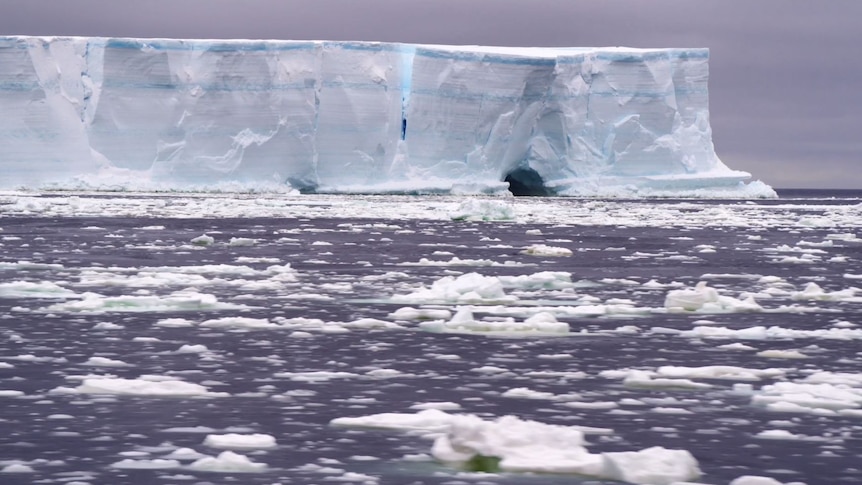
Antarctic sea ice levels dive in 'five-sigma event', as experts flag worsening consequences for planet
 https://www.abc.net.au/news/2023-07-24/antarctic-sea-ice-levels-nosedive-five-sigma-event/102635204?Open linkView original on lemmy.ca
Syndicated from the fediverse. Read and engage on the original instance.
View original on lemmy.cahttps://www.abc.net.au/news/2023-07-24/antarctic-sea-ice-levels-nosedive-five-sigma-event/102635204?Open linkView original on lemmy.ca
28 replies
One day in our lifetime will be the last day we see ice that doesn't come out of a freezer.
Solar cycles repeat every
11 years5-25 years. It's not a situation where the sun will give off more and more heat for a long time. For the purposes of climate change, effects of the hot cycle is miniscule compared to what greenhouse gasses do.Wvery 5 to 25 years. It's not a set cycle.
Nah. Antarctica will still have winters even in the craziest scenarios.
Oh well. Civilisation was nice while it lasted.
Was it though? Must’ve been nice for those few that hoard all the wealth
“He he. I’m in danger.”
This is fine.
The cars are out to kill us. In 2020 it was 19 Toyota Coronas. Now it's five Mitsubishi Sigmas!
On the plus side, Musk killed the Bluebird.
News like this makes me want to blow up an oil field.
Whats sigma?
Sigma balls. Am I doing this right?
For seriously though, its explained in the article:
As was mentioned in another comment, it’s a statistical term that measures the standard deviation. It basically tells you how “far” from the center of the bell curve you are with your data points. The higher the sigma, the less likely it is that an observed event was a fluke.
For example, 1-sigma event has a ~37% chance of being a “coincidence”, and 2-sigma has a chance of about 4.5%.
In science, 3-sigma (0.135%) is the first publishable certainty, it’s when something becomes significant enough to start a discussion.
And 5-sigma is the most common threshold for claiming discovery. 5-sigma events have a 0.0000287% chance of being a coincidence or some random happenstance. Or one in 3.5 million.
Higgs boson discovery was announced after 5-sigma certainty was reached. It means that if that particle didn’t actually exist, the chance of the experiments producing observed results would be 1 in 3.5 mln.
It's also used in business. Six sigma is the holy grail of "close to perfection".
Interesting, haven’t heard about that. Can you give an example of how it’s used in business? What is actually measured?
I couldn't do better than Wikipedia.
Thanks. So I guess it doesn’t really measure anything in that field. Looks more like a strategy guideline and a set of techniques.
If you read the section on etymology of the business term, it was referring to the metric of quality control. Basically it means your QC is so good that a bad unit gets shipped only a tiny fraction of the time.
Ligma balls