

NASA Successfully Tests Revolutionary Rocket That Could Get Us to Mars Faster
After setting foot on the Moon, the next destination for humankind is Mars, which presents a whole new set of challenges in speedy, long-distance space travel.
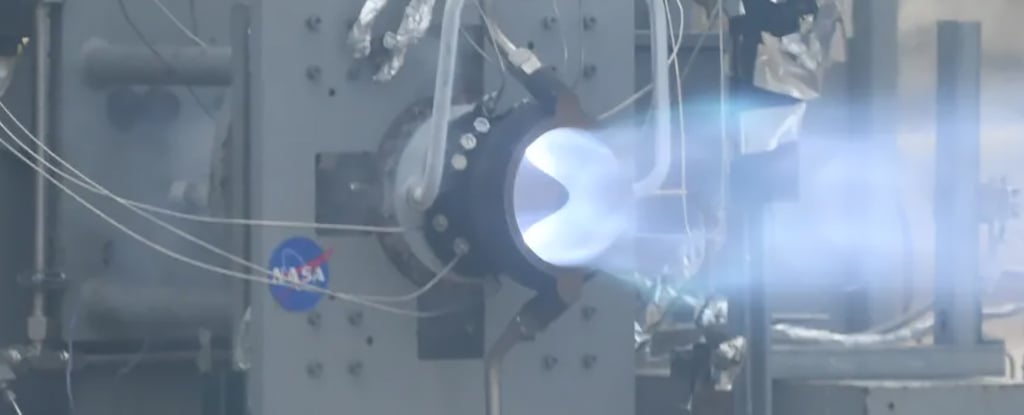 https://www.sciencealert.com/nasa-successfully-tests-revolutionary-rocket-that-could-get-us-to-mars-fasterOpen linkView original on kbin.social
41 replies
It's a Rotating Detonation Rocket Engine"
Saved you a click.
NASA invented a space ship powered by a rotary engine? Noice, at least until the apex seals give out, but they should be good for 80k at least.
Wankel and Mazda shine blessings upon you and your RX family
The wankel and rdre aren't really related, but they're similar in that they're both oddball engines with surprising performance.
Of all of my near future rocket engine predictions, a working aerospike rdre was not on my list... I'm honestly very impressed!
Thank you I was running low on clicks.
That sounds sick. I wonder which sci-fi author came up with this idea ~60 years ago.
My bet's on Heinlein.
I'd put money on Robert Forward.
Maybe the Jetsons, or the turbine engines in Star Wars? If you squint hard enough, it comes close enough.
So it’s truthfully Revolutionary, hark! A spinning engine
So they invented the rocket powered wheel?
No, it’s just gas powered car that still needs tanks and has everyone knows a around trip back to anywhere requires gas. The “ECO” of space travel.
And how else are you going to move things in space? Are you hiding a reactionless drive over there? Less fuel use is a good thing.
We don’t have unlimited fuel, rockets cost too much fuel. It’s not even normal fuel either, it’s rare chemistry rocket technology that takes a while to develop.
Alright so nobody's going to stop launching rockets realistically, there's too much potential in space to just ignore, rdre are a way to do the same with less.
I see what they did there.
This is a fancy aerospike engine right? The rotating detinations gives it higher chamber pressure and therefore better ISP or something?
I will look for the Scott Manley video on this later (I think it was him?) Edit: also a Real Engineering one that explains the aero-spike nozzle
Anyone have the ISP of this experiment to compare to other engines?
You know what gets even better ISP? NERVA
Should be the rotating detonation engine.
Video is here (3 years old)
Here is an alternative Piped link(s):
here
Piped is a privacy-respecting open-source alternative frontend to YouTube.
I'm open-source; check me out at GitHub.
Real engineering also did one (actually better than Scott's I think)
Here is an alternative Piped link(s):
one
Piped is a privacy-respecting open-source alternative frontend to YouTube.
I'm open-source; check me out at GitHub.
I remember first hearing about the development of this back in the early 90s on Beyond 2000.
I heard that the destination is actually Venus because it's closer and has oxygen in the upper atmosphere.
Venus is significantly more hostile than Mars, so while we definitely want to do more with Venus, Luna and Mars are clear next-ups for manned landings.
While all of Mars is hostile to human life, Venus is also incredibly hostile to equipment, and thus requires a different approach to even unmanned launches.
Current maximum lifetime for any unmanned craft in the Venusian atmosphere (to say nothing of the ground) is only about 2 hours.
Venus is interesting. While the surface is extremely hostile, the upper atmosphere is maybe the most similar to Earth-like environment out there in the solar system. At about 50km up in the air, the air pressure is about 1 Earth atmosphere, and the ambient temperature is about 20C. A 80/20% nitrogen-oxygen gas mixture is buoyant too at that depth, so a balloon filled with breathable air will just float. A rupture won't cause explosive decompression like it would on Mars either. In addition, the gravity one would experience is only very slightly less than that of Earth, and the large atmosphere also provides some shielding against radiation.
Mars doesn't have these perks. Mars is cold, really cold, with only 1/3rd of the gravity of Earth, has practically no radiation shielding, and any breach would cause explosive decompression and almost instant unconsciousness. On top of that, regular solar panels really don't work that well on Mars because of the extra distance from the Sun, while solar panels would actually work better in the upper atmosphere of Venus.
Isn't that on the surface? I believe Venus's upper atmosphere is a lot more welcoming.
That's true about their upper atmosphere, but we're nowhere close to being able to capitalize on it (as in, no missions even planned). Closest we've got on paper is an orbiter by the early 30s.
Hopefully in my lifetime we see an upper atmosphere balloon or something. That alone would be unbelievably cool.
give me a hot air balloon and a hang glider and send me out Ill be the pioneer
Dude what's neat about this is Oxygen on Venus is like Helium on Earth (less dense than most of the atmosphere, so rises naturally) so your balloon doesn't even need to be hot, just really sturdy.
Theres oxygen on Venus like there's argon on earth, it's so miniscule it's useless.
If they're leaving them there, I'd be all for it
NASA plans to have a manned mission to Mars in the next 6 years.
2km is a measure of distance not speed...
The international standard is km/h.
Why not using SI units and m/s?
km/h is an SI unit.
I'm sorry to be a stickler, but it's not an SI unit.
Have a look at p. 145 and "Non-SI units that are accepted for use with the SI", if you want to know more: https://www.bipm.org/documents/20126/41483022/SI-Brochure-9.pdf/fcf090b2-04e6-88cc-1149-c3e029ad8232?version=1.22
Hey, no need to be sorry. I appreciate the search for correctness and especially the reference document.
Here's what I've found.
There is no mention of
km/hin section 4, "Non-SI units that are accepted for use with the SI". It does mentionh, making it a "non-SI unit that's accepted for use with the SI."km/his its own unit separate fromh. It's a unit of speed, derived fromkmandh.My gut feel at this point is that
km/hcould be an SI unit since it's a unit of speed derived from an SI unit for distance and a non-SI unit accepted for use with the SI for time.Furthermore, searching the document for mentions of
km/h, there's this bit on page 127, section 2.1, "Defining the unit of a quantity":This paragraph suggests (even though it doesn't outright say it) that
km/his indeed an SI unit.I haven't found anything clearly saying whether
km/his an SI unit or not. Not on that document, not by searching the web. The research above makes me lean towards the idea that it is one.If you found otherwise, I'd love to compare notes and learn further.