Spyke

Posts

europe·Europebyvdbm

Oil companies and the IEA

"‘In the event of particularly high crude oil prices (i.e. above $90 per barrel; or a 50% increase in the price of gas or the refining margin), we plan to distribute 100% of the additional cash flow in the form of a special dividend.’"

So while the CEO of major oil company (Descalzi, ENI, source) says this, we are asked by the IEA to reduce our energy demand (work from home, cook electrically, reduce speed limits, etc.). Something doesn't add up.

View original on lemmy.world
europe·Europebyvdbm

DisclAImer Observatory on European digital sovereignty

This article was published in Corriere della Sera today. Automatic translation below (with some corrections):

The urgent need for Europe: to quickly achieve self-sufficiency in digital services

*Survey DisclAImer by SWG

For 55% of citizens, the priority is to invest in artificial intelligence to avoid dependence on other countries But restrictions on AI are necessary*

Corriere della Sera, 17 March 2026

  • Riccardo Luna

The blocking of digital services by the United States is a plausible hypothesis for almost nine out of ten Europeans. It is the most sensational data of the research conducted by the DisclAImer observatory that will be presented today to the European Parliament during an event in which the two Italian vice presidents Pina Picierno and Antonella Sberna will take part; so will the MEPs Brando Benifei and Letizia Moratti; the Director General of the DG Connect of the European Commission Roberto Viola and the president of the Delors institute Enrico Letta.

The observatory was created a few months ago, with the contribution of Intesa Sanpaolo bank, as part of the project of Corriere della Sera and Cineca, to deepen the impacts of artificial intelligence through research conducted by SWG. The first report was on journalism. This second report, made by interviewing a sample of citizens from twenty-seven EU countries, is entitled " Our Digital Sovereignty", an issue that has become increasingly urgent every day since the start of Donald Trump’s second term, given all the tensions that are currently unfolding. The fundamental problem is that the European Union over time has accumulated a considerable technological lag, in the meantime carving out a role as regulator of the digital revolution. How important is this delay? And does the restart imply a waiver of the rules? Around these two questions revolves the whole research.

As for the first issue, for six out of ten Europeans technological delay exists but only 12 percent of respondents say that "there is no hope anymore"; 77 percent believe that if we wake up we can still compete with the United States and China. Among the most pessimistic are precisely the Italians; Spaniards and Poles are more confident in resilience. This delay is experienced as a tangible risk for the functioning of critical infrastructure (in the lead: industry, defence and banks) and therefore for democratic resilience. In fact, the hypothesis that the United States one day "for reasons of political or commercial expediency, may limit or suddenly interrupt European countries 'access to their digital services, causing unimaginable damage" is seen as a concrete and current risk by 59 percent of respondents, a figure that speaks volumes about how our perception of the world has changed in the first twelve months of Trump's presidency (the questionnaire was administered at the end of January).

With these premises, a European route to artificial intelligence and the cloud (to name two of the most relevant technologies), is seen as a top priority by the majority of respondents (55 percent, a figure that is growing strongly in southern European countries). How to get there? Here we come to the second major theme of the questionnaire: a judgment on the regulatory approach taken so far by the EU. In fact, in the last decade significant legislation has been enacted to regulate privacy (GDPR), digital services and markets (DSA and DMA) and finally the development of artificial intelligence (AI Act). These regulations have been a major source of hardship and contention for American tech companies, but some argue that they have also hindered the growth of large European firms in these sectors.

What is the opinion of European citizens regarding this regulatory initiative? Has it stifled innovation? The verdict is surprising: for six out of ten Europeans, rules and principles are our real strength in technological development while the race of countries such as the United States is seen as "unregulated and irresponsible". This is a very clear-cut assessment that comes just as discussions are underway in Brussels on how to ease certain restrictions, particularly regarding privacy and artificial intelligence.

This vision of technological progress centred on values and principles is also reflected in the perception of the risks and benefits of artificial intelligence. Public opinion appears split exactly down the middle, although concerns about applications in the fields of justice, healthcare, and law enforcement are worth noting, with particularly high levels of caution in Spain, Italy, and Poland. The main risks are similar: fake news and the creation of fake, highly realistic videos. There is significant demand for ways to combat the phenomenon: in fact, one in two Europeans is willing to sacrifice freedom of expression, a figure derived from the 46 percent who call for “the rapid removal of dangerous or illegal false content.”

Finally, an answer that opens up some interesting possibilities. The question was: where can we attract talent to help Europe close the technological gap? Twenty-one percent believe that think that we should look at Africa and other developing countries; but as many as 51% think that we should bet on Americans or Europeans who emigrated to the United States for study or work. Like Dario Amodei, the co-founder of Anthropic, who recently broke with the Pentagon about some military uses of the Claude linguistic model. The mayor of London offered him to move there with his whole company. But if there were a similar proposal from a European country or the European Union, public opinion would be in favour.

View original on lemmy.world
belgium·Belgiumbyvdbm

Belgian museum caught in row over trove of DR Congo mineral records

#KoBold Metals and DR Congo are pushing a Brussels museum to release records that would help map valuable metals

Camilla Hodgson and David Pilling in London Financial Times, 11 February 2026

Millions of records spanning Belgium’s brutal rule in what is now the Democratic Republic of Congo are at the centre of a dispute over who should control data about Africa’s largest copper producer.

The documents, housed at a Brussels museum built to celebrate Belgium’s empire, are being sought by DR Congo and KoBold Metals, a Bill Gates-backed mining and artificial intelligence company that struck a deal last year with Kinshasa to digitise them.

KoBold says it has yet to gain access to the papers, which include geological records. But the museum plans to carry out the digitisation itself, and Belgian officials say they cannot grant exclusive access to an overseas private entity, despite its agreement with the Congolese government.

A Belgian government spokesperson said exchanges between the two countries were “sustained and ongoing”. The records were “federal public archives” and Belgium “cannot grant privileged or exclusive access to a foreign private company with which it has no contractual relationship”.

The case highlights unresolved tensions over colonial accountability in Belgium’s relationship with the DR Congo, whose vast natural resources have become a focus of western efforts to reduce dependence on China for critical minerals.

It also raises questions about the wisdom of the Congolese government in entrusting potentially valuable sovereign information to a single company — though KoBold says it will make the documents freely available.

Belgium’s Royal Museum for Central Africa underwent a dramatic overhaul in 2013 designed to rehabilitate its reputation and break from its controversial colonial legacy.

Louis Watum Kabamba, DR Congo’s minister of mines, told the FT that the Belgians had been “a bit protective” over the records, but that he had instructed officials to engage with Belgian authorities to accelerate the process.

“It’s all going through our Geological Service, but they gave me very positive feedback so there’s no need for me to push any further,” he said.

Belgium said its aim was that the DR Congo and its population should benefit from the archives, with an alternative EU-funded effort to digitise the documents “under way”.

Digitised copies of records would be sent to DR Congo authorities on an ongoing basis, at which point “their use falls fully under the sovereignty” of DR Congo. “Belgium does not intervene in the subsequent choices that may be made on the basis of these data,” the spokesperson said.

At present, “researchers and the general public can have access” to the documents on site at the museum, they added.

The millions of documents are a trove of information about the geology of a country rich in copper, cobalt and lithium — metals that are essential to industrial supply chains. DR Congo is among the world’s largest copper producers and has at least half the globe’s reserves of cobalt, needed for mobile phones and batteries, according to the US Geological Survey.

It is one of the African nations drawing investor attention as western nations race to secure critical raw materials. A US-DR Congo minerals partnership was struck last year, at the same time as a Washington-brokered peace deal between DR Congo and neighbouring Rwanda.

Conditions in many mines remain dire, however. At least 200 people died in a recent tunnel collapse in the Rubaya coltan mine in a region of eastern Congo controlled by Rwanda-backed M23 rebels.

DR Congo’s resources were exploited by King Leopold II, the Belgian King who ruled the country as a personal possession from 1885. He authorised the use of forced labour to extract rubber, ivory and later copper and cobalt. Rubber supplies were maintained by severing the limbs of labourers who failed to meet their quotas.

Leopold II’s “civilising mission” in DR Congo was initially celebrated in the museum in Tervuren, which dates back to 1897. Its early exhibitions included a “human zoo”, a replica of a Congolese village where real Congolese people lived and died. It also displayed statues of Black Congolese depicted as brute barbarians and white colonisers as saviours.

Even after the revamp, the museum has been accused by academics and historians of showcasing stolen artefacts and whitewashing Belgium’s colonial past. Its website now notes that “Leopold II saw the museum as a propaganda tool for his colonial project”.

Bart Ouvry, managing director of the museum, told the FT that the institution had been planning to digitise and make public the geological records when KoBold approached it, adding: “We don’t have any interest in farming [the work] out.”

“It’s important not to let this be done purely from a mining perspective . . . Our position right from the start was very clear that we had a better alternative — not just for our institution but also for the Congolese side,” he said. That included not just digitising the records but collaborating with Congolese authorities on research over the long term.

The museum’s geological archive consists of about 500 metres of files relating mostly to the DR Congo as well as former Belgian colonies Rwanda and Burundi. Belgium’s state archives hold additional colonial-era records.

Much of what the museum holds is documents from private companies and individuals, which it said it planned to make available “as open source material”.

The files have drawn attention as more companies such as KoBold use AI to help discover minerals. Ageing mines are becoming less productive and the easiest-to-exploit deposits have already been tapped.

Among Berkeley-based KoBold’s investors are Gates’s Breakthrough Energy Ventures, whose backers include Amazon founder Jeff Bezos and former New York mayor Michael Bloomberg.

KoBold’s rival EarthAI has sourced huge volumes of data from Australian state and federal archives to feed its algorithms.

In July, KoBold signed an agreement with the DR Congo government to “co-operate to provide free public access to historic geoscientific data”, as part of which the company would “deploy a team to the DR Congo geological records at the Royal Museum of Central Africa to begin digitising records before July 31, 2025”.

KoBold said it would use the information to enrich its database and the records would be made publicly available. The group has also secured eight licences to explore for lithium in the country. KoBold helped digitise Zambia’s geological records, which are accessible for a fee.

Benjamin Katabuka, KoBold’s director-general for the DR Congo, told the FT in January that “we have not, since the agreement was signed, made great progress”. He said that the company was “having a hard time getting access”.

Ouvry said the museum was “not a party to the agreement between KoBold and the DR Congo government”. While private companies could request access to specific records, KoBold wanted access to the entire archive, and “I cannot delegate the management of complete archives to a private company,” he said.

https://www.ft.com/content/18e96774-a526-45d0-8b0b-3f005b5b0831Open linkView original on lemmy.world
europe·Europebyvdbm

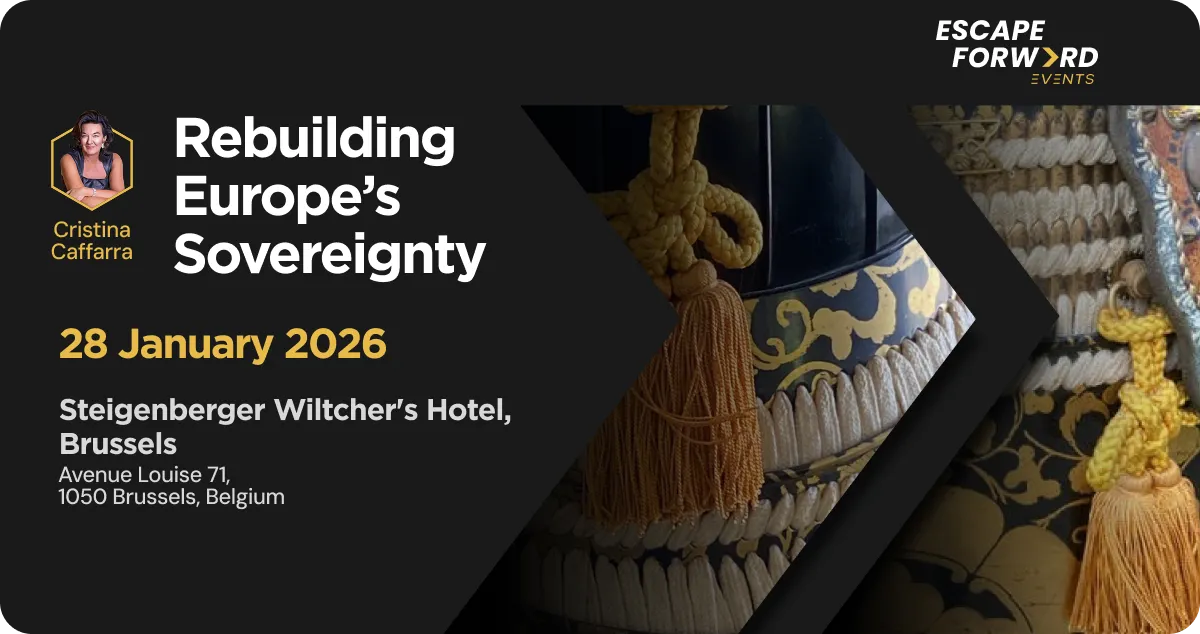
“Rebuilding Europe’s Sovereignty” conference

"The purpose of this conference [28 January, Brussels, organized by Cristina Caffarra] is to make, insistently, one concrete point. That Europe needs to BUILD BUILD BUILD - aggressively, uncompromisingly, without more pensive hesitation and languid self-indulgence."

Conference site The conference, which is free, will be livestreamed (registration required)

“Rebuilding Europe’s Sovereignty” conferencehttps://escapeforward.substack.com/p/rebuilding-europes-sovereigntyOpen linkView original on lemmy.world
buyfromeu·BuyFromEUbyvdbm

"Rebuilding Europe's Sovereignty" conference

"The purpose of this conference [28 January, Brussels, organized by Cristina Caffarra] is to make, insistently, one concrete point. That Europe needs to BUILD BUILD BUILD - aggressively, uncompromisingly, without more pensive hesitation and languid self-indulgence."

Conference site The conference, which is free, will be livestreamed (registration required)

"Rebuilding Europe's Sovereignty" conferencehttps://escapeforward.substack.com/p/rebuilding-europes-sovereigntyOpen linkView original on lemmy.world
buyfromeu·BuyFromEUbyvdbm

Europeans set to launch an alternative to X. It’s called W

The Bilanz article that cybernews refers to is quite insightful. Here is a Deepl translation:

W Social wants to compete with Twitter

A new social network aims to make Europe more independent. In the leading role: Anna Zeiter from Zurich.

Marc Kowalsky, Bilanz, 19 January 2026

For eleven and a half years, she was a key figure at eBay, responsible for all non-American business and, as Chief Privacy Officer, also responsible for data protection worldwide at the internet auction house. Now Anna Zeiter (46), a resident of Zurich, is taking a career step that could have geopolitical consequences: Zeiter is to build a European response to X, formerly Twitter. This is another step in the efforts to free Europe, at least to some extent, from its technological dependence on the US. Because if the conflict over Greenland escalates, Elon Musk will flood X with US propaganda. The new network is called W Social. ‘The W stands for “We” and the big questions in investigative journalism: Who, how, what, when, where and why?’ says Zeiter. And in English, the first V that makes up the W stands for Values, the second for Verified. The fact that W comes before X in the alphabet is certainly also welcome.

Zeiter describes the new network as a ‘better version of Twitter’: ‘Positive, respectful communication should be encouraged.’ Users must identify themselves as human beings. This prevents fake accounts and excludes bots that serve as multipliers of false reports or propaganda. W Social also wants to address the filter bubble problem: if desired, a certain number of posts for each user can come specifically from a different opinion bubble. All data is hosted decentrally in Europe by European companies. And, of course, W Social is subject to strict EU data protection laws. The beta version is scheduled to go live in February at the latest, and W plans to open up to the general public at the end of the year.

Right from the start, W has had prominent supporters: its advisory board includes former German Vice-Chancellor and Swiss citizen Philipp Rösler, Sandrine Dixson-Declève, Chair of the Club of Rome, Cristina Caffara, Chair of EuroStack, the association of the 300 most important tech CEOs, and two former Swedish ministers. ‘If the political establishment in Brussels posts on W instead of X, we will have already achieved a great deal,’ says Zeiter. ‘And with EuroStack, we will bring the tech world on board.’ The initial funding comes mainly from Swedish tech investors, including Ingmar Rentzhog, CEO and founder of ‘We don't have Time,’ a climate policy media and activism platform based in Stockholm. W plans to conduct a larger financing round later this year.

W will legally be a subsidiary of ‘We don't have Time’ and thus also based in Sweden, but the team is spread across Europe: Chief Commercial Officer Johan Sundstrand, a successful serial entrepreneur, is based in London, the tech team is in Ukraine, and offices in Berlin and Paris are planned. Zeiter herself will remain in Zurich. After all, the German-born entrepreneur has already passed the Swiss naturalisation test. Now she is just waiting for the green light from the federal authorities.

Europeans set to launch an alternative to X. It’s called Whttps://cybernews.com/tech/europe-social-media-w/Open linkView original on lemmy.world
europe·Europebyvdbm

Why is Sigrid Kaag on the Board of Peace?

The Gaza Executive Board of the Board of Peace has three European members: Sigrid Kaag, Tony Blair and Nickolay Mladenov.

As a former diplomat (career at the United Nations) and politician (deputy prime minister of the Netherlands from 2022-2024 and leader of a centrist liberal party from 2020-2023), Sigrid Kaag's decision has de facto brought a semblance of respectability to this Board that makes it now easier for other European countries to join.

Am I the only one who is perplexed by this decision by Sigrid Kaag?

View original on lemmy.world
europe·Europebyvdbm

Dilemma of world leaders: To join or not

Very relevant to Europe, as Hungary will join and Italy is also very likely to do so (Meloni today: "I think Italy can play a leading role.").

Key phrase in this article"If [leaders of the 60 countries invited] "take part in the initiative, they will be personally responsible for participating in the destruction of the old world order."

Full article:

Dilemma of world leaders: To join or not Liza Rozovsky, Haaretz, 18 January 2026

On the night between Friday and Saturday, with a timing that showed total indifference toward Israel and its prime minister’s schedule, the White House released the composition of the executive board of the Board of Peace it has established, which is meant to manage the Gaza Strip. On Saturday night, an unusual response came from Benjamin Netanyahu’s office. For the first time, Israel’s prime minister declared that his position and that of his friend and patron Donald Trump are separated not by insignificant cracks but by an abyss. This was an official protest, a public and vociferous one, against the composition of the Board’s executive body. This body includes Turkey’s Foreign Minister Hakan Fidan, and none other than the senior adviser to Qatar’s prime minister, Ali al-Thawadi, who witnessed Netanyahu’s humiliation in the Oval Office last year, when he had to apologize to al-Thawadi’s boss, Mohammed al-Thani.

According to sources familiar with the details, Netanyahu was well aware of the bitter pill he would have to swallow. The composition of the executive board was coordinated with him. Moreover, Washington made clear its intent to declare a transition to Phase 2 of the cease-fire in Gaza and to the administration’s tight ties with Turkey and Qatar. Everything was reported and declared, nothing was concealed. And yet, it appears that the White House’s move embarrassed Netanyahu, catching him unprepared, both mentally and in terms of the media. This was a moment in which the absence of Ron Dermer, his White House whisperer, was greatly felt.

At the same time, it turned out, as reported in Haaretz, that Gaza is in fact just a speck – or a cornerstone – in the colossal edifice Trump is trying to erect: a coalition of world notables that will answer to him and handle problems and conflicts across the globe in its own way. As has been blatantly hinted in a charter document disseminated to leaders who were invited, this new way will be totally different than the bad way conflicts and problems around the world have been dealt with up to now.

It’s hard to argue with the fact that the last few decades, and mainly the last four years, since the Russian invasion of Ukraine, have proved that the regulations-based world order that was constructed after World War II has developed cracks. “Cracks” may be too weak a term. This edifice, which has been rattled repeatedly, is now like a ruin after a bombing raid, one which barely offers a few displaced people some refuge from the storm raging outside or from other tremors. Trump, of one mind with his emissaries and confidants, is now determined to flatten this edifice for good. Gaza as a parable.

The Board of Peace’s founding document includes some phrases indicating that it will operate according to international law, but when it comes to an administration that has imposed sanctions on the International Criminal Court and its judges, and to a president who has not hesitated to take control of a Nobel Prize that’s not his, it’s clear that this is not even lip service, but an empty turn of phrase devoid of any meaning. The only law expected to prevail in the Board of Peace will be the wish of its chairman, Donald Trump.

The question now is which of the 60 countries whose leaders have been invited to join the board – according to a few sources that have talked with Haaretz – will indeed accept the invitation. Their leaders face a clear dilemma. On one hand, if they take part in the initiative, they will be personally responsible for participating in the destruction of the old world order. Moreover, they will in fact agree to subjugate the new world to Trump and his whims. Any decision taken by the Board of Peace and even its agenda will be subject to the ratification of its chairman. If he wishes to, he could set up other bodies that are subordinate to the board. He will be able to “fire” members of the board or extend their tenure. Those pulling the purse strings will also be pulling the board’s strings. This has been stated openly. Anyone contributing $1 billion to the board’s needs will have their tenure extended automatically.

Such a move means a high risk to the image of Western leaders. For countries belonging to the “global South,” which enjoy, even if only ostensibly, some equality with large and powerful states at the UN General Assembly, the attempt to construct a “competing UN” is akin to sawing off the branch on which they sit. Furthermore, at least for now, the U.S. is still a democracy. According to its constitution, the president is expected to retire after two terms in office. What will Trump’s megalomaniac Board of Peace be worth once he stops leading the strongest country in the world?

On the other hand, it’s reasonable to assume that there are some countries that will not be able to or want to refuse Trump’s offer. Examples of such countries are the three mediators who are guarantors of the agreement between Israel and Hamas – Turkey, Qatar and Egypt,each one for its own reasons, but mainly because none of them will want to relinquish having maximal influence on the situation in Gaza and on the conflict in the Middle East. Their official representatives, as well as that of the United Arab Emirates, are already on the Gaza Executive Board, but that may not be enough. On the other hand, there are those who assume that Saudi Arabia, whose Crown Prince Mohammed bin Salman was declared by Trump as the possible first member of the executive board, will forgo the pleasure.

Western states will also have to decide which is more important: respect (for themselves and the law), and possibly some elusive legacy, or short-term impact. Britain and France will in practice have to relinquish their heft at the UN Security Council if they join Trump’s board. But what in fact does their veto right give them in an institution that cannot pass any significant resolution due to the paralyzing balance with Russia and China? In any case, as of the time of writing there was no clear information as to whether France was even invited to join the board. Britain was invited, according to some sources, and, according to reports in The Times, British Prime Minister Keir Starmer intends to join. A Western source who spoke to Haaretz also predicted that if Starmer was invited, he would join.

The board’s charter contains an interesting clause, according to which no qualifications can be made with regard to the document. In simple Trumpese, invitees to the board can take it or leave it. They can make some additions to the document with the approval of a supermajority and with Trump’s ratification but only after they agree to join. It’s possible that the establishment of the board was announced on the eve of the World Economic Forum meeting in Davos in an attempt to increase pressure on the invitees. They will all be locked in one room in the Swiss Alps, where they will feel that they have to decide, the sooner the better.

Some sources say that Trump did not hesitate to invite to the board leaders of countries which are not known to be that influential, such as Salvador and Paraguay.

The one not invited yet is Benjamin Netanyahu. The move – which began on Wednesday with Steve Witkoff’s announcement of a technocratic committee, continued on Thursday with a tweet by Trump about the Board of Peace and culminated in the White House’s official declaration on the night between Friday and Saturday – garnered sweeping and almost enthusiastic support by the Palestinian Authority and Hamas, as well as other Palestinian factions. Netanyahu let drop some statement about a “declarative move” on Wednesday. He later remained silent for three days.

On Saturday night he was already protesting. It seems that the role of Foreign Minister Gideon Sa’ar (and by implication that of U.S. Secretary of State Marco Rubio) in this show is mainly ceremonial. Netanyahu’s protest, delivered through Sa’ar, was meant to minimize the event and not turn it into a head-on collision with Trump. Whether this is an attempt to rebuild Gaza or an attempt to disrupt the global order, Trump’s train is rushing ahead and all Netanyahu can do is wave from the platform.

Dilemma of world leaders: To join or nothttps://www.haaretz.com/us-news/2026-01-18/ty-article/.premium/the-questions-on-world-leaders-minds-to-join-or-not-to-join-trumps-board-of-peace/0000019b-cdc1-d627-a99b-ffd9c7b80000Open linkView original on lemmy.world
reddit·Redditbyvdbm

Dutch media are starting to join Reddit

Merel Reiniers wrote in Dutch newspaper NRC today about how Dutch media are starting to join Reddit as "one of the few platforms where you can still have substantive discussions". DeepL translation below 👇

Original article

On 3 January Michael Savage wrote in the Guardian about how Reddit has become the fourth largest UK social media site and a month ago I wrote about how European news sites are using social media [Reddit was not listed]. The Dutch are definitely at the vanguard.

#Reddit is still relevant after 20 years#

Discussion platform Reddit is built on anonymity and input from individual users, but is also attracting increasing attention from traditional media brands. ‘Reddit is in a transitional phase.’

Merel Reiniers, NRC, 13 January 2026

From users who voluntarily expose themselves (r/RoastMe) to people who explain complex topics to each other in child-friendly language (r/explainlikeimfive). Since 2005, the discussion platform Reddit has been a place on the internet where users can discuss all kinds of different topics, and it is currently one of the most visited platforms. It is built on anonymity and input from individual users, but at the same time it is also attracting increasing attention from traditional (news) media brands.

With Reddit pages for the programmes De Marker, Boos, Zembla and De Rode Draad (formerly De Nieuws BV), the broadcaster BNNVARA is looking for new ways to interact with its audience. Since May, the broadcaster has been exploring the platform as a place for “public discussions” and accountability. But BNNVARA is not the only one exploring the platform. NRC is also placing advertisements on the platform in the hope of reaching a new audience.

‘We feel that it is one of the few platforms where you can still have substantive discussions,’ BNNVARA innovation strategist Dennis van Brouwershaven told Villamedia last week. With their presence on the platform, the broadcaster would no longer be ‘just broadcasting from a stage, but would be among the audience’. This is important for building a new relationship with the audience, according to Van Brouwershaven. Reddit, which has long been known for the absence of traditional media, public figures and visible central moderation (this is often done by the Reddit communities themselves), claims to have around 116 million daily users and is among the top five most visited social media websites in both the US and the UK. The platform, which derives most of its revenue from advertising, is particularly valued by its community for the equal conversation between users. The fact that each user has a randomly generated name by default, avatars fill in the profile photos and personal characteristics are often not found on the accounts contributes to this.

‘Because most users are anonymous, people aren't afraid to be very open,’ says frequent Reddit user Robin Vos (39), who created his account 12 years ago. ‘You sometimes learn people's deepest secrets. In addition, all information is public, so there are no private groups, but there are very close-knit communities of like-minded people. But you can find people from across the political spectrum on the platform.’ Mark Deuze, professor of Media Studies at the University of Amsterdam, also sees the platform's openness as one of the reasons why it remains relevant after 20 years. ‘Where other platforms have relied heavily on advertising and other revenue models, Reddit has remained fairly committed to its community focus,’ says Deuze. ‘Reddit is also a social media platform, a knowledge platform and a kind of search engine due to its many functions.’

According to Deuze, it is the latter in particular that is driving traditional media towards the platform. ‘Reddit is very easy to find on Google, which increases the visibility and findability of media brands. In addition, the platform's own content is very easy to control, because media outlets can manage their own pages.’

Transition period

BNNVARA is still one of the few Dutch broadcasters with an official page on the Reddit platform, but Deuze believes that this will change soon. ‘Reddit is in a moment of transition, with more and more brands, celebrities and companies seeking out the platform. But having a presence on Reddit requires a certain tone or attitude, which can change over time along with the community. Brands therefore need to be flexible with their conventions and formats.’

Reddit user Vos has also noticed this transition. ‘I'm seeing more and more traditional media becoming active on Reddit. Some American newspapers are giving free newspaper articles to Reddit users. I'm also seeing Dutch newspapers posting more and more topics.’ Vos himself has no objection to this: ‘I would find it interesting if more journalists were active on Reddit, because journalists have the latest knowledge when it comes to current affairs. I remember the question being asked on Reddit before, and at the time it was fifty-fifty among users. The opponents mainly wanted to prevent large media brands from exerting any influence.’

Reddit is also not exactly the ideal place for media brands that mainly want to promote their content. The platform is not a fan of so-called reposted content, which makes it difficult for media brands to attract audiences to their own sites. Van Brouwershaven therefore tells Villamedia that the community remains their main goal: ‘The platform must offer added value for the broadcaster. That's why we ask for input on topics, for example, or why we are accountable for our journalism.’ Thijs Rösken, editor-in-chief of NUjij (the interactive platform of NU.nl), says he has no intention of appearing on Reddit. ‘With NUjij, we have our own unique platform with many active readers, which already fits in well with our interaction with the public, so we have no plans to follow BNNVARA for the time being.’

Deuze also hopes that media brands will primarily use Reddit as an interactive platform. ‘Reddit is a good idea if you want to take a slightly more edgy approach with your content, if you are truly open to the community aspect, and if you actively contribute yourself. However, Reddit is also becoming increasingly commercialised, so “enshittification” is also a risk here!’

View original on lemmy.world
mastodon·Mastodonbyvdbm

Implications on Mastodon of a possible X ban in the UK

As X could soon be banned in the UK amid sexualised AI images concerns, the obvious beneficiary will be Bluesky (a US public benefit corporation) and not Mastodon (whose software is owned by the German non-profit Mastodon gGmbH, now in the process of moving the project to a new foundation.)

The privacy approach of the microblogging service Bluesky risks being confused with that of the instant messaging app Signal (also based in the US, but run by a Foundation), as they are both led by outspoken women (Jay Graber and Meredith Whittaker) who are frequently covered in the media.

But they are really quite different: direct messages on Bluesky are unencrypted (as they are on Mastodon unfortunately) and the service collects quite a lot of personal data (see section 8B in their privacy policy), uses these data for marketing and “other purposes” (section 10), and shares them with “third-party services” and “business partners” (section 11).

As a European-based service, what is Mastodon doing to be seen (and chosen) as a valid alternative?

View original on lemmy.world
europe·Europebyvdbm

USA withdraws from 29 Europe-based international organizations/ entities

In particular:

  • Education Cannot Wait (Geneva, Switzerland)
  • European Centre of Excellence for Countering Hybrid Threats (Helsinki, Finland)
  • Forum of European National Highway Research Laboratories (Brussels, Belgium)
  • Freedom Online Coalition (The Hague, The Netherlands)
  • Global Community Engagement and Resilience Fund (Geneva, Switzerland)
  • Global Counterterrorism Forum (The Hague, The Netherlands)
  • Global Forum on Cyber Expertise (The Hague, The Netherlands)
  • Global Forum on Migration and Development (Geneva, Switzerland)
  • Intergovernmental Panel on Climate Change (Geneva, Switzerland)
  • Intergovernmental Science-Policy Platform on Biodiversity and Ecosystem Services (Bonn, Germany)
  • International Centre for the Study of the Preservation and Restoration of Cultural Property (Rome, Italy)
  • International Development Law Organization (Rome, Italy)
  • International Institute for Democracy and Electoral Assistance (Stockholm, Sweden)
  • International Institute for Justice and the Rule of Law (Malta)
  • International Lead and Zinc Study Group (Lisbon, Portugal)
  • International Solar Alliance (Paris, France)
  • International Union for Conservation of Nature (Gland, Switzerland)
  • Regional Cooperation Council (Sarajevo, Bosnia & Herzegovina)
  • Renewable Energy Policy Network for the 21st Century (Paris, France)
  • Science and Technology Center in Ukraine (Kyiv, Ukraine)
  • Venice Commission of the Council of Europe (Strasbourg, France)
  • International Residual Mechanism for Criminal Tribunals (The Hague, The Netherlands)
  • International Trade Centre (Geneva, Switzerland)
  • UN Collaborative Programme on Reducing Emissions from Deforestation and Forest Degradation in Developing Countries (part of FAO, Rome, Italy)
  • UN Conference on Trade and Development (Geneva, Switzerland)
  • UN Framework Convention on Climate Change (Bonn, Germany)
  • UN Institute for Training and Research (Geneva, Switzerland)
  • UN System Staff College (Turin, Italy)
  • UN Water (Geneva, Switzerland)
USA withdraws from 29 Europe-based international organizations/ entitieshttps://www.whitehouse.gov/presidential-actions/2026/01/withdrawing-the-united-states-from-international-organizations-conventions-and-treaties-that-are-contrary-to-the-interests-of-the-united-states/Open linkView original on lemmy.world
europa·Europa / Europe and the EU + EEAbyvdbm

Swiss Federal Intelligence Service on cognitive blind spots in the global threat landscape

Gillian Tett wrote in the Financial Times (see below) an article on cognitive biases in the global threat landscape, referring to a manual by the Swiss Federal Intelligence Services on cognitive blind spots.

She links to the Situation Report of the Federal Intelligence Service “Switzerland's Security 2025” but not to the manual.

Does anyone in this community have a link to this document?

Why we should know what we don’t know

Cognitive blind spots are undermining our ability to see the world as it is, rather than as we would like it to be

Gillian Tett, Financial Times, 3 January 2026

A decade ago, the Swiss government made an optimistic decision: it dismantled the last of the cold war explosives it had previously installed in its roads, bridges and tunnels to deter an invasion.

The reason? At the start of the 21st century, western elites generally assumed that globalisation, democracy and the free market were self-evidently good, and would keep spreading, creating peace. It thus seemed pointless to plan for a putative invasion.

No longer. As 2026 dawns, “the security situation around Switzerland is deteriorating year by year [and] a global confrontation is emerging”, as a recent report from the Swiss Federal Intelligence Service points out. So, Swiss leaders — like other governments — are now scrambling to rebuild their defences, as they realise that they misread the future.

More striking still, the FIS has also published a manual about cognitive blind spots. “Many people have little to no knowledge of how human thinking works,” the handbook laments, urging the FIS staff to reflect on their mental biases to better understand both the present and future.

More specifically, the manual identifies 18 different cognitive biases that hamper our thinking, such as “group think” (adhering to the cosy assumptions of our tribe), “anchoring” (relying exclusively on whatever information we see first, say on social media), “confirmation bias” (only seeing data that reinforces pre-existing views), “mirror imaging” (assuming others think like us), the “absence of evidence” bias (failing to think about the data we lack) and “survivorship bias” (judging data only with success stories, not failures).

It is excellent advice — and not just for spooks. After all, 2025 was a jarring experience for anyone raised in the late 20th century western zeitgeist: globalisation was undermined by nationalism, free-market principles were corroded by government meddling; and democracy lost ground to oligarchs. The latter is the opposite of what had been expected, as Anne Applebaum notes in her book Autocracy, Inc.

So as 2026 gets under way, the question is how to make sense of these disorienting shocks? History offers one helpful frame. What is happening today echoes, in some ways, the zeitgeist of a century ago, when great powers vied for hegemonic control (ie dominance) between the world wars.

More specifically, what we are essentially witnessing today is a geoeconomic contest between the US, China and Russia, in which economic policy tools are being used for political ends.

America wields hegemonic power in this fight in finance, because it controls the world’s reserve currency. China has hegemonic power in manufacturing because it controls supply chain nodes. Tech hegemony is still contested.

And while each side wants to break the other’s hegemonic power, neither looks able to do so soon. So expect these battles to rumble on. Or for another perspective on events, look at what anthropologists refer to as “social silences”: our tendency to ignore parts of our world because of cultural frames. These are rife today.

One example is that we pay striking little attention to our dependence on vulnerable cyber infrastructure systems. Another is that western discourse pays scant attention to the fact that we live in a golden age of science (a pattern which reflects the largely non-scientific educational background of most western politicians and journalists.)

Anthropology can also shed light on US President Donald Trump’s White House. The current US government has shattered many modern western norms of rule-based, democratic systems, since it is shaped by the capricious whims of Trump, with officials wielding power depending on their proximity to the president, not an org chart.

Moreover Trump’s inner circle act as if their financial interests are with that of the state, with little shame — but an obsessive emphasis on “face” — or “honour.”

This shocks western liberals. But, as the anthropologist Matthew Engelke has noted, honour-based, kinship-focused political systems have been the rule — not exception — elsewhere in the world.

So one way to parse the White House is to treat it like a Tudor royal court — an insight that Swiss business leaders recently took to heart, when they visited Trump bearing symbolic tributes of Rolex watches and a gold bar.

However, the discipline that Swiss intelligence now prefers to stress is psychology. It can help us understand the behaviour of narcissistic rulers such as Trump. But arguably as important is what psychology tells us about our own mental blinkers — including the failure of so many western liberal elites to anticipate Trump’s rise.

Is there any solution to all these biases? The FIS offers some: “stress test your beliefs”; “think statistically”; “ask yourself what you know and what you don’t”; “show intellectual modesty”, deploy “creative thinking” and periodically “think the opposite” of your assumptions, to break out of our cosy intellectual echo chambers.

Call this, if you like, the fight against tunnel vision. It is painfully hard. But in 2026 we need it more than ever. Remember that when you next see a real Swiss tunnel.

View original on lemmy.world