Spyke

Posts

collapse·Collapsebyeleitl

We've moved to https://lemm.ee/c/collapse -- please update your subscription

Because of admin interference with the content https://lemmy.ml/modlog/16033 and disciplinary actions we obviously can't stay here.

We've set up shop on http://lemm.ee/c/collapse ![email protected] so please update your subscription if you intend to continue to follow this community.

At some point this community will be mothballed, unless [email protected] wants to continue taking care of it.

View original on lemmy.ml
collapse·Collapsebyeleitl

Modeling direct air carbon capture and storage in a 1.5 °C climate future using historical analogs

Significance

Technological innovation is central to sustainable development, but representing novel technologies in systems models is difficult due to limited data on their past performance. We propose a method to model the feasibility space for novel technologies that combines empirical data on historical analogs and early adoption with a global integrated assessment model. Applying this method to direct air carbon capture and storage (DACCS), we find that the feasibility space is large, with DACCS contributing meaningfully to net-zero goals if it grows like some analogs and failing to do so with others. The results can be used to identify technology and policy features that may be important in enabling rapid adoption to avert the worst effects of climate change.

Abstract

Limiting the rise in global temperature to 1.5 °C will rely, in part, on technologies to remove CO2 from the atmosphere. However, many carbon dioxide removal (CDR) technologies are in the early stages of development, and there is limited data to inform predictions of their future adoption. Here, we present an approach to model adoption of early-stage technologies such as CDR and apply it to direct air carbon capture and storage (DACCS). Our approach combines empirical data on historical technology analogs and early adoption indicators to model a range of feasible growth pathways. We use these pathways as inputs to an integrated assessment model (the Global Change Analysis Model, GCAM) and evaluate their effects under an emissions policy to limit end-of-century temperature change to 1.5 °C. Adoption varies widely across analogs, which share different strategic similarities with DACCS. If DACCS growth mirrors high-growth analogs (e.g., solar photovoltaics), it can reach up to 4.9 GtCO2 removal by midcentury, compared to as low as 0.2 GtCO2 for low-growth analogs (e.g., natural gas pipelines). For these slower growing analogs, unabated fossil fuel generation in 2050 is reduced by 44% compared to high-growth analogs, with implications for energy investments and stranded assets. Residual emissions at the end of the century are also substantially lower (by up to 43% and 34% in transportation and industry) under lower DACCS scenarios. The large variation in growth rates observed for different analogs can also point to policy takeaways for enabling DACCS.


https://www.pnas.org/doi/10.1073/pnas.2215679121Open linkView original on lemmy.ml
collapse·Collapsebyeleitl

Centennial Total Solar Irradiance Variation (2022)

Abstract

Total Solar Irradiance (TSI) quantifies the solar energy received by the Earth and therefore is of direct relevance for a possible solar influence on climate change on Earth. We analyse the TSI space measurements from 1991 to 2021, and we derive a regression model that reproduces the measured daily TSI variations with a Root Mean Square Error (RMSE) of 0.17 W/m2. The daily TSI regression model uses the MgII core to wing ratio as a facular brightening proxy and the Photometric Sunspot Index (PSI) as a measure of sunspot darkening. We reconstruct the annual mean TSI backwards to 1700 based on the Sunspot Number (SN), calibrated on the space measurements with an RMSE of 0.086 W/m2. The analysis of the 11 year running mean TSI reconstruction confirms the existence of a 105 year Gleissberg cycle. The TSI level of the current grand minimum is only about 0.15 W/m2 higher than the TSI level of the grand minimum in the beginning of the 18th century.

Keywords: total solar irradiance; sunspot number

Centennial Total Solar Irradiance Variation (2022)https://www.mdpi.com/2072-4292/14/5/1072Open linkView original on lemmy.ml
collapse·Collapsebyeleitl

Possible climate transitions from breakup of stratocumulus decks under greenhouse warming - Nature Geoscience (2019)

Abstract

Stratocumulus clouds cover 20% of the low-latitude oceans and are especially prevalent in the subtropics. They cool the Earth by shading large portions of its surface from sunlight. However, as their dynamical scales are too small to be resolvable in global climate models, predictions of their response to greenhouse warming have remained uncertain. Here we report how stratocumulus decks respond to greenhouse warming in large-eddy simulations that explicitly resolve cloud dynamics in a representative subtropical region. In the simulations, stratocumulus decks become unstable and break up into scattered clouds when CO2 levels rise above 1,200 ppm. In addition to the warming from rising CO2 levels, this instability triggers a surface warming of about 8 K globally and 10 K in the subtropics. Once the stratocumulus decks have broken up, they only re-form once CO2 concentrations drop substantially below the level at which the instability first occurred. Climate transitions that arise from this instability may have contributed importantly to hothouse climates and abrupt climate changes in the geological past. Such transitions to a much warmer climate may also occur in the future if CO2 levels continue to rise.

Possible climate transitions from breakup of stratocumulus decks under greenhouse warming - Nature Geoscience (2019)https://www.nature.com/articles/s41561-019-0310-1Open linkView original on lemmy.ml
collapse·Collapsebyeleitl

Atmospheric constraints on changing Arctic CH4 emissions

Abstract and Figures

Rapid warming in the Arctic has the potential to release vast reservoirs of carbon into the atmosphere as methane (CH4) resulting in a strong positive climate feedback. This raises the concern that, after a period of near-zero growth in atmospheric CH4 burden from 1999 to 2006, the increase since then may be in part related to increased Arctic emissions. Measurements of CH4 in background air samples provide useful, direct information to determine if Arctic CH4 emissions are increasing. One sensitive first-order indicator for large emission change is the Interpolar Difference, that is the difference in surface atmospheric annual means between polar northern and southern zones (53°–90°), which has varied interannually, but did not increase from 1992 to 2019. The Interpolar Difference has increased moderately during 2020–2022 when the global CH4 burden increased significantly, but not yet to its peak values in the late-1980s. For quantitative assessment of changing Arctic CH4 emissions, the atmospheric measurements must be combined with an atmospheric tracer transport model. Based on multiple studies including some using CH4 isotopes, it is clear that most of the increase in global atmospheric CH4 burden is driven by increased emissions from microbial sources in the tropics, and that Arctic emissions have not increased significantly since the beginning of our measurement record in 1983 through 2022.

https://www.researchgate.net/publication/380464763_Atmospheric_constraints_on_changing_Arctic_CH4_emissionsOpen linkView original on lemmy.ml
collapse·Collapsebyeleitl

Paleocene/Eocene carbon feedbacks triggered by volcanic activity - Nature Communications (2021)

Abstract

The Paleocene–Eocene Thermal Maximum (PETM) was a period of geologically-rapid carbon release and global warming ~56 million years ago. Although modelling, outcrop and proxy records suggest volcanic carbon release occurred, it has not yet been possible to identify the PETM trigger, or if multiple reservoirs of carbon were involved. Here we report elevated levels of mercury relative to organic carbon—a proxy for volcanism—directly preceding and within the early PETM from two North Sea sedimentary cores, signifying pulsed volcanism from the North Atlantic Igneous Province likely provided the trigger and subsequently sustained elevated CO2. However, the PETM onset coincides with a mercury low, suggesting at least one other carbon reservoir released significant greenhouse gases in response to initial warming. Our results support the existence of ‘tipping points’ in the Earth system, which can trigger release of additional carbon reservoirs and drive Earth’s climate into a hotter state.

Paleocene/Eocene carbon feedbacks triggered by volcanic activity - Nature Communications (2021)https://www.nature.com/articles/s41467-021-25536-0Open linkView original on lemmy.ml
collapse·Collapsebyeleitl

Flexible quasi-2D perovskite solar cells with high specific power and improved stability for energy-autonomous drones - Nature Energy

Abstract

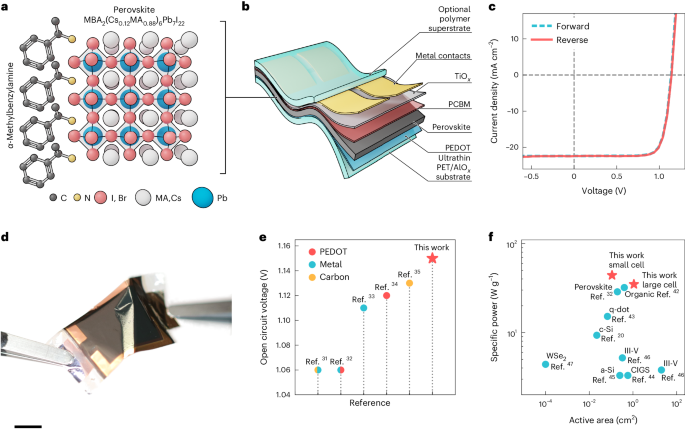
Perovskite solar cells are a promising technology for emerging photovoltaic applications that require mechanical compliance and high specific power. However, the devices suffer from poor operational stability. Here we develop lightweight, thin (<2.5 μm), flexible and transparent-conductive-oxide-free quasi-two-dimensional perovskite solar cells by incorporating alpha-methylbenzyl ammonium iodide into the photoactive perovskite layer. We fabricate the devices directly on an ultrathin polymer foil coated with an alumina barrier layer to ensure environmental and mechanical stability without compromising weight and flexibility. We demonstrate a champion specific power of 44 W g−1 (average: 41 W g−1), an open-circuit voltage of 1.15 V and a champion efficiency of 20.1% (average: 18.1%). To show scalability, we fabricate a photovoltaic module consisting of 24 interconnected 1 cm2 solar cells and demonstrate energy-autonomous operation of a hybrid solar-powered quadcopter, while constituting only 1/400 of the drone’s weight. Our performance and stability demonstration of ultra-lightweight perovskite solar cells highlight their potential as portable and cost-effective sustainable energy harvesting devices.

Flexible quasi-2D perovskite solar cells with high specific power and improved stability for energy-autonomous drones - Nature Energyhttps://www.nature.com/articles/s41560-024-01500-2Open linkView original on lemmy.ml