

Posts

NASA Webb Pushes Boundaries of Observable Universe Closer to Big Bang
Meet our current record holder for farthest galaxy ever seen (so far!!)
MoM-z14 may look like an unimpressive little yellow smudge here, but it's our first view of a galaxy that existed just 280 million years after the big bang and lies over 13.5 billion light years away from here.
https://www.flickr.com/photos/nasawebbtelescope/55065929901/in/album-72177720331299130
Intricacies of Helix Nebula Revealed with NASA’s Webb
Webb captured a new close-up of an old favorite, the Helix Nebula. We’ve seen this region before with telescopes like Hubble and the retired Spitzer Space Telescope, but Webb zooms into this dying star with a deeper, more detailed view.
https://science.nasa.gov/mission/webb/multimedia/images/#Engineering-And-Test-Images
 https://www.flickr.com/photos/nasawebbtelescope/55051947249/in/album-72177720331299130Open linkView original on lemmy.world
NASA's Webb Telescope Studies Moon-Forming Disk Around Massive Planet - NASA Science
NASA’s James Webb Space Telescope has provided the first direct measurements of the chemical and physical properties of a potential moon-forming disk encircling a large exoplanet. The carbon-rich disk surrounding the world called CT Cha b, which is located 625 light-years away from Earth, is a possible construction yard for moons, although no moons are detected in the Webb data.
 https://science.nasa.gov/missions/webb/nasas-webb-telescope-studies-moon-forming-disk-around-massive-planet/Open linkView original on lemmy.world
Webb brings cosmic lenses into focus
Webb brings cosmic lenses into focus Nature’s magnifying glass 🔎
Galaxies in these images might look stretched or warped. That’s due to gravitational lensing, a tool that allows us to peer even further into the universe!
Gravitational lensing occurs because the gravity of massive objects like galaxies and galaxy clusters can warp the fabric of spacetime, bending the path of light around the object. When a massive foreground object lines up with a background galaxy, the light from the background galaxy bends on its way to our telescopes.
https://www.flickr.com/photos/nasawebbtelescope/54822781985/in/album-72177720323168468
NASA's Webb Explores Largest Star-Forming Cloud in Milky Way - NASA Science
NASA’s James Webb Space Telescope has revealed a colorful array of massive stars and glowing cosmic dust in the Sagittarius B2 molecular cloud, the most massive and active star-forming region in our Milky Way galaxy.
https://science.nasa.gov/missions/webb/nasas-webb-explores-largest-star-forming-cloud-in-milky-way/Open linkView original on lemmy.worldNASA’s Webb Observes Immense Stellar Jet on Outskirts of Our Milky Way - NASA Science
A blowtorch of seething gasses erupting from a volcanically growing monster star has been captured by NASA’s James Webb Space Telescope. Stretching across 8 light-years, the length of the stellar eruption is approximately twice the distance between our Sun and the next nearest stars, the Alpha Centauri system. The size and strength of this particular stellar jet, located in a nebula known as Sharpless 2-284 (Sh2-284 for short), qualifies it as rare, say researchers.
Spying a spiral through a cosmic lens
Expand your imagination 🍥
What appears to be a single galaxy is actually two that are very far apart! The closer galaxy lies in the center of the image, while the more distant galaxy appears to be wrapped around it in a phenomenon we call an “Einstein ring.”
Einstein rings occur when light from a distant galaxy gets bent by the gravity of a massive closer-by object, in this case another galaxy. The light from the distant galaxy that would otherwise travel in a straight line follows the bend of gravitationally warped spacetime, brightening the light from behind the galaxy and acting as a sort of natural magnifying glass. Einstein predicted this effect in his theory of relativity.
Arp 107 (MIRI Image)
This image of Arp 107, shown by Webb’s MIRI (Mid-Infrared Instrument), reveals the supermassive black hole that lies in the center of the large spiral galaxy to the right. This black hole, which pulls much of the dust into lanes, also display’s Webb’s characteristic diffraction spikes, caused by the light that it emits interacting with the structure of the telescope itself.
Perhaps the defining feature of the region, which MIRI reveals, are the millions of young stars that are forming, highlighted in blue. These stars are surrounded by dusty silicates and soot-like molecules known as polycyclic aromatic hydrocarbons. The small elliptical galaxy to the left, which has already gone through much of its star formation, is composed of many of these organic molecules.
Credits Image NASA, ESA, CSA, STScI
https://webbtelescope.org/contents/media/images/2024/132/01J74B5B0C2MKBE2QXTMW46T4Z
Long-wavelength NIRCam Orion mosaic in ESASky
One of the brightest nebulae in the night sky is Messier 42, the Orion Nebula, located south of Orion’s belt. At its core is the young Trapezium Cluster of stars, the most massive of which illuminate the surrounding gas and dust with their intense ultraviolet radiation fields, while protostars continue to form today in the OMC-1 molecular cloud behind.
https://www.flickr.com/photos/nasawebbtelescope/53230009083/in/album-72177720305127361/
NASA’s Webb Snaps Supersonic Outflow of Young Star
Herbig-Haro (HH) objects are luminous regions surrounding newborn stars, formed when stellar winds or jets of gas spewing from these newborn stars form shock waves colliding with nearby gas and dust at high speeds. This image of HH 211 from NASA’s James Webb Space Telescope reveals an outflow from a Class 0 protostar, an infantile analog of our Sun when it was no more than a few tens of thousands of years old and with a mass only 8% of the present-day Sun (it will eventually grow into a star like the Sun).
Webb Reveals New Structures Within Iconic Supernova
NASA’s James Webb Space Telescope has begun the study of one of the most renowned supernovae, SN 1987A (Supernova 1987A). Located 168,000 light-years away in the Large Magellanic Cloud, SN 1987A has been a target of intense observations at wavelengths ranging from gamma rays to radio for nearly 40 years, since its discovery in February of 1987. New observations by Webb’s NIRCam (Near-Infrared Camera) provide a crucial clue to our understanding of how a supernova develops over time to shape its remnant.
https://www.nasa.gov/feature/goddard/2023/webb-reveals-new-structures-within-iconic-supernova
 https://www.nasa.gov/feature/goddard/2023/webb-reveals-new-structures-within-iconic-supernovaOpen linkView original on lemmy.world
Webb Reveals Intricate Details in the Remains of a Dying Star – James Webb Space Telescope
Editor’s Note: This post highlights data from Webb science in progress, which has not yet been through the peer-review process.
NASA’s James Webb Space Telescope obtained images of the Ring Nebula, one of the best-known examples of a planetary nebula. Much like the Southern Ring Nebula, one of Webb’s first images, the Ring Nebula displays intricate structures of the final stages of a dying star. Roger Wesson from Cardiff University tells us more about this phase of a Sun-like star’s stellar lifecycle and how Webb observations have given him and his colleagues valuable insights into the formation and evolution of these objects, hinting at a key role for binary companions.
Webb Reveals Colors of Earendel, Most Distant Star Ever Detected
NASA’s James Webb Space Telescope has followed up on observations by the Hubble Space Telescope of the farthest star ever detected in the very distant universe, within the first billion years after the big bang. Webb’s NIRCam (Near-Infrared Camera) instrument reveals the star to be a massive B-type star more than twice as hot as our Sun, and about a million times more luminous.
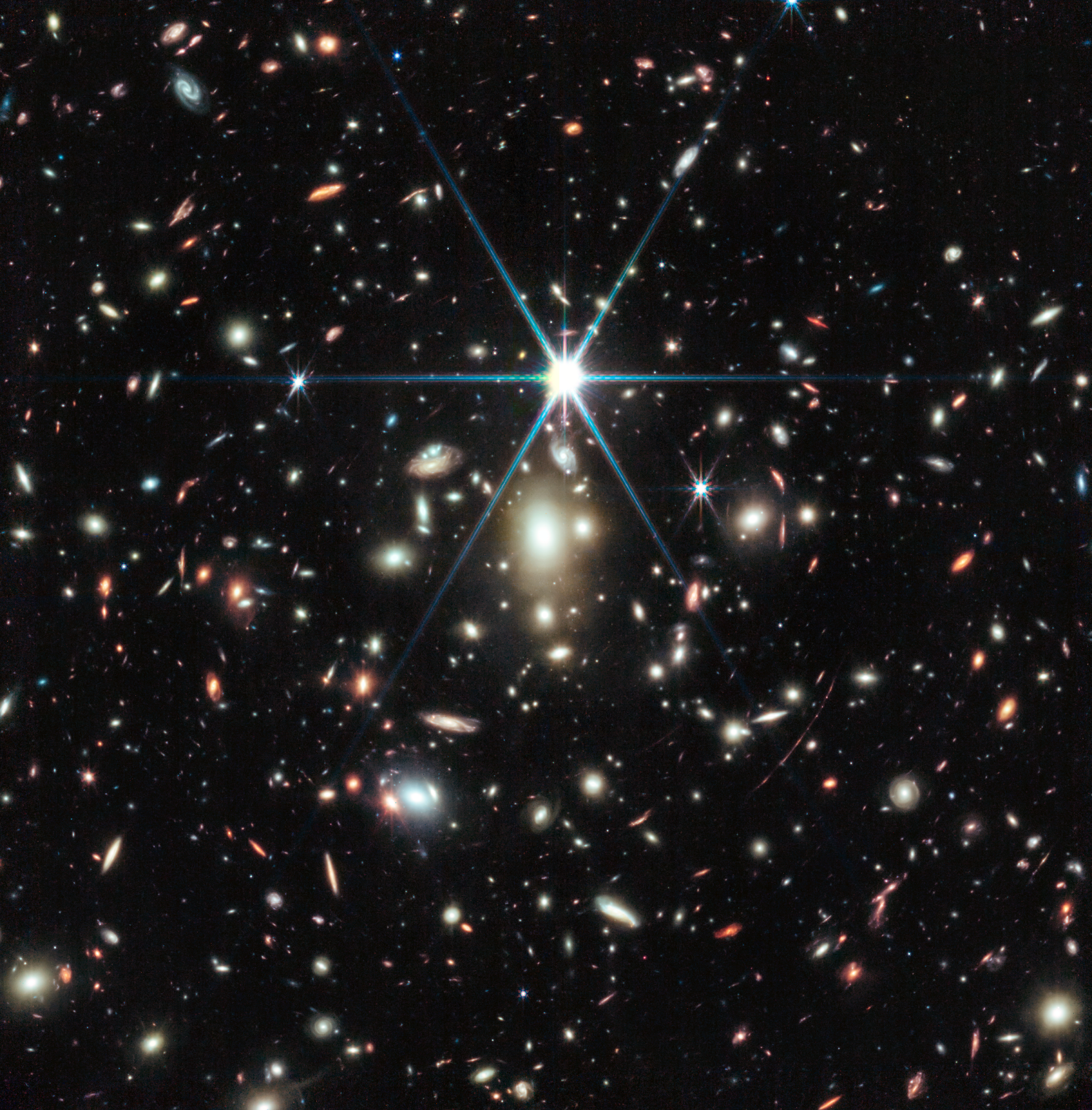 https://www.nasa.gov/feature/goddard/2023/webb-reveals-colors-of-earendel-most-distant-star-ever-detectedOpen linkView original on lemmy.world
Webb Spotlights Gravitational Arcs in ‘El Gordo’ Galaxy Cluster
A new image of the galaxy cluster known as “El Gordo” is revealing distant and dusty objects never seen before, and providing a bounty of fresh science. The infrared image, taken by NASA’s James Webb Space Telescope, displays a variety of unusual, distorted background galaxies that were only hinted at in previous Hubble Space Telescope images.
Webb Detects Water Vapor in Rocky Planet-Forming Zone
Water is essential for life as we know it. However, scientists debate how it reached the Earth and whether the same processes could seed rocky exoplanets orbiting distant stars. New insights may come from the planetary system PDS 70, located 370 light-years away. The star hosts both an inner disk and outer disk of gas and dust, separated by a 5 billion-mile-wide (8 billion kilometer) gap, and within that gap are two known gas-giant planets.
https://www.nasa.gov/feature/goddard/2023/webb-detects-water-vapor-in-rocky-planet-forming-zone
What’s in Webb’s Toolkit?
The James Webb Space Telescope’s four scientific instruments are capable of examining the universe across a range of light called infrared, which is beyond the red end of the visible light rainbow (Webb also captures a little visible red as well). Infrared wavelengths are broken down into near-, mid-, and far-infrared ranges. Each instrument has unique features that allow astronomers to study a variety of astronomical objects in different ways.
James Webb Space Telescope makes 1st detection of diamond-like carbon dust in the universe's earliest stars
The James Webb Space Telescope has detected the earliest-known carbon dust in a galaxy ever.
Using the powerful space telescope, a team of astronomers spotted signs of the element that forms the backbone of all life in ten different galaxies that existed as early as 1 billion years after the Big Bang.
The detection of carbon dust so soon after the Big Bang could shake up theories surrounding the chemical evolution of the universe. This is because the processes that create and disperse heavier elements like this should take longer to build up in galaxies than the age of these young galaxies at the time the James Webb Space Telescope (JWST) sees them.
 https://www.space.com/james-webb-space-telescope-1st-detection-of-diamond-like-carbon-dust-earliest-starsOpen linkView original on lemmy.world
JWST finds ‘smoking gun’ evidence of early galaxies transforming the universe
Using the James Webb Space Telescope (JWST), an international team of astronomers has found compelling evidence that early galaxies were responsible for the reionization of the early universe. This is the process by which neutral hydrogen atoms are ionized, making the universe transparent to light at wavelengths that would have been absorbed by the atoms. The research was done by members of the EIGER collaboration, which is using the JWST’s Near Infrared Camera (NIRCam) to study light from quasars in the early universe.
NASA’s Webb Delivers Deepest Infrared Image of Universe Yet
NASA’s James Webb Space Telescope has delivered the deepest and sharpest infrared image of the distant universe so far. Webb’s First Deep Field is galaxy cluster SMACS 0723, and it is teeming with thousands of galaxies – including the faintest objects ever observed in the infrared.