


Ipset Hash is full, cannot add more elements
My ipset hash is full!? I'm using Ubuntu Server and I created a separate fail2ban jail that uses "iptables-ipset-proto6-allports" as their ban action (thus using ipset instead of iptables).
However, today I seem to hit the limit: stderr: 'ipset v7.15: Hash is full, cannot add more elements'.
This can be confirmed by running the ipset -t list command:
Name: f2b-manual
Type: hash:ip
Revision: 5
Header: family inet hashsize 32768 maxelem 65536 timeout 0 bucketsize 12 initval 0xbc28aef1
Size in memory: 2605680
References: 1
Number of entries: 65571
Where the 65571 entries exceeds the maxelem (65536). So what now?? Could I create a banlist in a txt file or something? I just want to ban some large tech corps: https://gitlab.melroy.org/-/snippets/619

Supply Chain Security Harm Reduction with 3TOFU
3TOFU: Verifying Unsigned Releases
By Michael Altfield
License: CC BY-SA 4.0
https://tech.michaelaltfield.net
This article introduces the concept of "3TOFU" -- a harm-reduction process when downloading software that cannot be verified cryptographically.
| Verifying Unsigned Releases with 3TOFU |
⚠ NOTE: This article is about harm reduction.
It is dangerous to download and run binaries (or code) whose authenticity you cannot verify (using a cryptographic signature from a key stored offline). However, sometimes we cannot avoid it. If you're going to proceed with running untrusted code, then following the steps outlined in this guide may reduce your risk.
TOFU
TOFU stands for Trust On First Use. It's a (often abused) concept of downloading a person or org's signing key and just blindly trusting it (instead of verifying it).
3TOFU
3TOFU is a process where a user downloads something three times at three different locations. If-and-only-if all three downloads are identical, then you trust it.
Why 3TOFU?
During the Crypto Wars of the 1990s, it was illegal to export cryptography from the United States. In 1996, after intense public pressure and legal challenges, the government officially permitted export with the 56-bit DES cipher -- which was a known-vulnerable cipher.
| The EFF's Deep Crack proved DES to be insecure and pushed a switch to 3DES. |
But there was a simple way to use insecure DES to make secure messages: just use it three times.
3DES (aka "Triple DES") is the process encrypting a message using the insecure symmetric block cipher (DES) three times on each block, to produce an actually secure message (from known attacks at the time).
3TOFU (aka "Triple TOFU") is the process of downloading a payload using the insecure method (TOFU) three times, to obtain the payload that's magnitudes less likely to be maliciously altered.
3TOFU Process
To best mitigate targeted attacks, 3TOFU should be done:
- On three distinct days
- On three distinct machines (or VMs)
- Exiting from three distinct countries
- Exiting using three distinct networks
For example, I'll usually execute
- TOFU #1/3 in TAILS (via Tor)
- TOFU #2/3 in a Debian VM (via VPN)
- TOFU #3/3 on my daily laptop (via ISP)
The possibility of an attacker maliciously modifying something you download over your ISP's network are quite high, depending on which country you live-in.
The possibility of an attacker maliciously modifying something you download onto a VM with a freshly installed OS over an encrypted VPN connection (routed internationally and exiting from another country) is much less likely, but still possible -- especially for a well-funded adversary.
The possibility of an attacker maliciously modifying something you download onto a VM running a hardened OS (like Whonix or TAILS) using a hardened browser (like Tor Browser) over an anonymizing network (like Tor) is quite unlikely.
The possibility for someone to execute a network attack on all three downloads is very near-zero -- especially if the downloads were spread-out over days or weeks.
3TOFU bash Script
I provide the following bash script as an example snippet that I run for each of the 3TOFUs.
REMOTE_FILES="https://tails.net/tails-signing.key"

CURL="/usr/bin/curl"
WGET="/usr/bin/wget --retry-on-host-error --retry-connrefused"
PYTHON="/usr/bin/python3"

# in tails, we must torify
if [[ "`whoami`" == "amnesia" ]] ; then
	CURL="/usr/bin/torify ${CURL}"
	WGET="/usr/bin/torify ${WGET}"
	PYTHON="/usr/bin/torify ${PYTHON}"
fi

tmpDir=`mktemp -d`
pushd "${tmpDir}"

# first get some info about our internet connection
${CURL} -s https://ifconfig.co/country | head -n1
${CURL} -s https://check.torproject.org | grep Congratulations | head -n1

# and today's date
date -u +"%Y-%m-%d"

# get the file
for file in ${REMOTE_FILES}; do
	wget ${file}
done

# checksum
date -u +"%Y-%m-%d"
sha256sum *

# gpg fingerprint
gpg --with-fingerprint  --with-subkey-fingerprint --keyid-format 0xlong *
Here's one example execution of the above script (on a debian DispVM, executed with a VPN).
/tmp/tmp.xT9HCeTY0y ~
Canada
2024-05-04
--2024-05-04 14:58:54--  https://tails.net/tails-signing.key
Resolving tails.net (tails.net)... 204.13.164.63
Connecting to tails.net (tails.net)|204.13.164.63|:443... connected.
HTTP request sent, awaiting response... 200 OK
Length: 1387192 (1.3M) [application/octet-stream]
Saving to: ‘tails-signing.key’

tails-signing.key   100%[===================>]   1.32M  1.26MB/s    in 1.1s

2024-05-04 14:58:56 (1.26 MB/s) - ‘tails-signing.key’ saved [1387192/1387192]

2024-05-04
8c641252767dc8815d3453e540142ea143498f8fbd76850066dc134445b3e532  tails-signing.key
gpg: WARNING: no command supplied.  Trying to guess what you mean ...
pub   rsa4096/0xDBB802B258ACD84F 2015-01-18 [C] [expires: 2025-01-25]
      Key fingerprint = A490 D0F4 D311 A415 3E2B  B7CA DBB8 02B2 58AC D84F
uid                             Tails developers (offline long-term identity key) <[email protected]>
uid                             Tails developers <[email protected]>
sub   rsa4096/0x3C83DCB52F699C56 2015-01-18 [S] [expired: 2018-01-11]
sub   rsa4096/0x98FEC6BC752A3DB6 2015-01-18 [S] [expired: 2018-01-11]
sub   rsa4096/0xAA9E014656987A65 2015-01-18 [S] [revoked: 2015-10-29]
sub   rsa4096/0xAF292B44A0EDAA41 2016-08-30 [S] [expired: 2018-01-11]
sub   rsa4096/0xD21DAD38AF281C0B 2017-08-28 [S] [expires: 2025-01-25]
sub   rsa4096/0x3020A7A9C2B72733 2017-08-28 [S] [revoked: 2020-05-29]
sub   ed25519/0x90B2B4BD7AED235F 2017-08-28 [S] [expires: 2025-01-25]
sub   rsa4096/0xA8B0F4E45B1B50E2 2018-08-30 [S] [revoked: 2021-10-14]
sub   rsa4096/0x7BFBD2B902EE13D0 2021-10-14 [S] [expires: 2025-01-25]
sub   rsa4096/0xE5DBA2E186D5BAFC 2023-10-03 [S] [expires: 2025-01-25]
The TOFU output above shows that the release signing key from the TAILS project is a 4096-bit RSA key with a full fingerprint of "A490 D0F4 D311 A415 3E2B B7CA DBB8 02B2 58AC D84F". The key file itself has a sha256 hash of "8c641252767dc8815d3453e540142ea143498f8fbd76850066dc134445b3e532".
When doing a 3TOFU, save the output of each execution. After collecting output from all 3 executions (intentionally spread-out over 3 days or more), diff the output.
If the output of all three TOFUs match, then the confidence of the file's authenticity is very high.
Why do 3TOFU?
Unfortunately, many developers think that hosting their releases on a server with https is sufficient to protect their users from obtaining a maliciously-modified release. But https won't protect you if:
- Your DNS or publishing infrastructure is compromised (it happens), or
- An attacker has just one (subordinate) CA in the user's PKI root store (it happens)
Generally speaking, publishing infrastructure compromises are detected and resolved within days and MITM attacks using compromised CAs are targeted attacks (to avoid detection). Therefore, a 3TOFU verification should thwart these types of attacks.
⚠ Note on hashes: Unfortunately, many well-meaning developers erroneously think that cryptographic hashes provide authenticity, but cryptographic hashes do not provide authenticity -- they provide integrity.
Integrity checks are useful to detect corrupted data on-download; it does not protect you from maliciously altered data unless those hashes are cryptographically signed with a key whose private key isn't stored on the publishing infrastructure.
Improvements
There are some things you can do to further improve the confidence of the authenticity of a file you download from the internet.
Distinct Domains
If possible, download your payload from as many distinct domains as possible.
An adversary may successfully compromise the publishing infrastructure of a software project, but it's far less likely for them to compromise the project website (eg 'tails.net') and their forge (eg 'github.com') and their mastodon instance (eg 'mastodon.social').
Use TAILS
| TAILS is by far the best OS to use for security-critical situations. |
If you are a high-risk target (investigative journalist, activist, or political dissident) then you should definitely use TAILS for one of your TOFUs.
Signature Verification
It's always better to verify the authenticity of a file using cryptographic signatures than with 3TOFU.
Unfortunately, some companies like Microsoft don't sign their releases, so the only option to verify the authenticity of something like a Windows .iso is with 3TOFU.
Still, whenever you encounter some software that is not signed using an offline key, please do us all a favor and create a bug report asking the developer to sign their releases with PGP (or minisign or signify or something).
4TOFU
3TOFU is easy because Tor is free and most people have access to a VPN (corporate or commercial or an ssh socks proxy).
But, if you'd like, you could also add i2p or some other proxy network into the mix (and do 4TOFU).
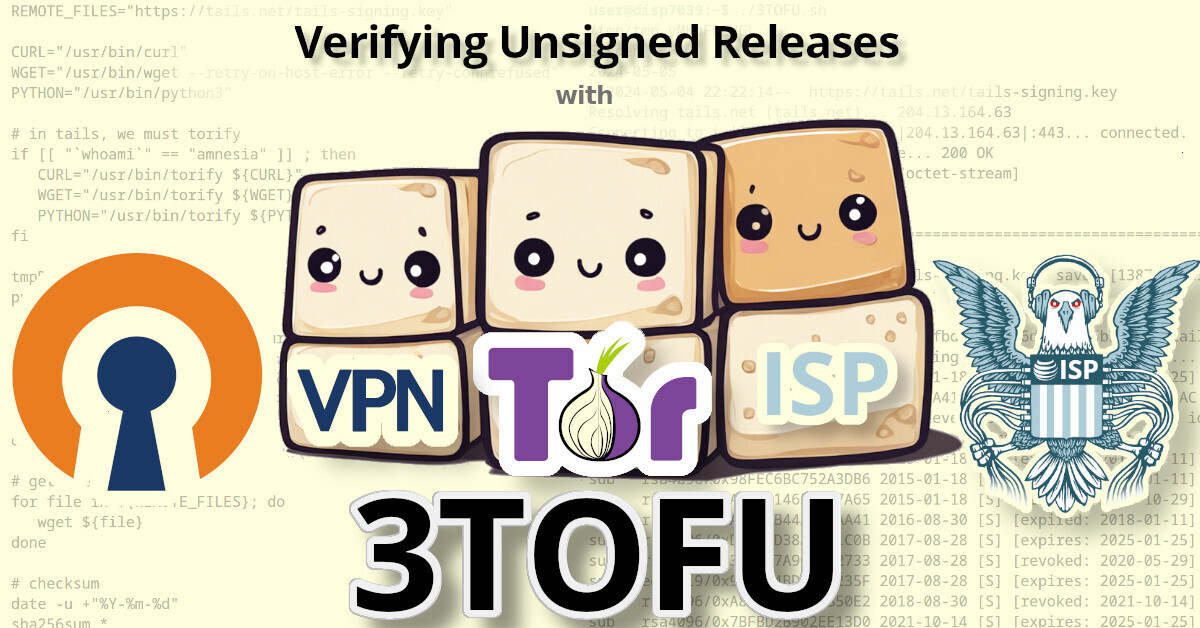 https://tech.michaelaltfield.net/2024/08/04/3tofu/Open linkView original on monero.town
Ghidra training classes from NSA
Ghidra training classes from NSA::undefined
An intro to automated evasion and compilation of .NET offensive tools
An intro to automated evasion and compilation of .NET offensive tools::Information Security Services. Offensive Security, Penetration Testing, Mobile and Application, Purple Team, Red Team
 https://tierzerosecurity.co.nz/2024/03/03/teamcity-sharpwmi-evasion.htmlOpen linkView original on lemmy.world
Phrack #71: Call For Paper
Phrack #71: Call For Paper::Phrack staff website.


Hacking Terraform state to gain code execution and privilege escalation
Hacking Terraform state to gain code execution and privilege escalation::undefined
 https://blog.plerion.com/hacking-terraform-state-privilege-escalation/Open linkView original on lemmy.world
Data Scientists Targeted by Malicious Hugging Face ML Models with Silent Backdoor
Data Scientists Targeted by Malicious Hugging Face ML Models with Silent Backdoor::Is Hugging Face the target of model-based attacks? See a detailed explanation of the attack mechanism and what is required to identify real threats >
 https://jfrog.com/blog/data-scientists-targeted-by-malicious-hugging-face-ml-models-with-silent-backdoor/Open linkView original on lemmy.world
New Server Side Prototype Pollution Gadgets Scanner from Doyensec
New Server Side Prototype Pollution Gadgets Scanner from Doyensec::Unveiling the Server-Side Prototype Pollution Gadgets Scanner
It's now possible to find the AWS Account ID for any S3 Bucket (private or public)
It's now possible to find the AWS Account ID for any S3 Bucket (private or public)::A technique to find the Account ID of a private S3 bucket.
“SubdoMailing” — Thousands of Hijacked Major-Brand Subdomains Found Bombarding Users With Millions of Malicious Emails
“SubdoMailing” — Thousands of Hijacked Major-Brand Subdomains Found Bombarding Users With Millions of Malicious Emails::undefined
SEO Poisoning to Domain Control: The Gootloader Saga Continues
SEO Poisoning to Domain Control: The Gootloader Saga Continues::Key Takeaways More information about Gootloader can be found in the following reports: The DFIR Report, GootloaderSites, Mandiant, Red Canary, & Kroll. An audio version of this report can be … Read More
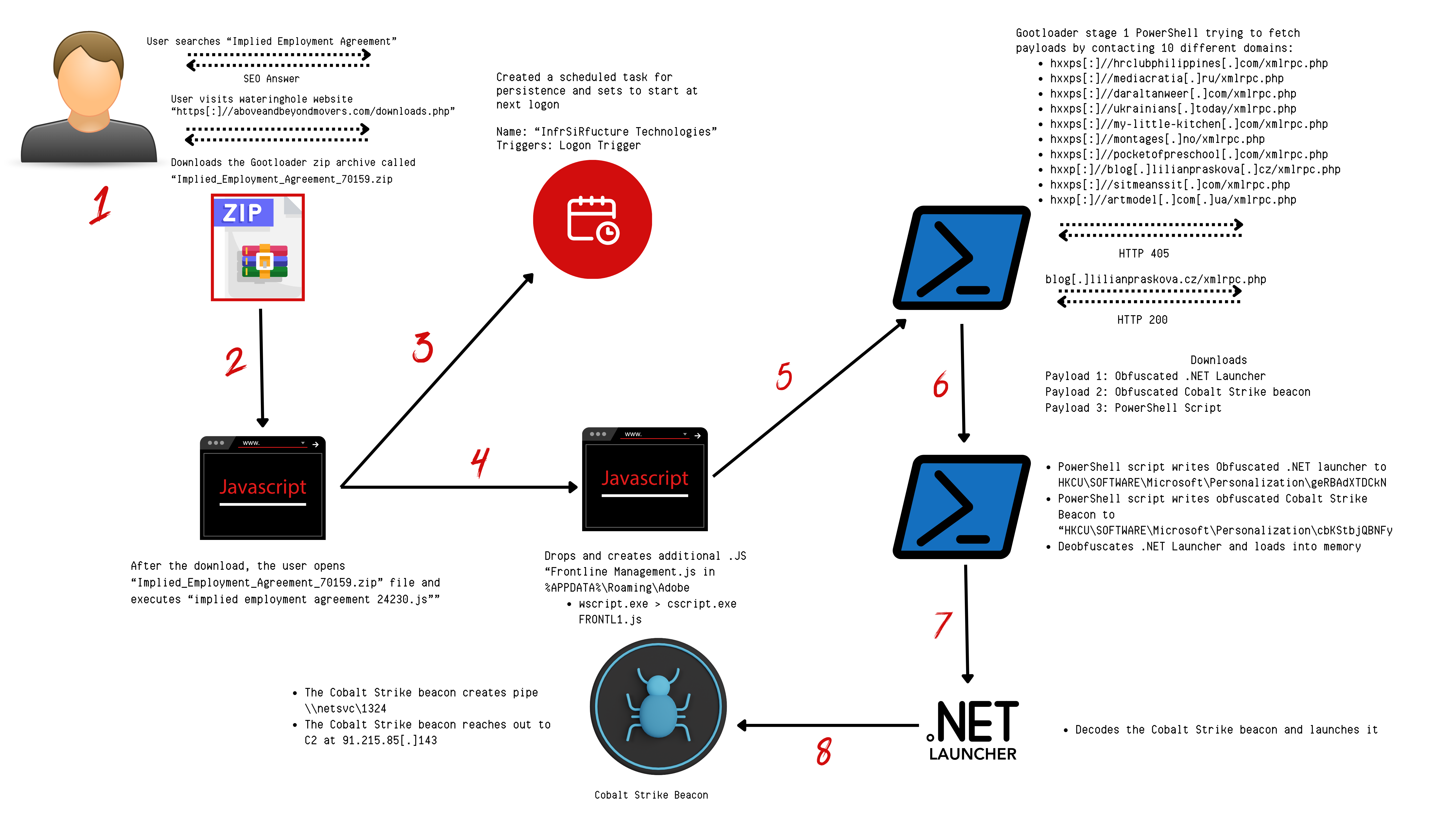 https://thedfirreport.com/2024/02/26/seo-poisoning-to-domain-control-the-gootloader-saga-continues/Open linkView original on lemmy.world
Code injection or backdoor: A new look at Ivanti's CVE-2021-44529
Code injection or backdoor: A new look at Ivanti's CVE-2021-44529::In 2021, Ivanti patched a vulnerability that they called “code injection”. Rumors say it was a backdoor in an open source project. Let’s find out what actually happened!
 https://www.labs.greynoise.io/grimoire/2024-02-what-is-this-old-ivanti-exploit/Open linkView original on lemmy.world
Python Risk Identification Tool for generative AI (PyRIT)
Python Risk Identification Tool for generative AI (PyRIT)::The Python Risk Identification Tool for generative AI (PyRIT) is an open access automation framework to empower security professionals and machine learning engineers to proactively find risks in their generative AI systems. - Azure/PyRIT
 https://github.com/Azure/PyRITOpen linkView original on lemmy.world
New TP-Link authentication Bypass!
New TP-Link authentication Bypass!::undefined