


'Absolutely Crazy': Acceleration of Climate Collapse Feared as Temps in Antarctic 20°C Higher Than Normal | Common Dreams
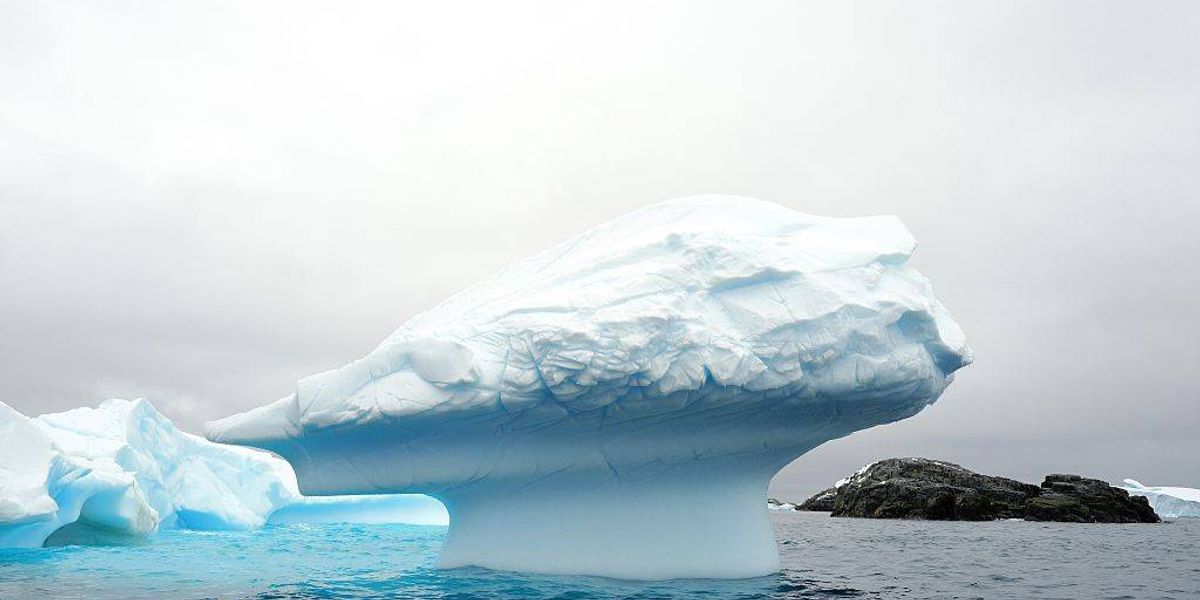
Climate scientists are sounding the alarm after an unprecedented heatwave hit Antarctica this month and delivered temperatures 20°C higher than normal.
According to a Friday report in The Guardian, temperatures at Antarctica's Trinity Peninsula this month hit peaks of over 15°C, even though it is the start of winter when ice typically expands on the continent. The prior record June temperature at the peninsula, 13.3°C, was set in 1998.
After weeks of above-average temperatures, scientists noticed that an area of sea ice that typically forms in the region—one roughly the size of France—was missing.
"It’s depressing,” Will Hobbs, an Antarctic sea ice expert at the University of Tasmania, told The Guardian. "It is remarkable that we are in June and there is no sea ice there."
Hobbs also predicted that the loss of sea ice is likely permanent at this point given the trajectory of global temperature changes.
Peter Fretwell, a scientist at the British Antarctic Survey, explained to the newspaper that the loss of sea ice poses a serious threat to penguin populations.
"Sea ice is forming too late and breaking up too early," Fretwell explained. "It leads to reduced breeding success and longer trips to moulting grounds."
In a separate interview with The Guardian last week, Raúl Cordero, a climate professor at the University of Groningen, expressed astonishment at the record-breaking Antarctic heat.
“This is absolutely crazy,” Cordero said. "That is a huge anomaly.”
Luis Muñoz, a Chilean glaciologist, told the newspaper he was shocked to step outside at King George's Island, located just north of Trinity Peninsula, and seeing the ground uncovered by snow.
"The temperatures here went very high so everything outside melted,” Muñoz explained. “Usually there is 20 centimeters of snow and a lot of ice on the ground at this time.”
Taking stock of the bigger picture, the newspaper reported that scientists are now fearful that some of the biggest glaciers in the region of the peninsula have now "past a tipping point" that could "push up global sea levels by four meters."
Such a rise in global sea levels would be unprecedented. Scientists estimate that global sea levels have risen by between 21 and 24 centimeters since 1880.
 https://www.commondreams.org/news/antarctica-record-heat-juneOpen linkView original on mander.xyz

Warm winter fuels early virus threat in Yuma, AZ melon fields. Mild temperatures helped insects survive in larger numbers than usual, including whiteflies, which can spread multiple plant viruses.
 https://www.azfamily.com/2026/05/28/warm-winter-fuels-early-virus-threat-yuma-melon-fields/?ICID=ref_farkOpen linkView original on lemmy.world

Green Group Warns Trump's Offshore Drilling Plan Risks 4,000+ Additional Oil Spills | Common Dreams
President Donald Trump's plan to dramatically expand offshore drilling could result in thousands of additional oil spills and put dozens of endangered species at increased risk, according to a new analysis by a leading conservation group.
In November, the US Department of the Interior published a draft plan to expand drilling over the next five years, replacing a more restrictive one drawn up by the Biden administration.
The proposal includes as many as 34 potential offshore lease sales across American coasts, covering approximately 1.27 billion acres, far more than previous administrations have offered.
The new plan opens up drilling in 21 areas off the coast of Alaska, seven in the Gulf of Mexico, and six along the Pacific Coast. These are in addition to 36 new offshore oil lease sales mandated in last year's Republican budget reconciliation package.
An analysis published Tuesday by the Center for Biological Diversity found that the increase in drilling could lead to an additional 4,232 oil spills and dump an extra 12.1 million gallons of oil into ocean waters.
The calculation is based on average spill rates from pipelines and platforms from 1974 to 2015. However, it does not even include catastrophic events like the 2010 BP oil spill, which resulted in more than 210 million gallons of oil being released into the Gulf of Mexico.
"Trump’s ridiculously reckless drilling plan could cause thousands of new oil spills, threatening almost every US coast,” said Kristen Monsell, the oceans legal director at the Center for Biological Diversity.
The group estimates, based on prior figures, that 2,627 of those spills—more than half—will occur in the Gulf of Mexico, releasing about 7.5 million gallons of oil into the ecosystem.
The Gulf is home to several endangered species likely to be affected by the new drilling. The black-capped petrel's population is in rapid decline as pollution has destroyed its food source. Rice's whale has only about 50 individuals remaining and lost 20% of its population in the BP spill. Kemp's ridley sea turtle, which has experienced a population rebound after dropping to near extinction, would be imperiled by another spill.
In the Pacific, sea otters are uniquely vulnerable to oil spills because they coat their fur, which acts as insulation against the cold. Killer and blue whales, whose populations have been nearly wiped out, would also be in danger.
Meanwhile, Arctic animals already affected by climate change—like bowhead whales, Pacific walruses, and beluga whales—all face potential further damage to their habitats due to drilling off the coast of Alaska.
“Nobody wants beaches and marine life coated in crude, but that’ll be our future if Trump’s scheme goes forward," Monsell said. "Every new drilling project signs us up for decades of problems, and our wildlife and coastal economies will suffer the most.”
 https://www.commondreams.org/news/trump-offshore-drilling-spillsOpen linkView original on literature.cafe

Reforming CEQA: What California’s Environmental Law Changes Mean For Housing
The California Environmental Quality Act (CEQA) created environmental protections in areas of government and most private developments. Some advocate for rolling back CEQA to decrease housing costs. Others argue the roll back undermines California’s position as a climate leader and worsen water quality and pollution conditions. Is affordable housing worth worsening environmental conditions? Should CEQA’s roll back wording be updated to best protect California’s environment?
 https://ace-usa.org/blog/research/research-housing-policy/reforming-ceqa-what-californias-environmental-law-changes-mean-for-housing/Open linkView original on lemmy.world
China Sets First Absolute Emissions Cut Target for 2035, Falling Short of Paris Path
cross-posted from: https://lemmy.sdf.org/post/42916278
[...]
China has pledged for the first time to cut its greenhouse gas emissions in absolute terms, committing to reduce economy-wide net emissions by 7–10% from peak levels by 2035, “striving to do better.” President Xi Jinping announced the target in a video address to a high-level climate summit in New York convened by UN Secretary-General António Guterres during the General Assembly.
[...]
Experts welcomed the structural shift to an absolute cut but judged the ambition insufficient for a 1.5°C pathway. “Anything less than 30% is not aligned with 1.5 degrees,” said Lauri Myllyvirta of the Centre for Research on Energy and Clean Air (CREA). Greenpeace East Asia’s Yao Zhe said the plan “still falls short,” even for tempered expectations. Belinda Schäpe, a China policy analyst at CREA, framed the pledge as politically cautious and argued China’s clean-energy boom could still deliver reductions of 30% or more by 2035 if current trends hold. In her words, today’s announcement should be viewed as the floor, not the ceiling.
[...]
 https://esgnews.com/china-sets-first-absolute-emissions-cut-target-for-2035-falling-short-of-paris-path/Open linkView original on lemmy.sdf.org

Photos: The Scale of China’s Solar-Power Projects
A good-news story. Geopolitical enemy or not, at least someone's doing something about the problem.
 https://www.theatlantic.com/photography/archive/2025/07/photos-china-solar-power-energy/683488/Open linkView original on lemmy.world