
"Useless syntax sugar": Numbered block parameters in Ruby
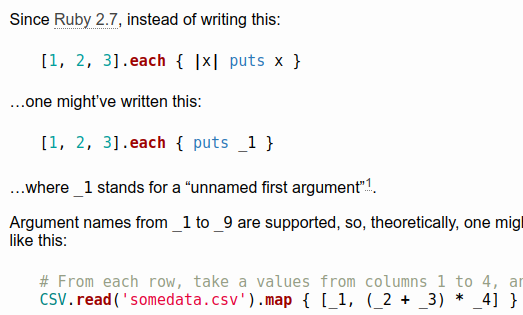 https://zverok.space/blog/2023-10-11-syntax-sugar1-numeric-block-args.htmlOpen linkView original on programming.devhttps://zverok.space/blog/2023-10-11-syntax-sugar1-numeric-block-args.htmlOpen linkView original on programming.dev
and that's yet another way to end up with hard to read code.
Variables hold values that have meaning. Learn how to name things and you'll write good code.
edit: someone just wrote an article along these lines. The only thing I'd change is the cause-effect relationship between bad names and bad code. IME bad names lead to bad code, not usually the other way around. The reason is that by starting from good name choices, it's much easier to have a well structured code. And not rarely, bad names lead to mangled up code that screams for a refactoring.
This makes me want to write a function for you to add to numbers where the variables are leftumber and rightnumber, instead of x and y.
if "left" and "right" were relevant for addition, they would indeed be better names
Are you against using a single letter variable like e for element in iterating over things?
yes
To each their own. But man imagine if you have a collection of stuff that has a large name, and then having to figure out a short name other than e when iterating. I hope you're not iterating over chemical names 😬
No need to be over-descriptive. Anything at all more specific than
ewill probably be a better nameImplementing add (and other math operations) in rust for your types has the type signature self and rhs (right hand side).
Lhs and rhs are much better than x and y
In what way? If you encountered a function that had x and y which just added them together, that's not readable enough?
Well in a vacuum yes sure, you're right, but in practice there's always some context. x and y could be referring to axes, where an addition makes little sense. However lhs and rhs make more sense if you're overloading an operator
Is ruby the new Perl?
That deserves an "always has been" meme... But IMO, Ruby outperled Perl since the beginning.
Perl doesn't let you redefine the syntax so that you can write the same program multiple ways. All it does is to encourage multiple programs to have the same meaning.
I never looked at Ruby, but that doesn't seem like it would be great for readability (although maybe productivity).
People mostly refrain from using it.
Much like people used to create an idiom in Perl and stick to it.
It's designed to be as readable as english.
Take that as you will
And lets you easily write metal languages due to the way you can pass around blocks. Think configuration as code type stuff.
Ruby cribbed a whole lot of syntax from Perl from the very beginning. Most of the rest comes from Smalltalk, but Ruby got it's multitude of two character "$" variables from Perl, it's autosplit mode (-a -n -p switches, letting Ruby, like Perl "emulate Awk"), it's regexp match captures going into $1, $2 etc. from Perl.
I do think the unnumbered variant of such anonymous parameters is useful, if you've got a team of devs that knows not to misuse them.
In particular, folks who are unexperienced will gladly make massive multi-line transformations, all in one step, and then continue blathering on about
itor similar, as if everyone knew what they were talking about and there was no potential for ambiguity.This is also particularly annoying, because you rarely read code top-to-bottom. Ideally, you should be able to jump into the middle of any code and start reading, without having to figure out what the regional abbreviations or
itmean.Damn, I wish rust had that
It wouldn't be as relevant, since passing a function or method instead of a closure is much easier in Rust - you can just name it, while Ruby requires you to use the
methodmethod.So instead of
.map(|res| res.unwrap())you can do.map(Result::unwrap)and it'll Just Work™.Except when Type::Method takes a reference, then it doesn't just work
Well, that's to be expected - the implementation of
mapexpects a function that takes ownership of its inputs, so you get a type mismatch.If you really want to golf things, you can tack your own
map_ref(and friends) onto theIteratortrait. It's not very useful - the output can't reference the input - but it's possible!I imagine you could possibly extend this to a combinator that returns a tuple of
(Input, ref_map'd output)to get around that limitation, although I can't think of any cases where that would actually be useful.In the case of your example we'd do
.map(&:unwrap)in Ruby (if unwrap was a method we'd actually want to call)Notably, these are not the cases
_1and_2etc are for. They are there for the cases that are not structurally "call this method on the single argument to the block" e.g..map{ _1 + _2 }or.map { x.foo(_1) }(
_1is reasonable, because iterating over an enumerable sequence makes it obvious what it is;_1and_2combined is often reasonable, because e.g. if we iterate over a key, value enumerable, such as what you get from enumerating aHash, it's obvious what you get; if you find yourself using_3or above, you're turning to the dark side and should rethink your entire life)Ruby lets you do
.map(&:unwrap)no need for resultsedit: lemmy keeps adding in the
&, not sure how to avoid thatI'm glad it doesnt.
Swift does, though using the dollar sign rather than underscores
I sincerely doubt Rust would ever add something like this.
Is it just me or does it feel kinda unclean for it to just support 1 through 9?
tbf positional arguments are already bad enough. Now if you're using over 9 positional args... just take a break, go for a short walk, and maybe you'll come back with a better plan
I mean 4 is probably too many, 8 definitely is, but also what about splat-args like zip or min. Why not stop at 4? Why not stop at 8 since its a power of two? Any hand-picked limit just feels pretty bleh to me. Either support everything or dont support it at all IMO
Why overthink it. Stopping at the highest single digit decimal number is a fine choice. I'm more unsettled by the sequence starting at
_1instead of_0if anything.OMG looks like Raku