
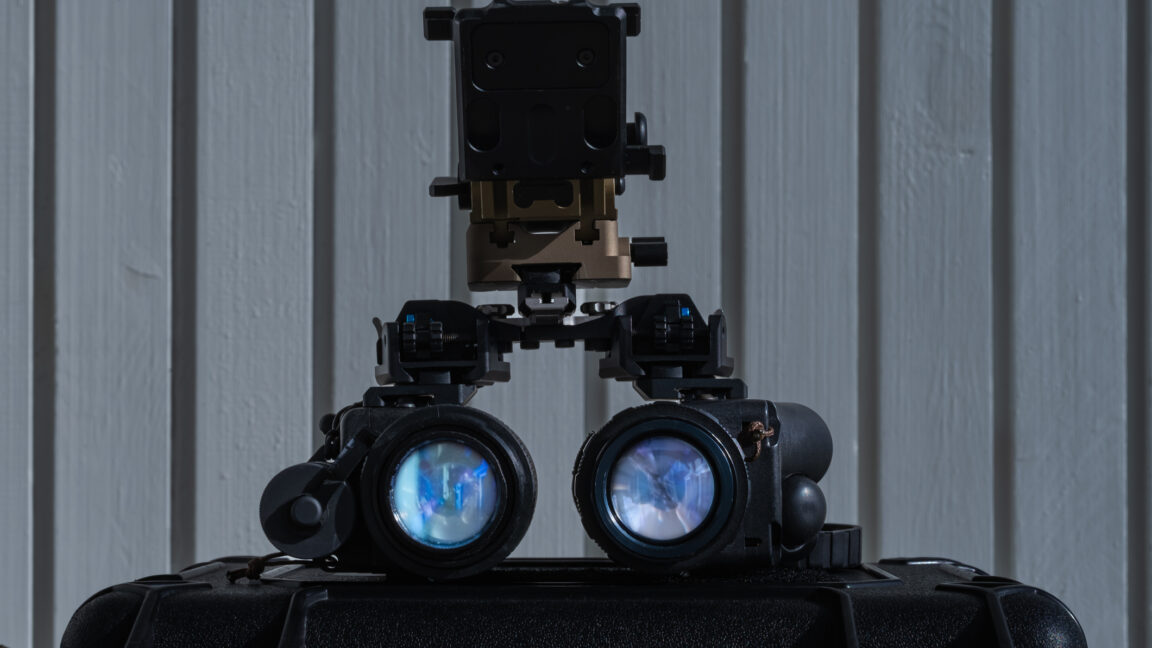
Researchers devise a full-color night vision goggle
Bulk semiconductors routinely used in IR detectors have continuous energy bands, which means they absorb a broad, undifferentiated swath of the infrared spectrum. This doesn’t preserve much information about which specific wavelength arrived. The mercury telluride colloidal quantum dots the Chinese team picked for their device behave differently. Due to their tiny size, roughly 4 nanometers across, quantum confinement breaks their energy levels into discrete steps rather than a continuous chunk. Photons of different infrared wavelengths and intensities excite different electronic transitions, moving an electron between discrete energy levels within the dot, rather than just producing more or less of a single signal.
At wavelengths of around 2 micrometers, the longest the team tested, incoming photons have just enough energy to bump an electron across the dot’s fundamental bandgap, producing a modest number of charge carriers, either negatively charged electrons or positively charged holes that move around the dot.
At shorter infrared wavelengths, photons carry more energy per particle, and they can access additional, higher-energy electronic transitions inside the dot. In some cases the excess energy in a carrier can be enough to kick loose more than one electron-hole pair per photon. These processes open extra channels for generating charge carriers. The effect is that shorter infrared wavelengths and more intense infrared light push more positively charged holes out of the quantum dot layer and toward the OLED side of the device.
 https://arstechnica.com/science/2026/07/see-the-heat-an-infrared-imaging-system-that-outputs-in-color/Open linkView original on sopuli.xyz
2 replies
Super surprised this wouldn't have been implemented as a (mono) camera sensor first. Military funding anyone?
Only if you use "A.I." at least 50 times in the business plan!