

Faster sorting algorithms discovered using deep reinforcement learning
I've not yet had time for reading the full article but the topic is really interesting. This is for sure one great and good application of deep learning. Anyone with some insights on this topic?
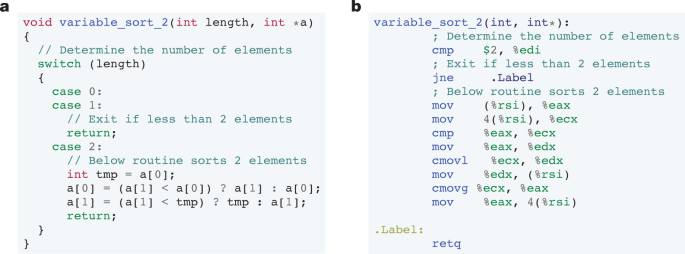 https://www.nature.com/articles/s41586-023-06004-9Open linkView original on beehaw.org
At first glance this doesn't seem to be as impactful as you might think...
Wouldn't this still be pretty massive at large scales like datacenters?
Yes, I'm saying this is actually more important that you might initially think.
I'm afraid it would take a lot of time for me to fully understand this paper, and I know a thing or two about Computer Science.
I'm positive you can't get any better than n log (n) when sorting a vector of size n using comparisons, and the most widely used algorithm, QuickSort, gets very close to that performance. I guess the improvement here only involves some constant factor, but I can't be sure without actually reading the paper. Everyone, feel free to correct me ofc c:
My first thoughts were on the same line. I think the new "algorithm" are heuristics for small values of n.
I gave it a quick skim. It seems the improvements are on specific sort tasks. There may also be fitting to the distribution of sequences. It won’t beat n log(n) for all cases, but it might do better for common common situations in the data set.
It’s still neat they made it work.
Sorry, I'm now seeing this was already posted in this community a few days ago :(