
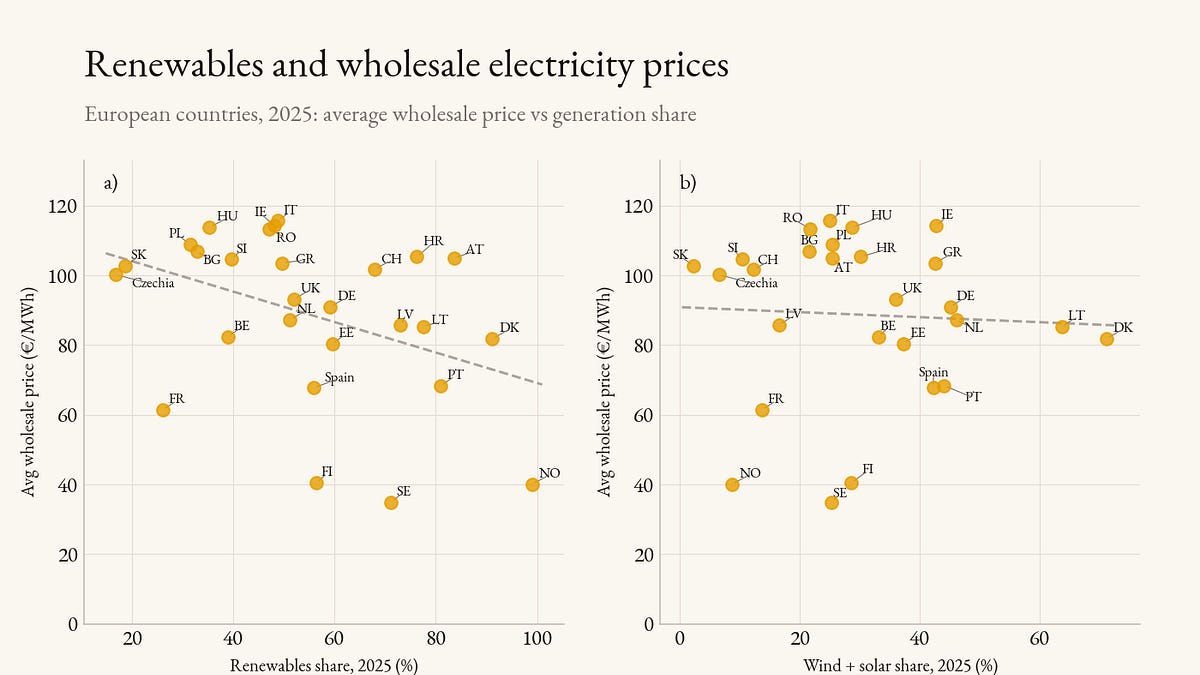
Wholesale electricity prices track gas exposure, not renewables share.
What this means is that wholesale price doesn't drop until gas -burning power plants are not being used. So it takes quite high renewables+ battery deployment to lowe wholesale price.
 https://janrosenow.substack.com/p/do-renewables-make-electricity-cheaperOpen linkView original on slrpnk.net
Funny how these businesses are able to tailor prices to individuals by spying on them, but they can't figure the math to calculate their costs by source.
Convenient problem, isn't it?
Wholesale electricity markets tend to be set up like this:
This causes the marginal supplier price to set prices for everybody. So long as any gas is being burned, they're usually the marginal supplier, so the price of gas sets the price.
Yes, I know. Like I said, "can't" do the math expected of their employees for their work. Theare able to measure the kilowats going into millions of homes, but can't measure the kilowatts they consume. So they get potentially 90% of the electricity dirt cheep, but charge everybody as if they paid the highest price on the market for all of it.
It's not that they "cant figure it out", its that its a reverse auction where everyone gets paid the lowest price that is needed to provide the last bit of capacity. Why should a solar plant get paid 20% of what the gas plant gets paid just because they are more efficient?
That marginally cheap sources like solar or nuclear get paid a large profit for each kwh is a good thing, it encourages more of them to be build and over time push out the expensive marginal cost of gas (and coal where it's still used).
Are you sure that is what is happening? I doubt the utility is paying the solar supplier more than their stated price. That is not how Capitalism works over here.
That is exactly what happens, each potential provider says "I will sell you Y amount of power for at least X price" the grid tots up the offers going from cheapest up until they have enough generating capacity and then pay all the providers the highest price they needed to get to. This is all public so they cant pay the cheap provider less than the expensive one, because they can just turn round and raise their price to that same highest price, knowing that the provider wold lose more money to go to everyone else.
(They actually do it the other way round, start at the highest price and keep lowering it and having providers drop out, until too many drop out and then the previous price is set for everyone that's still in. But it has the same end result, everyone gets paid the lowest price that enough people are willing to sell at in order to cover demand.)
I'm not sure those conclusions can be drawn by that article. I mean, there was one solid regression in there which clearly showed a near perfect linearity between less gas-hours (that is more fossil free power) and lower electricity cost. And in that regression Sweden and norway was even omitted, had they not been the correlation would be even stronger.
As for the other regressions presented they were not apples to apples comparisons and no conclusions can be drawn because of bad methodology. Sure enough R-square was very low as well, but that would be expected.
The issues with the methodology are that A) the cost of electricity isnt decided by what is produced in a country, but by how much is in demand in neighboring electricity regions. For instance, the price of electricity in sweden is closely tied to demand in Germany. Thus will wind and solar in Sweden have very little explanative power on price. And B) the meassured price is t the true mean price as met by the consumers. If 5% of households has a solar installation it will skew the mean price by alot. Not only will their price of electricity inversely follow production as they will first use there own production, they will also see negative prices when the installation delivers more electricity than what is used by the household. Both mechanisms skew the price of the mean bought kwh electricity And neither is accounted for in this comparison.
But the main conclusion stands. Any reduction in gas-hours will lower the price of electricity.