
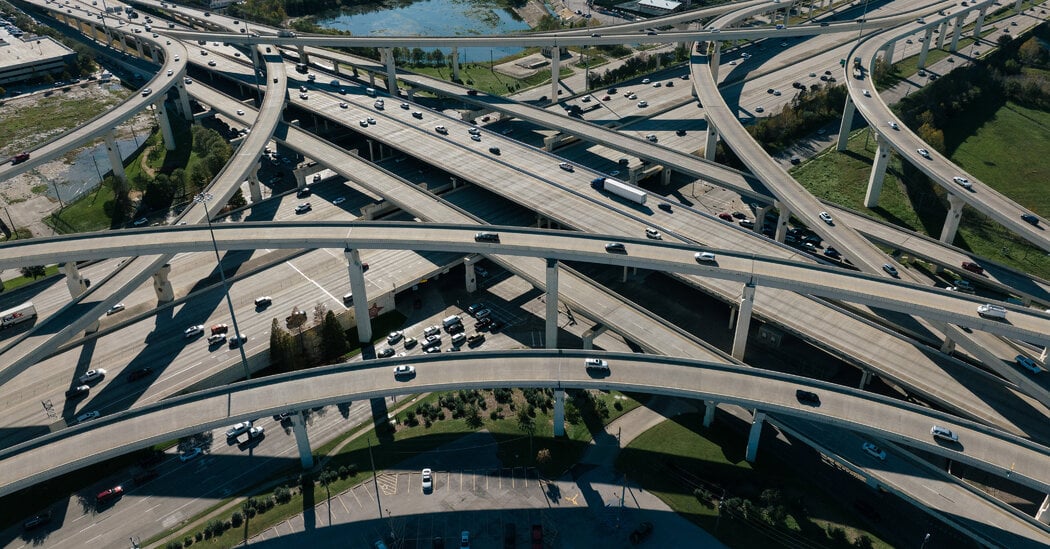
TIL The Katy Freeway in Houston, TX was expanded in 2008 to 26 lanes (one of the widest in the world) and 5 years later had longer peak travel times than before the expansion
For critics of widening projects, the prime example of induced demand is the Katy Freeway in Houston, one of the widest highways in the world with 26 lanes.
Immediately after Katy’s last expansion, in 2008, the project was hailed as a success. But within five years, peak hour travel times on the freeway were longer than before the expansion.
Matt Turner, an economics professor at Brown University and co-author of the 2009 study on congestion, said adding lanes is a fine solution if the goal is to get more cars on the road. But most highway expansion projects, including those in progress in Texas, cite reducing traffic as a primary goal.
“If you keep adding lanes because you want to reduce traffic congestion, you have to be really determined not to learn from history,” Dr. Turner said.
 https://www.nytimes.com/2023/01/06/us/widen-highways-traffic.htmlOpen linkView original on lemmy.world
197 replies
Just one more lane bro, I swear it'll fix traffic. Just one more lane.
Just a little more trickle down bro, I promise once we privatize the next utility it will all work.
Lol. One thing I just thought of. Ignoring the extremely obvious fact that trickle down economics is something you tell stupid people to be okay with getting the shaft... can we name one time in history (golden shower jokes aside) where something trickling onto you is a good thing? The word carries questionable connotations. I don't want anything trickling onto me...
snorts asphalt
Underrated comment of the day 🤣
The intended purpose isn’t to fix traffic. It’s supposed to allow more volume of cars through per day. Entirely different things.
I’m not suggesting that’s a good thing.
Eventually there's gotta be diminishing returns too given that every lane makes it a little harder to drive on. Can't imagine the idiots swerving over 13 lanes of traffic because they didn't realize they had to get off until the last minute
T R A I N S
https://youtu.be/0dKrUE_O0VE
Here is an alternative Piped link(s): https://piped.video/0dKrUE_O0VE
Piped is a privacy-respecting open-source alternative frontend to YouTube.
I'm open-source, check me out at GitHub.
But think of the alternative. In Japan the trains arrive every 10 minutes are publicity subsidized so cost is minimal and because of this there exists an entire generation of train nerds that just want to go out and photograph trains. Are you gonna let the nerds win?
Can't let a bunch of train virgins take away my Ford F-750.
12 yards long, 2 lanes wide,
65 tons of American Pride!
Canyonero! Canyonero!
It's getting to the point where that isn't exaggerating all that much.
Those train nerds are super cool. James may talked to a couple of them that had memorized every station’s unique arrival jingle and message and the one guy could whistle them. They said they weren’t popular with the ladies but i don’t understand how with cool skills/knowledge like that
I’m all for trains and against cars, but is Japan really the best example? Don’t they have people stuffing passengers into cars with special passenger packing sticks?
In Tokyo there are 20 million people
The yamanote line at peak hour has a lot of folks, it's true
But if these 20 million people were in cars? My friend the entire city would be a gigantic 100 lane highway and things would be significantly shittier I guarantee
Trains are the solution and america is insane for ripping up lines to force people to buy cars
100 lanes sounds like a massive exaggeration but is actually undercutting it lol. It's insane how space and energy inefficient it is to transport that many people in individual cars.
The yamenote line transports 5 million people a day
The Katy Freeway transports 219 000 cars. Let's say that's 400 000 people. (pretty generous I think, most cars are just one guy driving to work)
You would need 5 million / 400 000 = 12.5 Katy freeways.
That would be 12.5*26 lanes =325 lanes!
Absolutely true. The amount of land required for not only all the damn traffic, but parking as well. Cars do not make any sense. I can see individual battery assist bikes and scooters but cars in a city are just stupid. And don't get me started on the colossal idiocy of Musks 'hyperloop'
I was there as a tourist this summer and it was fine overall. Middle of the day there were often lots of seats open but early morning or around 6 you had to stand but it wasnt bad at all. No pushing or anything.
The Tokyo metro system is amazing, I rode like 50 trains all over the city the entire day, and it was really pleasant the entire time
And housing is still affordable because they control zoning at the federal level and build houses to meet demand.
Whut? Everything I've read about housing in Japan (which admittedly is little) tell me housing is super expensive.
If you have to make apartments shoebox sized so people can afford it, that's not a sign that it's affordable. Also, there is normal sized housing in suburbs / rural areas there. It's like they will choose to live like humans given the chance, and not sardines in a can.
That's a false dichotomy. I want affordable housing everywhere. How about that?
Texas is around 700000 sq km with 30 million people, whereas Japan is 400000 sq km with 125 million people. The demands for space are very different between the two places and their respective urban areas. Costs are always higher in dense cities, but the links up above seem to suggest that they haven't ballooned as much in Japan. Space constraints of urban regions will also obviously lead to less space per person, for those who want to live there. With finite space, you have to compromise on size or on cost. I think the poster above is simply stating that fact with the "homeless or small space" dichotomy, though I think that is maybe a bit hyperbolic.
https://www.wsj.com/articles/what-housing-crisis-in-japan-home-prices-stay-flat-11554210002
https://thinkrealstate.com/why-are-houses-in-japan-so-cheap/
https://marketurbanism.com/2019/03/19/why-is-japanese-zoning-more-liberal-than-us-zoning/
They are cheap compared to other major cities. It is because of vastly different zoning laws that limit sprawl (they do not have a lot of excess land) and stops NIMBY issue. They keep building to match demand.
Yup. Been plenty of studies to show that increasing lanes only alleviates traffic in the short term and long term only makes it worse. Better to spend money on trains and busses that actually work and get people where they need to go with minimal hassle and a reasonable cost than to do this crap.
to me it's like the military industrial complex - they don't care what evidence supports, they want their fucking money and they'll keep building roads until it's a giant parking lot from sea to fucking sea. we could have an ecosystem, but fuck you, because cars.
I already see the angry republicans on Fox news raging on how their precious tax dollars are being wasted just to benefit poor people
Yeah it's too bad only poor people can ride trains :(
It also costs the taxpayer more because of maintenance
I don’t necessarily disagree that it costs more, I have no idea but it seems logical to me that it would. However, even if it is cheaper, public transit solutions also have maintenance.
Far less maintenance, and it's generally directly supported by rider fares instead of petitioning for government tax money.
Also the density of passengers on transit justifies the costs. 90%+ of all cars have a single person, whereas transit is on average magnitudes more. On that basis alone transit is far far cheaper.
Fares alone do not pay the bills. Buses are always subsidized (which is totally fine IMO. Every fine metro area has a good transit system, and it should be affordable to all who would want to use it.)
True enough. But my point still stands that there are fares that are collected that help offset operational and maintenance costs.
It's still cheaper than maintaining huge roadways.
Trains predate cars and busses have always been with us since the car. People have voted -- with their cars.
The Interstate Highway System started in the 1950s. Population has more than doubled since then. Of course, we have more traffic, we have more people!
The auto industry lobbied to kill public transportation back in the day to sell more cars. For a recent example see Ellen Musk and the Hyper Loop.
History? Is that a recent thing?
Source: live in Texas :(
History is a conspiracy cooked up by cultural Marxists to push their gay liberal agenda
Remember the Alamo? It's like that but the stuff that happened after, up until now. I don't know if there was anything before.
Source: I paid attention during my Texas History classes. (It's an actual required class in Texas, at least when I went)
They got rid of everything before the Alamo. They towed it out of the environment.
This is because the extra lane allows demand to change. It is not congested so people feel ok building and moving to further out suburbs. This continues until demand has increased to cause delays.
Note that Houston and Paris have about the same population. Paris is 1/3 the size. They are actually removing a lane from their loop highway and planting trees, and turning another lane into busses only. Only considering transportation, I would much rather live in Paris.
If you also consider the weather and politics, I would still much rather live in Paris.
Food and culture, also Paris
Houston has fantastic food. I will die on that hill.
I know I'm putting myself in harm's way, but I would say Austin instead. Houston is a large parking lot with buildings in-between.
Austin is not a better food city. It might be a better city, but not because of the food.
I was just being facetious; I spent quite some time in Plano and around Dallas and I don't miss it due the whole commuting thing.
I had to drive to Houston now and then it was a miserable experience, and made me bitter of the whole Americana road trip thing.
That said, on last trip, we went somewhere down to Sant Jacinto (?) and I'll gladly live there. I did had some delicious crawfish that later vomited somewhere along the I-10 East freeway.
Edit: maybe I'm just mad nobody wears ten gallon hats.
I'll die on that hill with you. Most likely from self-induced health problems from loving the good food here too much, but for all the crap that we deal with the good food is a plus.
Let's list the reasons why Houston is better....hrmmm...I got nothing.
Less French people?
Plenty of Cajuns in the area, which is basically French-Swamp-People
We prefer swamp frenchies.
Source, am half swamp frenchie
French bad. Wow, never heard that one before.
But what options do you have in Houston, compared to Paris?
You can’t just not widen roads but instead
— less sprawl - places to live closer to each other and to destinations
-- useful transit or short distance commute options
-- remove bottlenecks
These are a lot harder to do, and I don’t imagine Houston even considered it
Investing is public transport can be as hard or as easy as you want it to be. Sure building a full on subterranean high density metro system might be the utopia, but actually developing a high frequency, high quality bus route with dedicated bus lanes can be low cost and hugely increase the volume of people carried Vs the lane you took from cars.
Compliment this with docking cycle rental schemes, and some dedicated cycle infrastructure and you can transform how a big chunk of people get to work ...you start to win back the city from one which is built around cars and instead making it a city for people.
In Texas, and most of the places I know of, people won't ride the bus, or the bike. When it's August and the high temp for the day is 108, with 65% relative humidity, everybody wants to get in their car with the AC blowing directly on them, and be comfortable.
In my experience, every public bus I've been on has been miserable.
A modern bus on a hot day is like walking into a fridge in my country. They also look about 30 years newer than whatever I've seen when it comes to American buses, so that might help a little.
Paris also has a subway.
I stayed in Paris for a few months once, never once used a car. Never once had a problem getting somewhere, either.
This makes sense. With the increased cost of city living, and an ever increasing population; doesnt this support the need for more lanes?
Why, oh why didn't they build 27 lanes?!?
99% of urban planners stop just one lane short of permanently solving traffic for good.
Simply make it a single flat wide open surface, drive where you're trying to go in a straight line.
If you die, you die.
Well the population decrease would certainly decrease traffic so I think you're on to something.
Sounds like Moscow
Otherwise called, the Mad Max method.
Yes. This is the basic driving style on the Katy. No rules, no lanes. Just wide open spaces, bumper to bumper at a minimum of 75 mph. On a good day.
I live in Katy. Driving through this from 4-7 pm is an absolute nightmare. Horrible traffic jams, erratic drivers and multi-car accidents daily. Mornings aren’t fun either.
After Hurricane Katrina I lived in Houston for about six months. I still have nightmares about your highways. I don’t know how y’all do it.
Oh jeeze… it was so bad after Katrina. I’m sorry you had to deal with this and the hurricane.
Toll roads were a great alternative 10-15 years ago. Now they are just as bad as freeways. It’s nearly impossible to find alternatives unless Google Maps finds a neat back way around this hell hole.
Luckily I was a typical self-centered teenager, so I was pretty good at being oblivious and ignoring what was going on around me. It also helped that I had very strong parents who worked tirelessly to make it as seamless/normal for my siblings and me haha.
Well hopefully they will come up with a solution that isn’t just adding more lanes! Don’t have a lot of hope for Texas and public transit these days, but I feel like y’all would be prime candidates for high speed rail between some of your cities.
Sounds like you have amazing parents!
And yeah, a speed train would be great, but I doubt we’ll ever get one. I was very excited for the infrastructure plan, but who knows if and when it’ll happen.
Oh absolutely. A few years ago someone did just that because they were about to miss their exit. I slammed on my breaks and it caused 8 cars to crash. I wasn’t found at fault, but because I was the first car to stop, I had to deal with 8 different insurances from all the people involved… it was such a pain. The whole thing took around 4 months to settle all the claims and get my car fixed.
Who knew that adding complexity to a system entirely reliant on millions of autonomous drivers who only communicate with each other through lights, horns, and middle fingers would slow things down.
Lived out there for a few years and i can tell you no one is communicating through the lights on their cars.
Maybe flashing the brights
That might get you shot in Texas. It's a low bar there.
Similar in Southern AZ, but that didn't stop people!
Perhaps drivers who can't understand the "complexity" of highways shouldn't be on the road.
Exactly, it'd be great if said drivers had some compelling alternative to get around.
You, one of those autonomous drivers, going from point A to point B might not be that complex. Traffic management in a system with millions of drivers is obviously very complex.
Proud to not understand that systems can be varying degrees of complexity? Not really something to be proud of.
There are limits on how well you can train a dry nosed monkey to drive a car.
For anyone wondering what that looks like-
Absolute insanity.
Where are the bridges? How do you walk from one side to the other?
Oh yeah, right, of course. But how do you even drive from one side to the other?
You don't really... You exit and follow the service road until you find a way to get across, usually by going under.
I hate driving in Texas because this kind of shit is everywhere. Middle of nowhere and want to get to the rest area ahead? Exit and follow the service road for a mile.
I feel like Texas intentionally did that so that everything seems large af. If the exit road is long af then it must make you feel like the place is large when in reality it is just inefficient spaghetti
It's not an exit road. The service road is a parallel road to a highway that contains all the turns with occasional on/off ramps into the highway. It's actually a pretty efficient design, as it reduces the amount of on/off ramps needed. Similar design style is local vs express lanes in some highways.
Tl;dr less ramps = less slowdowns
I have no idea. I've never driven on it. I was just searching around and was mortified.
Walk? In Houston? Nope.
Hey this looks just like my failed Cities Skylines build!
The fools, if they had made in 27 lanes they would have been fine!
27 is an odd number, do I assume the center lane switches direction for rush hour. That's sure to fix it.
27 lanes in each direction.
I thought it was common knowledge of the only way to reduce traffic is to reduce demand on roads, eg more expensive gas and tolls etc.
If you add another lane to the highway you're just gonna attract more people and make it worse.
I agree. In addition to impacting the poor in towns and cities, raising gas prices also has an even larger impact on people in more rural areas where everything is spread out. We do most of our grocery shopping in the next town over, which is 15 miles away, with basically nothing in between. Sure it still takes only 15-20 minutes to get anywhere we want to go, but those minutes are a lot more miles out here compared to driving 15-20 minutes to go a shorter distance I'm a city.
Within towns and cities, infrastructure should be built for people first, not cars, so as to make it easier and more pleasant to navigate a city by foot, bike, or public transit. It drives me crazy how pedestrian hostile most towns are. I'd like to see the design paradigm flipped.
Reducing traffic by raising prices is a pretty piss-poor way to do so if the only alternative is walking or decrepit bus lines. There need to be other measures taken.
You mean by.... Fixing the bus lines and adding more public transit?
Yep. But that has to be done first. The Houston metro has piss poor public transit. Honestly most of the south does.
The US is all about more lanes for cars and less public transportation. Congestion be damned. Because "SoCiaLiSm."
Funny thing is that congestion is basically queuing for mobility services. And queuing is exactly what you get in communist systems where the state provides for you. So highways are socialism!
#3 Americans are too selfish to zipper. The proper American solution is to install special traffic lights mounted with cameras that fine whoever does not zipper on the right time
Yeah, traffic congestion is a lot more complex than it seems. If you alleviate one bottleneck, you can create 15 more (because now more traffic flows through the "fixed" area, stressing everything else) where some of those new ones interact with each other in a way that slows traffic more than the original bottleneck did.
You need to consider the endpoints as well as the middle. If you make it easier for people to get to their destination and off the road, then traffic will improve. Problem is, destinations are all over the place, so even that can end up causing more congestion if it also enables higher throughput that other roads it feeds into can't handle.
Mass transit experiences the same thing. Not to say that there's no point in emphasizing it, just that it won't get rid of the problem entirely.
You can reduce traffic with more lanes, but not just willy nilly. They need to be carefully planned and managed while limiting lane changes.
But a lot of the time, they won't. The issue usually comes from people wanting to change lanes while others are merging on. In high traffic areas, lane changes will slow the traffic down while increasing the risk of an accident. Making alternatives such as different routes, other modes of transportation, or reducing the need for traveling usually work better in cities.
By that logic just make driving illegal, problem solved!
Something is left out of the equation because more lanes != more traffic, yet there is ALWAYS someone around saying otherwise. Go drive on the highways in Montana if you don't believe me.
Houston is commonly used as an example for what NOT to do, when it comes to civil planning and development.
Whoops should have used this gift link: https://www.nytimes.com/2023/01/06/us/widen-highways-traffic.html?unlocked_article_code=Si7TexwYggpvmSXOYHececNLy0PwyxLKVvINkua9n0Bn17aAT86gZS5-iomiLv4TLAa4846kpv-dEg9NaSmyPitsohN5-1B2S5c8aKBs6Ia8TsJbF4WRjQYzBQgRV_DOa1nDfAI_5xo8GTpwQdQfX4s8pO6O_T4LbccN4D2uaKrOKAKMB-CIxdi-ZXkHy2UoHLUNf5HUHMdP8WmS7bRW0KMuxfUPJROF6wWvtsxqvEKddU5pJsbSxAnOvr-ujBc2le7srKRE7WGaLJkNarvQfbx_pq34IPVvjzaN2-95rvhqMwEfa8ozPQAKvjzRSGVQebno0S1KlhnlTyMC&smid=url-share
Consider adding gift links to this community: https://sopuli.xyz/post/2743454
If you've got more lanes then you've got more lanes for idiots to cross right before the exit they need to take because they weren't paying attention and they MUST take this particular exit or their life is over or something.
Especially since most exits have very easy U Turn options. Just get off at the next one and then turn around
Not all of them. If someone tries to ram you and you get off on the wrong exit to avoid the crazy person at 5pm on a Tuesday you can lose an hour and a half of your life over a distance of 7 miles.
Don't ask how I know.
Oh I'm well aware. I missed an exit once so I just kept going, and the next one happened to be one of the few that was just a winding road and took me far away.
Exactly this! It’s especially terrifying to drive here Friday and Saturday nights and during heavy rains. You’re also expected to go 15-20 over the speed limit and yeah, idiots will absolutely speed-cross from the furthest lane to their exit without giving a f*ck about anyone else.
This is more than likely the real reason more lanes doesnt help.
Literally play 2 minutes of cities skylines and you will discover how bad of an idea this is lmao
I say the words "shitty skylines" way too often driving around the real world. My city lives and dies on suicide lanes >_>
I N D U C E D D E M A N D
Great for sidewalks, bike paths, and trains, but terrible for cars.
The purpose of widening the highway isn’t to make individuals move faster or to solve congestion. It’s to move more individuals, and therefore more money.
And to allow for more development to house those people etc.
My only time in the Houston area, and visiting friends staying in Katy TX, and I learned how quickly I hated the traffic there. This makes sense
It worked great at the start, but the Houston area population just kept exploding at unprecedented rates.
The Greater Houston area grew by 70% between 2000 and 2020 - largely on the West side. Of course a 30% capacity improvement couldn't keep up.
Just one more lane bro. I promise. It'll fix everything, I swear. Just one more lane bro.
If they had just built it with 52 lanes!
/s
Finally, the congestion code in SimCity is justified!
Too bad they never heard of Braess's paradox…
If you build it, they will come.... Or something
At least it look really cool.
In an "urban hell" kind of way.
True.
If they had the space for 26 lanes maybe go with express lanes and better on/off ramps?
Express lanes essentially reduce traffic for the wealthy and make it worse for the poor.
Some express lanes do charge a toll so I see his point but ideally it would be a toll free express lane
And yet we hear the argument that when it comes to cycle lanes the opposite is true, the more you add the less they are used.
Anti-car people use this to try to explain that adding more lanes doesn't help traffic congestion. Except that every highway system is different and the vast majority of them don't have anywhere near those number of lanes. Adding 1 lane to a 2 lane road would dramatically help traffic situations.
If you are 'pro car' then you should definitely be resistant to adding lanes (and pro using that money for transit alternatives).
Getting cars off the road is the only thing that's going to make driving less miserable in the kinds of places were adding lanes is suggested.
And maybe a warm take, while this discussion is going on: Whether or not you're pro car or anti car, you're gonna want to provide and improve alternatives to driving. If you're anti car, it's so that you don't need to drive to go from A to B. If you're pro car, it's so that others don't need to drive to go from A to B, keeping more room on the roads for you. Build trains, busses and bike space, and everybody wins.
Just like with nearly anything else, if you do a shit job of implementing something and do a 1/2-ass effort then the results will be shit. Garbage-in, garbage-out.
The US population has grown considerably over the decades and yet our highway traffic system has not even come close to keeping pace. I'M ALL FOR MORE TRAINS and MASS TRANSIT, but I am also not some deluded hippy that thinks we can just get rid of cars and all our traffic problems will magically go away like all your problems after a few hits from a bong.
We need more lanes on MANY highways throughout the nation and this terrible example in Houston doesn't change that fact.
Hmm for some reason I don't believe you've actually considered opposing views
By definition, if you got rid of cars, you wouldn't have traffic. Traffic is made from cars.
As many other people have explained, more lanes are not the main solution. Going from 1 to 2 or 2 to 3 may help, but any more just creates more "induced demand" and more traffic. More cars on the road guarantees more traffic.
There are highways, major streets, and side streets all over LA and NYC. Traffic is still terrible.
Can confirm. My area added a third lane to the highway over the last 10 years or so. So much better than before. One grandma can't bring the entire highway to a snails pace anymore.
What was the population and commuter increases of your area in the last 10 years? I think that is a big factor people don’t consider.
If it’s relatively stable or slow Y/Y then absolutely it’ll help. But if you live in a place where urban sprawl is the city’s building mandate for the next 20 years, it’ll be like Los Angeles traffic in no time.
Even 290 in Houston got more lanes recently and it's like night and day.
It's almost like it's more nuanced than loud people want to admit.
As with many things there's not a clear cut answer. I think you could make a strong case for the Katy Freeway expansion being a failure where those resources would have been better spent on other forms of transportation. I'd agree that adding lanes is not always a bad idea, but blindly adding lanes like the US has done for decades has not been a good thing overall, imo. We're dependent on cars for everything, they're heating up the planet and they're a very inefficient solution to the ultimate problem of getting people from point A to B. I'm not so much anti-car as anti-inefficient travel that has saddled us with tons of negative aspects to city life.
They don't consider it because they want to be re-elected in the next few years. Fixing a problem that's more than "the next election" away holds no interest for them, or most of their constituents.
America is just too beautiful to be on this earth.
The conclusions in the article are bizarre. The widening worked, and as the population increased, the congestion increased in those areas.
The solution is stop upping population density in population dense areas.
You just can't pack that many people in per square mile and make it work, regardless of if we are using cars or not.
No...no it doesn't...where does your eutopia actually exist? Does it have a growing population center?
This is where someone says the Nordic countries usually...the problem with that example is the US is what...20-50x bigger.
You're not biking across your state...more or less the whole of the US. You also might want to take a harder look at their cultures and see how they deal with no homogeneous populations...it's not pretty.
Just because the US has more space, that doesn't mean it has to be filled with unsustainably sparse development.
And you're correct—you're not biking across your state, but the average resident of Amsterdam isn't bicycling across the entire Netherlands, just to all of the amenities which are in reasonable walking/biking distance with the infrastructure to safely facilitate it.
Sure you can, you just have to make sure that the people have multiple forms of viable transport beyond getting in their cars. Trains, bike lanes and trails, walkability improvements, etc. Of course there’s an upper limit to density, but that density can be more thoughtfully designed and built. Mixed-use development is essential.
This is completely backwards. Increasing population density means people can afford to live closer to work & resources. Low density means they have to drive 50 miles a day to get anywhere, and thus need more lanes.
Think about this...ever been to a large sporting event in a huge arena? Think of a sold out NFL game. The stadiums are designed to get people in and out quickly. Lots of people in a out quickly.
It's a fucking disaster, every game, every time.
Now imagine doing that daily just to get to work. That's what you're proposing here.
The highway has greater capacity, and that's a good thing. The congestion would be far worse if it hasn't been widened, and the increased capacity helps the local economy.
That's what makes sense intuitively, but adding lanes doesn't solve congestion. Investing in more mass transit and improving walkability through more thoughtful zoning would be a better place to start.
No, I'm sorry, but the reason congestion persists is induced demand. That with a wide open highway, more people use the highway until congestion returns. This means that more people are able to use the highway at the end of the day. Invest in mass transit and walkability, absolutely, but without appropriate transportation infrastructure problems will appear.
Weirdly aggressive way to agree with everything I was trying to say, thanks.
Yeah I mean you're kind of just re-framing point. Yes the mega highway has the ability to move more cars, but still the end result after 5 years is it's actually taking longer to move cars than before (at peak travel time). So what if it's due to induced demand, we just want to solve the problem of getting people from point A to B, and adding more lanes is a very inefficient transportation method. It's a massive waste of resources when moving around in a car is so costly compared to public transit.
Which is why you do both. There's lots of reasons people sometimes don't use public transit. Refusing to modernize highway infrastructure will kill local industry and punish people whose commutes are inevitably not adequately covered by public transit because they fall outside the planning of the planners.
I see better where we disagree now.
I would contend that allowing sprawl to get bad enough that you can even contemplate 26 lanes is the real "refusing to modernize".
I would contend that while promoting densification is wise, allowing people to live where they want us also wise.
As long as we're talking about allowing and not "privileging". When we allow auto industry political interests to sway spending, that's what usually happens. Moving away from that and toward density is usually fairer than it feels (as equality often does feel unfair to the privileged).
We have a lot to untangle politically and economically. A lot of infrastructure is too utilized for direct profit rather than societal good. Some US states even have privatized DMVs.
What does modernizing highway infrastructure even mean? I don't think you could call adding more lanes "modernizing" if you're being serious. That's been the blind answer for years but adding more lanes does not solve congestion/demand/whatever you want to call it. It's not an efficient way to solve the transportation problem. You spend a ton of resources (punishing people bulldozing neighborhoods or with noise pollution, destroying nature, etc) and you still have the same ultimate problem you did before you started, people traveling slowly in a pollution emitting vehicle. So doing both is not even the point when one side of the equation (adding lanes) is a very poor solution. Focus on better solutions like public transportation reaching more people.
Driving is the most expensive and dangerous way to get around, ironically championed by the party of "fiscal responsibility".
Train tracks would have been cheaper to build (and maintain), take up far less space and be far better for the local economy. Hell, just investing the money on buses would have been far more efficient.
Not everyone can take public transit.
So they can use the thinner roads, which will be way less crowded when everyone else that can is using public transportation.
Did you really think this was a coherent response? It’s not like all roads are being removed.
That just leads to incredibly long commutes for the working class as they are forced to struggle through progressively worse traffic on neglected, overstrained highways. You need to invest in both mass transit and general transportation infrastructure.
Not sure how you came up with this fantasy tbh.
Do you think the working class isn’t going to use public transportation and will all drive? Do you think investing in public transportation means purposefully letting roads degrade? Neither assumption is based on anything I’ve said or in reality in general.
What do you even think my argument is?
The point is that diverting resources to public transportation will reduce traffic by providing an efficient alternative. Then you don’t have to expand roads to accommodate drivers because the bulk of commuters only really need good public transportation to get around.
All? No. Public transit is very useful. But there's a lot of people who can't afford rent in the city and must live outside the reach of a good public transit network. Or who keep working hours which don't allow them to use the network. Or who needs to travel between two locations which would be an extreme journey for public transit.
That's why you do both. Because not all people are going to be served well by any one solution.
I'm sorry but you don't seem to understand how public transport works. Public transport usually does extend quite far outside the inner city, with efficient links into the city. That's an incredibly common pattern for public transport.
Look at a city like London. Absurd rental prices. The working class lives well outside the city. Few people have cars.
The only situations where having a car tends to be preferable is if you live outside the city AND also work outside the city. And even then, bus routes usually alleviate the problem of getting between suburbs. And those routes usually aren't as congested anyway.
Again, how did you read everything I’ve written and act like the conversation is about one or the other? Did you even read what I wrote?
Not to mention you very clearly don’t understand how public transportation works based on where you think it goes between.
Who can’t?
Not with idiots fighting it every step of the way to make sure it's as unreliable or nonexistent as possible.
but most people can
and, ironically, the commute would be better for drivers too, if most people were to take public transport, since roads would be less crowded (and only with people who enjoy driving, instead of people who are forced to drive)
Which is why the smart decision is to invest in both.
Besides, if you add an HOV lane to a public highway, you can double it as a bus lane, improving public transit. Roads are like rails for buses, after all.
This is an article also about Houston’s freeways and traffic; induced demand is the reason congestion is not lessened in these situations:
Please stop adding more lanes to busy highways—it doesn’t help
This is explored extensively in the book ‘Traffic: Why We Drive the Way We Do (and What It Says About Us)’ by Tom Vanderbilt. I highly recommend it; it’s excellent and very informative about this widely misunderstood topic.
Getting more cars off the road using things like better public transportation is the answer here, something that is sadly lacking in Houston…yet they keep widening roads. It never helps, and it never will.
By definition, if the road has more capacity, it is helping. It just isn't helping enough to eliminate traffic. Unless you're claiming that the larger freeways have the same capacity as the smaller ones, which doesn't really make sense.
I think you’re intentionally missing the point, so I’m gonna go about my day now. But feel free to check out either of the sources I linked if you want to learn why bigger roads don’t reduce congestion. :)
Yeah, you didn't read what I wrote, you just chose to be an arrogant ass. Fucking hell, you people are dickheads.
It’s insane how little self awareness you have. They politely correct you and provide information to confirm it and you get pissy and call them a dickhead.
Look in the mirror you dense loser.
You’re wrong though.
I'm really not
Just think about this for a minute dude.
Who are people going to belive, civil engineers and planning strategists that research this topic for a living and have done for decades, or some random on lemmy?
Why does induced demand lead to congestion on a highway? Because more people use the road. Because more people are able to use the road.
Therefore, wider highways allow greater movement. It's not very complicated.
I think adding lanes helps up to a point but after that just creates more problems. Here are a couple problems with adding lanes:
It assumes that everyone drives efficiently. For example, that everyone knows exactly where they're going and if they're in the left lane to go fast that they start migrating over to the right lane well in advance of their exit. But this is not true and instead causes people to panic swerve across 10 lanes while slowing down in order to get to their exit. Anyone who has been driving for a few years has seen this happen. Multiply this problem by the number of idiots on the road, and again by the number of exits. And having more lanes makes this a bigger problem because it has a higher capacity for more of these idiots to exist, and more "obstacle" lanes between them and their goal (not to mention more victims in those right lanes).
If you don't expand the lanes across all the exits from this super highway, traffic will still back up because the traffic cannot smoothly flow out to the rest of the city where people are trying to go. This backs up traffic on the highway itself. It's like having a clogged artery. And expanding those roads is not always an option if it's already in a heavily developed part of a city. If there's no room due to buildings, you simply cannot add lanes.
In addition to the zoning and walkability suggestion someone else made, I would propose that more alternate routes (even if not as direct a route) can help offload traffic especially at peak times, and is a much more feasible solution in the short term for our country that is built around private vehicle transportation. This is also an effective solution if you add tolls to one of those routes and increase the speed limit. It has the side benefit of funding other city projects, and acts as a sort of tax for people who want to go fast. The lazy implementation of this that I've seen in some places (including in Texas) is to add toll express lanes on the same highway. I see this as mostly a money grab but does not help much, if at all, with congestion. It's more like a streaming service raising their subscription costs just because they can.