
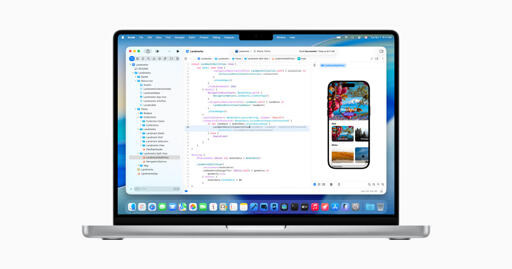
macOS 26 introduces the Containerization Framework: "enables developers to create, download, or run Linux container images directly on Mac"
 https://www.apple.com/newsroom/2025/06/apple-supercharges-its-tools-and-technologies-for-developers/Open linkView original on lemmy.world
42 replies
Ok. So now both Apple and Microsoft are distributors of the Linux kernel. What a timeline.
it's the year of the linux desktop without the year of the linux desktop.
It's everyday the year of Linux !
Cool. Podman Desktop should be easier after this. Presumably, it’s still a Linux VM driven by something written by Apple instead of qemu.
No macOS containers though. Being able to spin up macOS containers would have been nice for builds and isolating things like pkgsrc.
And here it is.
Small VMs, like everything else.
https://github.com/apple/containerization
*Cries in 8GB Macbook*
If containers are part of your work then you wouldn't buy a 8GB RAM unupgradable device anyway.
No, but the company's IT would buy a 16GB Macbook for you that isn't even initially compatible with the images/containers you need to work with. Ask me how I know >.>
You're right. I wouldn't, but someone did for me!
Bad IT departments are a PITA.
If it's a work computer, tell your IT department it's getting in the way of your job.
:notlikethis:
You're doing it wrong. I want to run a macOS container on Linux
But why?
Certain application only has Mac OS or Windows version.
How the GPU support, does it support Metal?!
So I guess now you can run some games.
Yeah, about that... Heroic game launcher is free and can run a loooooooot of pc games. It now runs pc steam directly.
Noice!
When all you hire are web devs everything becomes a docker
Embrace <-- You are here
Extend
Extinguish
Fuck Apple
I'll believe it if I see it.
I wonder if they’re going to allow GPU access from inside the VMs.
Apple being Apple, the answer is probably yes. But realistically there's going to be some stupid hurdle in the way and because they make it a PITA nobody's really going to do it.
Which really sucks because the massive GPU and "unified memory" is incredible when they work in conjunction.
Like, you can use the GPU on Linux…with Metal
virtio-gpu with Vulkan pass through for the VM with a Vulkan to Metal translator in host user space. There are various talks about this including at KVM forum: https://kvm-forum.qemu.org/2024/The_many_faces_of_virtio-gpu_F4XtKDi.pdf
Is Apple’s tech going to be using KVM machinery then, or are you just saying that it’s possible in general?
No the Apple hypervisor is called hvf, but projects like rust-vmm and QEMU can control and service guests run on that hypervisor. No KVM required.
Oh that’s cool! I thought virtio and such were KVM-specific things. I have never been super clear on the relationship between QEMU and the hypervisor itself, like where one ends and the other begins.
VirtIO was originally developed as a device para-virtualization as part of KVM but it is now an OASIS standard: https://docs.oasis-open.org/virtio/virtio/v1.3/virtio-v1.3.html which a number of hypervisors/VMM's support.
The line between what a hypervisor (like KVM) does and what is delegated to a Virtual Machine Monitor - VMM (like QEMU) is fairly blurry. There is always an additional cost to leaving the hypervisor to the VMM so it tends to be for configuration and lifetime management. However VirtIO is fairly well designed so the bulk of VirtIO data transactions can be processed by a dedicated thread which just gets nudged by the kernel when it needs to do stuff leaving the VM cores to just continue running.
I should add HVF tends to delegate most things to the VMM rather than deal with things in the hypervisor. It makes for a simpler hypervisor interface although not quite as performance tuned as KVM can be for big servers.
Mac and Linux feel like cousins than ultra far apart at times.
Can you run amd64 containers?
It supports Rosetta2, so yes.
Sweet, that will help me, although it takes away my last blocker allowing me to use my Linux box as my primary blocker.
I guess I will have to comain about performance or something.
[email protected] It is certified to be UNIX, yes. But Linux is not UNIX. Not that it would matter if Linux was certified to be UNIX anyhow. UNIX is a certification that you go through and pay for. The kernel beneath is not necessarily binary compatible with other UNIX operating systems.
It is based on Unix yeah but Linux and Unix are different enough.
Isn't it this one ? https://github.com/apple/containerization
Proud of you!
This isn't a Linux post.
While I read the title I was thinking “that sounds like Linux with extra steps” - maybe that’s good enough for some discussion.
Not here, it's not.
Container and Ai ! Now you get the sparkle junkie virus, guys!