

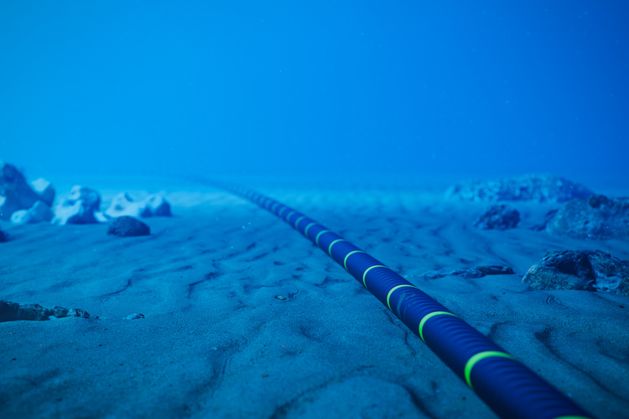
The North Atlantic Transmission One Link (Nato-L) wants to connect the European & American electricity grids via a 3,500 km cable to share excess renewable energy.
 https://www.independent.ie/business/irish/ireland-is-key-to-proposed-atlantic-interconnector-that-would-secure-energy-supply-for-nato-members/a716773347.htmlOpen linkView original on futurology.today
16 replies
Rough calculations suggest that, on current trends, adding 12 hours of storage to the entire US grid would cost around $500 billion and pay for itself within a few years. By contrast, upgrading the US transmission grid could cost $7 trillion over 20 years.
Counterintuitively, electricity cables under the North Atlantic might be much more economical. It would not have the eminent domain and construction complexities of upgrading the US continental land grid. If this cost estimate is accurate, it may be much cheaper.
Is it really much more secure though? Wouldn't one well-placed underwater bomb knock it out of action for weeks or months?
If security was your top priority, surely decentralized microgrids with widely dispersed battery grid storage would be much more effective?
There's a similar project that would supply power from Australia-Asia that spans 4,600 km when completed. But such big projects could easily be caught up in various delays, and it's a problem if a country is too dependent on a single power link. Self-reliant renewable energy production definitely seems more secure.
I'm very skeptical of the actual benefit of something like this.
I don't see much benefit unless this becomes cheaper than the cost of building and running the equivalent generation (about two large plants.) Ohio's data center load alone is projected to increase by about 4.5 GW by 2030.
I'd say so, and it seemed like that was the way the industry was trending about 10 years ago but it seems like the large data center demand stalled that considering some of the facilities could use their own generation plant. Plus, the United States already has a precedent of substations being taken down by gun toting idiots.
You really make some fantastic posts! Kudos to you!
This is over 4x longer than the longest undersea cable in the world
So 15.75% of the electricity would just vanish. That takes the shine off it a bit although if the price difference is big enough it would still be worth doing.
Well, even 84% sunshine transmitted is still rather shiny and is more than what is available at night.
And 1k km longer than the existing longest line
😁 you don't transport electricity at low voltages like that, because the loss is bigger. In France there is roughly 400.000 volt lines, they get split up in 200.000v then 63.000 IIRC etc etc down to 230v (220, 230, 240 I never remember which country has which).
So no problem there.
And for reference some US transmission lines are up to 765kV.
As a layman could this be used as a pipeline for mid Atlantic renewables like if we made a big ol wave/wind/solar farm island
once you lay deep sea cable, afaik you don’t really touch it again… it’s better to just lay another one
only the finest US Imperialism
“Here, have our extra power”
— classic line of empires
“Share”. Looks like is not enough with all that EU has sucked from the Americas.
The cost of the USA for the world since WW2 is certainly a lot more than what the rest of the world "sucked" from the Americas.
Well you got your northstream pipeline blewn up, no need to be jealous for other countries projects that work.